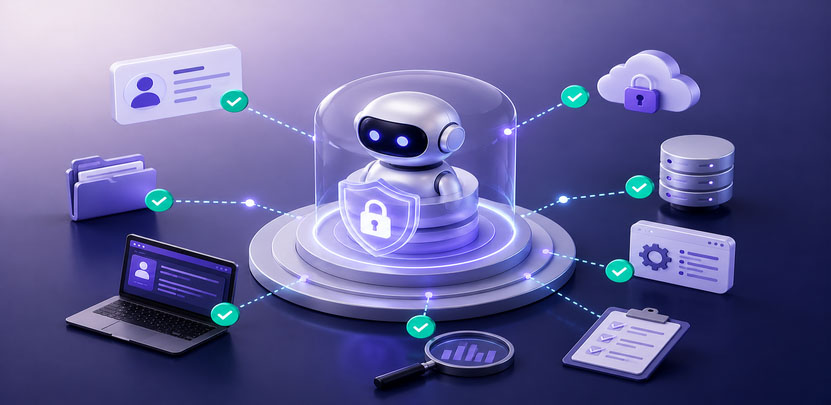
The enterprise security perimeter has officially shifted. For decades, Identity and Access Management (IAM) centered around human credentials: single sign-on (SSO), multi-factor authentication (MFA), and role-based access for employees. However, as autonomous agentic workflows scale across corporate environments, non-human identities (NHIs) now outnumber human accounts in typical enterprises by an overwhelming margin. Managing this explosion of digital workers has turned AI agent identity management into the primary frontier of cybersecurity strategy.
Unlike traditional static service accounts or background API scripts, autonomous agents operate dynamically. An agent can plan tasks, select external tools, chain multiple API calls together, and adapt its behavior in real time. This operational agency creates a distinct security challenge: if an agent accumulates excessive credentials or inherits overly broad user privileges, a single prompt injection attack or software vulnerability can compromise your entire enterprise infrastructure. Securing the autonomous workforce requires completely rethinking how digital identities are issued, authenticated, governed, and revoked.

The Identity Paradox: How AI Agents Differ from Legacy Machines
To establish robust governance, cybersecurity teams must recognize that AI agents occupy a unique middle ground between human workers and traditional machine accounts.
1. Traditional Service Accounts (Predictable and Static)
Legacy non-human identities, such as cron jobs, microservices, or database connectors, operate on predictable logic. They perform fixed, pre-programmed tasks using static credentials (like API keys or secrets stored in code). Their behavior is deterministic, making their access needs easy to define and audit.
2. Human Identities (Flexible but Boundary-Enforced)
Human employees possess high flexibility and contextual reasoning, but their access is restricted by physical and temporal boundaries. Humans log in through interactive interfaces using MFA, perform actions during working hours, and operate within the scope of explicit organizational roles.
3. AI Agents (Autonomous, Adaptive, and High-Velocity)
An autonomous agent possesses human-like reasoning flexibility combined with machine-like operational velocity. An agent might act on behalf of a human user one minute, delegate tasks to a sub-agent the next, and trigger autonomous database updates seconds later. It uses dynamic tools, handles unstructured data, and creates ephemeral sub-processes on demand. This fluid behavior makes traditional static role-based access control (RBAC) obsolete.
Core Pillars of Enterprise AI Agent Identity Management
To govern autonomous non-human identities effectively, technology and security leaders must implement an identity-first security control plane built around four architectural pillars.
1. Attribute-Based and Just-in-Time Access (Zero Standing Privileges)
Granting an AI agent broad, persistent access to an entire enterprise database is an unacceptable security risk. Modern governance requires shifting from static permissions to Attribute-Based Access Control (ABAC) combined with Zero Standing Privileges (ZSP).
Under this model, an agent holds zero default access. When an agent is triggered to perform a specific workflow, the IAM plane evaluates real-time contextual attributes (such as the specific user delegating the task, current transaction risk limits, and system health status) to issue short-lived, ephemeral OAuth tokens. Once the specific micro-task is completed, the credentials expire automatically, eliminating the risk of long-term credential abuse.
2. Identity Delegation and Context Propagation
One of the most complex vectors in AI agent identity management is delegation tracking. When a human user asks a concierge agent to process an order, and that concierge agent delegates the task to a specialized logistics agent, whose identity applies?
Leading architecture standards enforce strict context-propagation chains. The system utilizes cryptographic delegation tokens that pass the original human user’s identity along with the agent’s specific non-human identity. This ensures that an agent can never act with greater authority than the human user who initiated the workflow, preventing elevation-of-privilege attacks where an agent is tricked into escalating actions beyond the user’s explicit clearance.
3. Centralized Non-Human Identity Inventories
Enterprise visibility is the foundation of governance. Security teams cannot protect digital workers they do not know exist. Organizations must maintain a centralized non-human identity registry that acts as an automated “HR system” for digital workers.
Every deployed agent must be registered with an assigned human owner, a clear operational purpose, a list of authorized tool interfaces, and a defined lifecycle limit. Tying every autonomous agent to a verifiable corporate registry prevents unmanaged “ghost” accounts and shadow AI deployments from accumulating unchecked system permissions.
4. Identity Threat Detection and Response (ITDR) for Agents
Because agents reason dynamically, security teams must monitor their behavior in real time for anomalies. Agentic Identity Threat Detection and Response (ITDR) systems analyze execution logs to establish a behavioral baseline for every agent persona.
If a financial reconciliation agent suddenly attempts to query an HR payroll repository or begins generating an abnormally high volume of API calls to an external endpoint, the ITDR framework detects the access drift immediately. The system triggers an automated response, revoking the agent’s active tokens and placing the digital worker into a sandboxed freeze state before data exfiltration can occur.
Architectural Comparison: Legacy IAM vs. AI-Native Identity Governance
| Security Dimension | Legacy IAM Framework | AI-Native Identity Management |
| Primary Focus | Human users and static service accounts | Dynamic, autonomous non-human identities |
| Access Model | Role-Based Access Control (RBAC) | Contextual Attribute-Based Access Control (ABAC) |
| Credential Lifetime | Long-lived API keys and static passwords | Ephemeral, short-lived tokens (Zero Standing Privileges) |
| Delegation Handling | Single-tier service impersonation | Cryptographic multi-tier context propagation |
| Drift Detection | Scheduled, periodic permission audits | Real-time behavioral monitoring and automated revocation |

Implementing Lifecycle Management: From Onboarding to Offboarding
Governing digital workers requires establishing a strict lifecycle management process that mirrors human personnel management, ensuring that every non-human identity is safely managed from creation to retirement.
[Agent Creation & Registration]
             │
             ▼
[Identity Issuance & Token Scoping] ──► (ABAC / Zero Standing Privileges)
             │
             ▼
[Runtime Monitoring & ITDR] ─────────► (Anomaly detected? ──► Auto-Freeze State)
             │
             ▼
[Decommissioning & Token Revocation]
Onboarding and Scoped Token Issuance
During development, engineers must avoid hardcoding API secrets or broad database credentials into configuration files. When an agent is instantiated, it receives a unique cryptographic workload identity. The identity control plane verifies the agent’s signature against the enterprise registry before issuing tightly scoped, short-lived access tokens mapped directly to the specific APIs needed for that execution run.
Offboarding and Automated Decommissioning
Agent sprawl inevitably leads to dormant digital accounts that sit unmonitored across enterprise networks. To prevent this, every non-human identity must have an automated lifecycle limit. When a temporary project concludes, or an agent reaches its expiration threshold without active execution, the IAM control plane automatically revokes its cryptographic keys, archives its execution logs, and removes the identity from active routing tables.
Conclusion
The shift toward autonomous, multi-agent enterprise systems offers unprecedented operational velocity, but it introduces an entirely new class of identity risk. Treating intelligent agents as standard API keys or simple service accounts leaves critical enterprise infrastructure vulnerable to unexpected compromise.
By implementing strict AI agent identity management frameworks centered on Zero Standing Privileges, contextual identity delegation, centralized inventory visibility, and real-time behavioral monitoring, organizations can build a secure operational foundation. Protecting the modern enterprise requires governing digital workers with the same rigor, accountability, and clarity as human employees, securing the autonomous workforce as it scales into the future.
FAQ
1. What is AI Agent Identity Management?
AI agent identity management is the framework, architecture, and set of policies used to verify, grant permissions to, monitor, and revoke digital credentials for autonomous AI agents operating within an enterprise network.
2. How do non-human identities differ from human identities?
Human identities are tied to physical individuals who authenticate interactively (e.g., via passwords and MFA) within structured roles. Non-human identities belong to software systems, bots, and AI agents that authenticate programmatically through API keys, OAuth tokens, or workload identities to perform automated tasks.
3. What is Zero Standing Privileges (ZSP) for AI agents?
Zero Standing Privileges is a security model where an AI agent possesses no default or persistent access rights to enterprise systems. Access credentials are issued dynamically on a short-lived, just-in-time basis only when a specific task is initiated, and expire immediately once the action concludes.
4. What is a context propagation token?
A context propagation token is a cryptographic credential that carries the original human user’s identity and permission boundaries along with the agent’s non-human identity as tasks are passed through multi-agent workflows. This ensures the agent cannot execute actions beyond the human user’s authorized clearance.
5. Why are hardcoded secrets in agent configuration files dangerous?
Hardcoding static API keys or database passwords directly inside agent codebases or tool configuration files exposes those credentials to repository leaks, unauthorized access, and prompt injection exploits. Enterprise governance mandates using managed workload identities and secret managers instead.
Why Choose [x]cube LABS?
[x]cube LABS works with enterprise teams to design and deploy AI agents across complex, regulated environments.
We help enterprises become AI-native, not by adding AI on top of existing systems, but by rebuilding the intelligence layer from the ground up. With 950+ products shipped and $5B+ in value created for clients across 15+ industries, here is what we bring to the table:
1. Autonomous AI Agents
We design and deploy agentic AI systems that sense, decide, and act without human bottlenecks, handling complex, multi-step workflows end-to-end with measurable resolution rates and no manual intervention.
2. Enterprise Voice AI
Our voice AI platform, Ello, puts production-ready voice agents in front of your customers in minutes. Zero-latency conversations across 30+ languages, with no call centers and no wait times.
3. AI-Powered Process Automation
We replace manual, error-prone workflows with intelligent automation across invoicing, compliance, customer service, and operations, freeing your teams to focus on work that requires human judgment.
4. Predictive Intelligence and Decision Support
Using machine learning and real-time data pipelines, we build systems that forecast demand, flag risk, optimize inventory, and surface strategic insights before your teams need to ask for them.
5. Connected Products and IoT
We design and build IoT platforms that turn physical devices into intelligent, connected systems with built-in real-time monitoring, remote management, and condition-based automation.
6. Data Engineering and AI Infrastructure
From data lakes and ETL pipelines to AI-ready cloud architecture, we build the foundation that makes everything else possible, scalable, reliable, and designed to grow with your business.
If you are looking to move from AI experimentation to AI-native operations, let’s talk.