Data Platforms and Production Models,
One Accountable Team.
120+ data platforms delivered, 80+ models running in production today. One team, one contract, no hand-off gap between data engineering and ML.
Schedule a Strategy Call
Tell us about your project and we'll get back to you within 24 hours.
Two Things Decide Whether AI
Reaches Production.
Every stalled program we get called into comes down to one of two failures, and usually both.
The data isn't AI-ready
Data that works for reporting rarely works for models. Schema debt, missing lineage, and inconsistent quality stall every ML project before the first training run.
The model doesn't survive contact with production
A model that passes accuracy thresholds in a notebook is not a production model. Drift, latency, rollback, compliance, and cost control are engineering problems, not research problems.
Cloud spend has to justify itself and ML infrastructure is expensive. Every platform decision carries a six-figure consequence.
GDPR, CCPA, the EU AI Act, and sector-specific rules are demanding lineage, explainability, and documented governance.
Our response: treat data and ML as one engineering discipline, ship to production, and operate it from day one.
Three Principles We Build By.
Data as a product
Domain-owned datasets with contracts, SLAs, and versioning. Discoverable and trusted, rather than a byproduct of whatever application wrote them. Quality and lineage enforced in the pipeline, not in review meetings.
Models as products
Every model ships with an owner, an evaluation harness, and a rollback plan. Versioned, monitored, retrained, and retired on a lifecycle. Build, fine-tune, or buy is decided on economics.
Closed-loop operations
Pipelines and models that observe themselves and self-heal. AI agents handle routine data and model ops; humans approve the exceptions. Every production signal feeds back into training, so the loop never opens.
The flywheel
One flywheel: better data makes better models, better models make better decisions, better decisions generate richer signal.
Each node names the capability that drives it, and each arc the mechanism that carries it forward.
See the broader AI Services practice →We engineer
every link.
Data Engineering
Eight offerings covering the platform, the pipelines that fill it, and the governance that keeps it usable. Delivered project-based, as a dedicated pod, or as a managed service.
Data strategy and architecture
Target-state architecture, platform selection, TCO models, AI-readiness roadmaps.
Data platform engineering
Lakehouse, warehouse, and streaming platforms, cloud-native with infrastructure as code on day one.
Migration and modernization
Legacy ETL and on-prem warehouses moved to cloud, with automated conversion and parallel-run validation.
Pipelines and integration
Batch, real-time, and CDC pipelines. API, event, and file-based integration at scale.
DataOps and orchestration
CI/CD for data, environment automation, Airflow and Dagster orchestration, testing frameworks.
Quality, observability, and reliability
Data contracts, anomaly detection, freshness SLAs, incident response for data.
Governance, security, and compliance
Cataloging, lineage, RBAC and ABAC, PII protection, HIPAA, GDPR, and SOC 2 alignment.
Analytics engineering and BI
Semantic layers, dbt transformation stacks, self-serve BI enablement and migration.
ML Engineering
Seven offerings covering the model and the machinery that runs it. Development and operations are sold together by default; we don't hand over a model without the apparatus to keep it alive.
Use-case discovery and feasibility
Value mapping, data audits, and feasibility spikes. We kill weak ideas in two weeks, not two quarters.
Custom model development
Classical ML, deep learning, and fine-tuned LLMs built to your data and your latency budget.
ML pipeline engineering
Feature, training, and serving pipelines as versioned, tested, reproducible code.
MLOps and model operations
CI/CD/CT, model registry, monitoring, and drift response. Models run like software.
Feature store engineering
Shared online and offline features with point-in-time correctness and reuse across teams.
Optimization and edge deployment
Quantization, distillation, ONNX and TensorRT. Models sized for device, GPU, and cost.
Responsible AI and model governance
Explainability, bias audits, model cards, and approval workflows for regulated industries.
Blueprints We Start From.
Nine reference architectures, each shipping with Terraform modules, CI/CD templates, and a hardening checklist. We adapt them to your estate rather than designing from a blank page.
Modern lakehouse
- Medallion layering on Delta or Iceberg.
- Unified batch and streaming ingestion under one governance plane.
- dbt and Spark transformation with a semantic layer serving both BI and ML.
Real-time streaming
- Kafka, Kinesis, or Pub/Sub backbone with schema registry.
- Flink or Spark Structured Streaming for stateful processing.
- Sub-second serving to APIs, caches, and feature stores.
Data mesh
- Domain-owned data products with contracts and SLAs.
- Self-serve platform with templated pipelines and paved-road IaC.
- Federated governance: central standards, local ownership.
AI-ready data stack
- Feature store and vector store beside the lakehouse.
- Unstructured pipeline that parses, chunks, embeds, and indexes.
- Lineage traced end to end, raw source through model prediction.
All five serving paths run on the same platform spine. Feature store, registry, observability, and CI/CD are shared; only the serving path changes.
Eight Stages. The Loop Closes.
Every model we build runs this loop. Data, features, code, and models are versioned and reproducible at every stage.
Retrain re-enters validation
Ingest and Prepare
Batch and streaming ingestion, validation gates, versioned datasets in the lakehouse or DVC.
Feature Engineering
Transformations as code. Online and offline feature store with point-in-time correct joins.
Train and Experiment
Distributed training, hyperparameter search, experiment tracking in MLflow or Weights & Biases.
Validate and Evaluate
Evaluation harness covering accuracy, bias, robustness, and latency, with automated pass/fail gates.
Register and Package
Model registry with signatures and lineage. Containerized artifacts with staged promotion gates.
Serve
Real-time, batch, streaming, or edge serving paths on a shared platform spine.
Monitor
Data drift, concept drift, latency, and cost tracked in real time with automated alerting.
Retrain
Trigger-based retraining re-enters the validation gate before promotion. The loop closes.
Six Stage Gates. Each One Can Stop the Work.
Gates are decision points, not milestones. Nothing passes on schedule pressure alone.
Frame the problem
The decision to improve, the metric to move, the cost of a wrong prediction. No metric, no model.
Audit the data
Coverage, label quality, leakage risk, drift history. Gate: is a model feasible at all?
Baseline first
The simplest credible model or heuristic, in week one. Every later idea has to beat it.
Iterate experiments
Tracked, reproducible runs. Feature and architecture search under a fixed evaluation harness.
Harden and pressure-test
Robustness, bias, adversarial, and latency testing, with a failure-mode review alongside your team.
Ship and hand over
Registry promotion, runbooks, on-call handover, retraining plan. Ops owns it on day one.
Build, fine-tune, or buy: decided at gate 2 and revisited at every gate after.
Build custom
When proprietary data is the moat, or latency and cost demand a specialized model.
Fine-tune
When a foundation model is close but the domain gap is real, and you want to own the weights and the evals.
Buy or call an API
When the capability is commodity and your differentiation lives elsewhere. Then the work is integration and monitoring.
Where You Are Now, and Where We Operate.
Manual and fragile
Notebook-driven training and hand-deployed models. No monitoring; retraining is a quarterly fire drill. Most enterprises start here, and many stay.
Automated training
Pipeline-triggered training with versioned data and features. Registry-gated promotion and basic drift monitoring. Deployment still waits on manual release steps.
Full CI/CD/CT
Code changes, data changes, or drift events trigger the whole loop automatically. Champion/challenger and shadow deploys, with auto-rollback on regression. Model ops run like SRE, with error budgets, on-call, and postmortems.
We operate at Level 2, and we build you toward it.
Drift response
Detection, triage, and a retrain-or-rollback decision within hours, with human sign-off wherever risk requires it.
Champion/challenger
Every production model is continuously challenged. Promotion happens on evidence.
Model SRE
SLOs per model covering latency, accuracy, and cost. Error budgets decide when feature work pauses and reliability work starts.
Which level are you at?
Level 0 is where most estates start. The first move is not a platform rebuild, it is one pipeline-triggered training run with versioned data behind it. We scope that in the readiness assessment.
Scope a readiness assessment →Six Things You Don't Have to Build.
Reusable IP we bring to every engagement.
Migration factory
Automated legacy-ETL parsing and conversion toolkit, with a parallel-run validation harness doing cell-level diffing.
Pipeline blueprints
Terraform and CI/CD templates for lakehouse, streaming, and CDC patterns on AWS, Azure, and GCP.
MLOps starter kit
Registry, serving, monitoring, and continuous training loops pre-wired. Production-grade MLOps in days.
Evaluation harness
Reusable framework covering accuracy, bias, robustness, latency, and LLM-as-judge for generative systems.
Data quality packs
Pre-built contract, anomaly, and freshness checks with alerting into Slack and PagerDuty.
Agentic ops library
AI agents handling pipeline triage, incident summarization, and routine model-ops toil. Actions are human-approved.
The IP is included. You don't fund our tooling twice.
The Stack, By Layer
Opinionated, not dogmatic. We fit your existing estate and your negotiated enterprise agreements first.
The Numbers We Commit To.
Every engagement opens by agreeing these. Every quarterly review reports against them.
Case Studies: Six Systems Running in Production.
Two data platforms, two predictive models, two computer vision systems. Each one live and carrying production load today.
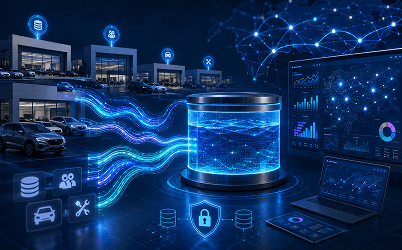
A multi-brand automotive dealership group
Unified data lake · DMS and CRM consolidation
The group set out to make first-party dealer data usable across a network running multiple disconnected systems. We built a unified data lake consolidating DMS, CRM, and operational sources through ETL and ELT pipelines, with real-time ingestion, BI dashboards, and governance covering encryption and access control.
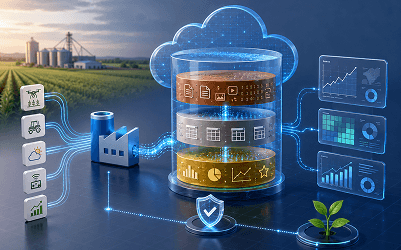
A publicly listed agribusiness
Azure Data Factory · Medallion architecture
The company wanted analytics it could trust without manual spreadsheet handling. We built an ingestion and validation pipeline on Azure Data Factory feeding a centralized data lake, segmented into bronze, silver, and gold zones, with metadata tracking and lineage across every transformation.
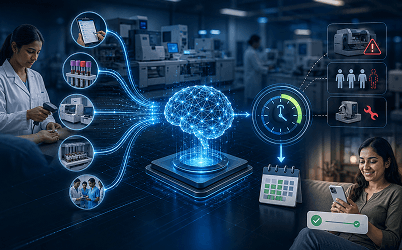
A leading diagnostics chain
Predictive ML · Operations
The chain wanted patients to know when results would arrive. We built a model predicting expected time of report from registration data, lab, and test mix, with handling for real-world disruptions such as equipment downtime and staffing gaps.
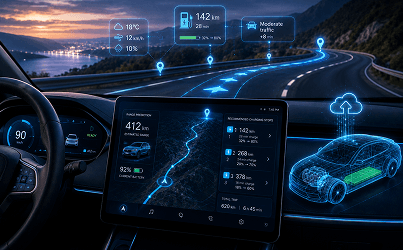
A global automotive manufacturer
Deep learning · Connected vehicle
The manufacturer wanted EV drivers planning long trips with confidence. We built a system predicting real-time range and recommending charging stops, trained on vehicle telemetry combined with weather, traffic, and routing data.
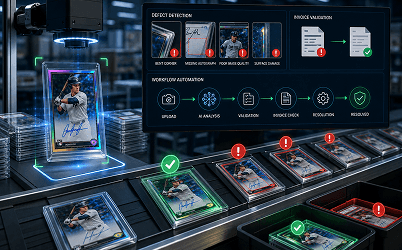
A global sports and entertainment collectibles brand
Computer vision · Quality automation
The brand wanted defect resolution to happen at upload rather than through manual reporting. We built a system detecting defects such as bent corners and missing autographs, running image quality checks to catch poor uploads early, validating invoices, and automating the resolution workflow.
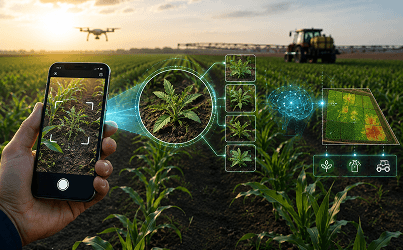
A multinational agricultural inputs company
Computer vision · Field operations
The company wanted growers identifying weeds accurately in the field. We built a computer vision system analyzing crop imagery to classify weed types, delivering real-time data into crop management decisions.
Why This Practice.
The comparison
Against large integrators
Senior engineers on your code, not a pyramid of juniors. Weeks to first production value rather than quarters of discovery. Accelerator IP included.
Against boutiques
Full lifecycle under one roof: data platform, models, and 24×7 operations. Enterprise-grade governance with HIPAA, SOC 2, and model-risk experience. 350+ practice engineers across time zones when you need to scale.
How we work
Engineering culture
Everything as code, including infrastructure, pipelines, evals, and governance. Baseline-first honesty, so weak use cases get killed early. We measure ourselves on your production metrics.
AI-native delivery
Agentic tooling runs inside our own delivery pods and the productivity goes to you. What we sell is how we operate. Human-in-the-loop governance is designed in on day one.
Questions Technical Buyers Ask Us
No, and sequencing it that way usually costs you a year. We scope the platform work to what your first two or three use cases actually need, run model development in parallel, and extend the foundation as the use cases extend. The readiness assessment tells you which parts actually block you.
Usually the operating layer rather than raw capacity: evaluation harnesses, feature stores, CI/CD for data and models, drift response, and the on-call discipline that keeps models alive after launch. Your engineers embed in our pods and keep the capability when we leave.
Yours. We build across AWS, Azure, GCP, Databricks, and Snowflake, and we work within enterprise agreements you've already negotiated. Our reference architectures are starting points that adapt to your estate.
At gate 2 of the methodology, on economics. Build custom when proprietary data is the moat or latency and cost demand a specialized model. Fine-tune when a foundation model is close but the domain gap is real. Buy when the capability is commodity. We revisit the decision at every subsequent gate.
Our ML Platform and Ops pod takes it: monitoring, drift triage, retraining, rollback, and cost management against per-model SLOs. That pod has no exit date, because model operations are a standing function.
Under 12 weeks to first production model is the target we commit to, and the readiness assessment that precedes it takes 2 to 3 weeks at a fixed fee. Speed depends mostly on data access, so that's the first thing we assess.
Yes. The practice has HIPAA, GDPR, and SOC 2 alignment experience, along with model-risk work in regulated industries. Lineage, explainability, bias audits, model cards, and approval workflows are built into the pipeline rather than added for audit.
AI-native companies win.
Let's build yours.
Bring us your data estate and the use case that stalled. We'll tell you what's blocking production and what clearing it costs.
Talk to our data + ML team →