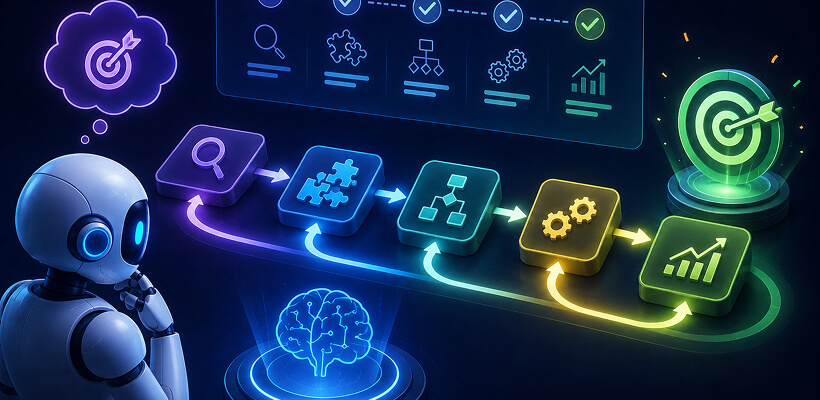
Most people think AI Agents are powerful because they can respond intelligently. But the real breakthrough isn’t in how agents answer, it’s in how they decide what to do next.
That structured decision-making layer is called AI Agent planning.
If an agent can interpret a goal, break it into steps, choose tools, adjust when something fails, and still move toward an outcome, that’s not just automation. That’s planning.
And without strong AI Agent planning, even the smartest AI Agents remain limited to isolated tasks.
Beyond Automation: What AI Agent Planning Really Means
At its core, AI Agent planning is the process that converts intent into structured execution.
It answers three essential questions:
- What is the goal?
- What sequence of actions will achieve it?
- What should be done first and why?
Unlike rule-based systems, AI Agent planning is dynamic. It evaluates context, constraints, risk thresholds, and available tools before acting. That’s the defining difference between scripted automation and true Agentic AI.
A chatbot reacts. An agent plans.
How AI Agent Planning Actually Works
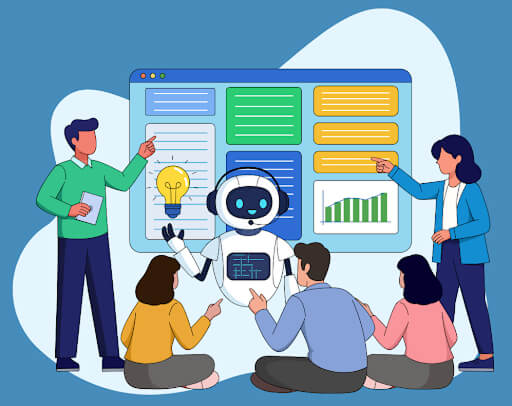
Every production-grade system that uses AI Agent planning follows a structured loop.
1. Interpret the Objective
The agent defines the outcome and identifies constraints, compliance rules, financial limits, and approval requirements.
2. Decompose the Goal
Instead of solving everything at once, it breaks objectives into sub-tasks.
For example, “resolve a disputed transaction” might become:
- Validate customer identity
- Pull transaction history
- Check fraud signals
- Assess policy thresholds
- Draft response
3. Generate Possible Action Paths
The system proposes alternative sequences. Some prioritize speed, and others prioritize safety.
4. Execute and Monitor
The agent selects the most appropriate next step, executes it through tools, and observes the results.
5. Re-Plan if Needed
If something fails or new information appears, the plan adjusts.
This adaptive loop is what makes AI Agent planning reliable in complex environments.
Why Planning Is Now a Strategic Priority
As organizations shift from pilots to operational deployment, planning has become the real differentiator.
Industry forecasts suggest that 40% of enterprise applications will embed task-specific AI agents by 2026, signaling that agent-driven execution will soon be embedded across business software.
As this adoption accelerates, structured AI Agent planning becomes essential. When agents move into real production systems, planning ensures consistency, safety, and compliance.
Without planning, autonomy introduces unpredictability.
With planning, autonomy becomes controlled and measurable.
Planning Is What Makes AI Agents Enterprise-Ready
As adoption deepens, organizations are evolving their AI Agent architecture to include clear planning layers.
Modern systems separate:
- Goal interpretation
- Plan generation
- Tool orchestration
- Risk enforcement
- Human-in-the-loop escalation
This layered design ensures that AI Agent planning is auditable and governed.
We’re also seeing the rise of supervisory or “guardian” agents, systems that monitor and validate other agents’ decisions. In fact, projections indicate that guardian agents will capture 10–15% of the agentic AI market by 2030, underscoring the critical importance of oversight and planning validation in autonomous environments.
Planning is no longer just about efficiency. It’s about trust.
The Role of AI Agent Frameworks
To standardize execution logic, organizations are turning to structured AI Agent frameworks.
These frameworks provide:
- Goal decomposition engines
- Memory and state management
- Controlled tool access
- Built-in monitoring mechanisms
Instead of building complex coordination from scratch, teams rely on these frameworks to formalize AI Agent planning and reduce operational risk.
This is especially important in environments where AI Agents operate across multiple systems and decisions must be explainable.
Designing Effective AI Agent Planning Systems
To make the AI Agent planning production-ready:
- Define outcomes clearly.
- Build structured goal decomposition logic.
- Apply policy filters before execution.
- Log every decision path.
- Insert human-in-the-loop controls for high-risk actions.
When done correctly, AI Agent planning transforms AI Agents from assistants into accountable operators.
Conclusion
So, what is AI Agent planning?
It is the structured intelligence that enables an agent to move from understanding a goal to executing it responsibly, adaptively, and safely.
As enterprise applications increasingly embed AI Agents and oversight layers expand, planning becomes the mechanism that determines whether systems scale or stall.
The future of Agentic AI isn’t just about smarter models. It’s about smarter AI Agent planning.
FAQs
1. What is AI Agent planning?
AI Agent planning is the process that enables an AI agent to break down a goal, decide the right sequence of actions, and execute them intelligently.
2. How is AI Agent planning different from automation?
Automation follows fixed rules. AI Agent planning adapts decisions based on context, constraints, and changing conditions.
3. Why does AI Agent planning matter for enterprises?
It ensures AI Agents act consistently, safely, and in alignment with business policies at scale.
4. What is the role of AI Agent architecture in planning?
AI Agent architecture separates planning, execution, and control layers to make agent decisions reliable and auditable.
5. Do AI Agent frameworks improve planning?
Yes. AI Agent frameworks provide built-in tools for goal decomposition, memory, and orchestration, making planning structured and scalable.
How Can [x]cube LABS Help?
At [x]cube LABS, we craft intelligent AI agents that seamlessly integrate with your systems, enhancing efficiency and innovation:
- Intelligent Virtual Assistants: Deploy AI-driven chatbots and voice assistants for 24/7 personalized customer support, streamlining service and reducing call center volume.
- RPA Agents for Process Automation: Automate repetitive tasks like invoicing and compliance checks, minimizing errors and boosting operational efficiency.
- Predictive Analytics & Decision-Making Agents: Utilize machine learning to forecast demand, optimize inventory, and provide real-time strategic insights.
- Supply Chain & Logistics Multi-Agent Systems: Enhance supply chain efficiency by leveraging autonomous agents that manage inventory and dynamically adapt logistics operations.
- Autonomous Cybersecurity Agents: Enhance security by autonomously detecting anomalies, responding to threats, and enforcing policies in real-time.
- Generative AI & Content Creation Agents: Accelerate content production with AI-generated descriptions, visuals, and code, ensuring brand consistency and scalability.
Integrate our Agentic AI solutions to automate tasks, derive actionable insights, and deliver superior customer experiences effortlessly within your existing workflows.
For more information and to schedule a FREE demo, check out all our ready-to-deploy agents here.