Your AI pilot worked. The agent answered questions, drafted replies, and impressed the steering committee. Then someone asked it to check a live order, update a CRM record, or pull last quarter’s numbers, and it stalled. It had no safe way into the systems where work actually happens.
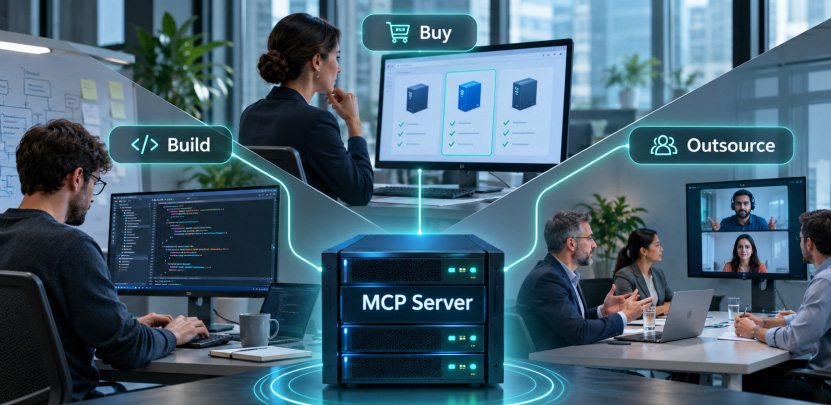
That gap is why MCP server development has moved onto enterprise roadmaps. A Model Context Protocol server gives AI agents governed access to a specific system, so the same connector works across assistants, IDEs, and agent frameworks. The hard question isn’t whether you need MCP servers. It’s how you get them: build them in-house, adopt prebuilt ones, or bring in a partner.
Each path trades speed, control, and cost differently. This blog breaks down what MCP server development really involves, when each option makes sense, what drives MCP server cost, and how to choose without locking yourself into the wrong one.
The Short Answer: Build, Buy, or Outsource?
Buy prebuilt MCP servers for common SaaS tools, build custom MCP servers for proprietary systems that set you apart, and outsource when you need production-grade servers faster than your team can deliver them. Most enterprises end up with a mix of all three.
| Build in-house | Buy or adopt prebuilt | Outsource to a partner | |
|---|---|---|---|
| Best for | Core, proprietary systems with unique logic | Popular SaaS tools with official vendor servers | Complex or regulated systems on a deadline |
| Speed to production | Slowest | Fastest | Fast |
| Control over tools and data | Full | Limited to what the vendor exposes | Full, once handed over |
| Upfront effort | High | Low | Medium |
| Ongoing maintenance | Your team | The vendor, plus your governance | Shared or transferred |
| Main risk | Skills gaps and slow delivery | Over-broad scopes and supply-chain exposure | Weak knowledge transfer |
What MCP Server Development Actually Involves
A working demo takes an afternoon; a production MCP server takes six distinct workstreams. Teams that compare build vs buy on the demo alone consistently underestimate the effort.
| Workstream | What it covers | Why it’s easy to underestimate |
|---|---|---|
| Capability design | Choosing which tools, resources, and prompts to expose, and writing schemas and description models that are read correctly | Poor tool descriptions cause wrong calls that look like model failures |
| Data modeling | Shaping the records, fields, and relationships the server returns | Agents amplify messy or ambiguous data |
| Identity and authorization | OAuth integration, per-user scopes, approval rules for sensitive actions | Agents act on delegated permissions, so one gap exposes many systems |
| Transport and hosting | stdio for local use, Streamable HTTP for shared servers, containers, scaling | Remote servers need the same hardening as any public API |
| Testing and evaluation | Unit tests, schema validation, and scenario tests on how models actually use the tools | Traditional QA doesn’t catch a model choosing the wrong tool |
| Operations | Logging, tracing, versioning, spec migrations, incident response | The MCP spec evolves, and every server needs an owner |
Data modeling deserves extra attention. An MCP server is only as useful as the meaning behind what it returns, which is why decisions about ontologies and semantic layers shape how accurately agents interpret business terms like “active customer” or “net revenue.”
Option 1: Build a Custom MCP Server In-House
Build a custom MCP server yourself when the system behind it is proprietary, central to how you compete, and owned by a team that can keep running it. In-house MCP server development gives you full control over which actions agents can take, how data is shaped, and how fast you iterate.
When building makes sense
- The system holds unique logic, such as pricing engines, underwriting rules, or a proprietary scheduling platform.
- No vendor server exists, or the official one exposes too much or too little.
- You already have platform engineers who own APIs, identity, and observability.
- Agents built on this server are part of a product, not just internal tooling.
What it takes
To build an MCP server well, you need more than an SDK. You need engineers who understand your system’s data and permissions, someone who can write tool descriptions for a model rather than a human reader, and a release process that includes model-in-the-loop testing. Teams already practicing AI-native engineering tend to move faster here, because AI-assisted development and evaluation are already part of how they ship.
Where in-house builds go wrong
The common failure isn’t the first server. It’s the fifth. Without shared patterns for auth, logging, and versioning, each team ships its own variation, and the security review turns into five separate reviews. Treat MCP server development as a platform capability with reusable templates, and fold it into the same AI-driven software development lifecycle you use for everything else.
Option 2: Buy or Adopt Prebuilt MCP Servers
Adopt prebuilt MCP servers for widely used SaaS tools, and only after a security review. Many major vendors now publish official servers for their platforms, and thousands of community servers cover everything from file systems to project trackers. For standard actions in standard tools, there’s rarely a reason to reinvent them.
Where buying wins
- Speed. An official server for your ticketing, chat, or code-hosting platform can be running in a pilot within days.
- Vendor maintenance. The SaaS provider updates the server as its own API and the MCP spec changes.
- Lower upfront effort. Your team focuses on governance and agent design instead of plumbing.
Where buying falls short
Prebuilt servers expose what the vendor decided to expose. If your workflow needs a custom field, a business rule, or a narrower permission than the server supports, you’re stuck or forced to grant more access than you’d like.
The bigger issue is trust. In a July 2026 audit of 9,695 servers from four public directories, Trend Micro’s researchers confirmed security issues in 2,259 of them and found that verified servers had nearly as many issues as unverified ones. Popularity and badges aren’t a substitute for review.
How to buy safely
Prefer official vendor servers over community forks. Pin versions, review the code or the vendor’s security documentation, run servers in isolated environments, and scope credentials to the minimum each workflow needs. Then register every approved server in an internal catalog so teams don’t quietly install their own. The same discipline applies to governing the non-human identities these servers act on behalf of.
Option 3: Outsource MCP Server Implementation to a Partner
Outsource MCP server implementation when the system is too important to wait for, too complex for a first attempt, or too regulated to learn on. A good partner brings tested patterns for auth, data access, and evaluation, so your first production server looks like your tenth.
Outsourcing tends to fit when:
- Agent initiatives are on a fixed timeline, and your platform team is already committed elsewhere.
- The target system is a legacy core platform, such as an ERP, mainframe, or claims engine, with little modern API surface.
- You operate in a regulated industry where audit trails and access controls must hold up from day one.
- You want a reusable MCP foundation, including templates, a gateway, and a registry, that internal teams can extend later.
The risk is ending up with servers nobody inside the company understands. Avoid it by making knowledge transfer part of the contract, not an afterthought.
What to ask a potential MCP development partner
- Which version of the MCP specification will you build against, and how do you handle spec migrations?
- How do you design and test tool descriptions so models call them correctly?
- How will the servers integrate with our identity provider and enforce per-user permissions?
- What observability do we get on day one: logs, traces, and alerts on unusual tool usage?
- Who owns the code, and what does handover look like for our engineers?
Partners that answer these with specifics, not slideware, are usually the ones that have shipped production agents before. The same lens applies when you’re choosing enterprise AI solutions more broadly: judge vendors on how they run systems after launch, not just on the demo.
MCP Server Cost: What Really Drives It
MCP server cost depends far less on lines of code than on the system behind the server and the controls around it. Two servers with the same number of tools can differ by orders of magnitude in effort, because one reads a clean API and the other wraps a legacy database with complex permissions.
| Cost driver | Lower cost when… | Higher cost when… |
|---|---|---|
| Underlying system | A modern, well-documented REST or GraphQL API exists | Access means a legacy database, mainframe, or brittle SOAP service |
| Data quality | Records are clean, consistent, and well labeled | Agents need data stitched from several sources first |
| Action type | Tools are read-only lookups | Tools write, delete, or move money |
| Permissions | One role-based model applies to everyone | Access varies by user, region, or record |
| Deployment | One local server for a small team | Multi-tenant, remote servers at enterprise scale |
| Compliance | Internal, low-sensitivity data | Regulated data with audit and retention requirements |
Maintenance is the line item most budgets miss. The MCP specification has gone through several revisions since 2025, and the latest one, 2026-07-28, removed protocol-level sessions entirely. Every server you own needs someone to handle migrations like that, along with model changes, API updates, and new security findings.
Data is the other hidden cost. If agents rely on information scattered across systems, you’ll likely spend as much on data engineering as on the MCP server itself. That spend isn’t wasted, though. Clean, governed data improves every agent, dashboard, and model that touches it.
When you compare build vs buy for AI integration, compare total cost over two to three years, not the cost of the first release.
A Simple Decision Framework for Enterprise MCP Integration
Two questions settle most enterprise MCP integration decisions: how much the system’s logic differentiates your business, and how hard the system is to connect safely. Differentiation tells you who should own the server. Complexity tells you who should build it.
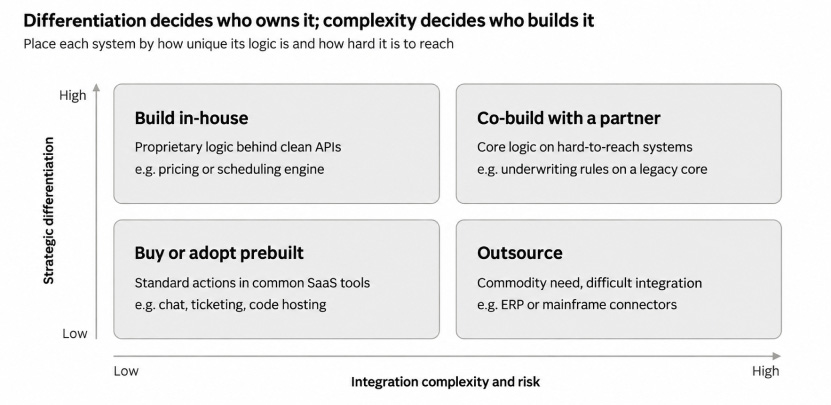
Read the grid system by system, not company-wide. A single enterprise will usually have servers in all four quadrants.
- Buy or adopt prebuilt when the need is common, and the integration is easy. There’s no advantage in owning a connector everyone else uses.
- Build in-house when the logic is yours, and the system is accessible. Ownership pays off because you’ll keep refining what agents can do.
- Outsource when the need is standard, but the integration is painful. A partner absorbs the complexity, and you don’t build expertise you won’t reuse.
- Co-build when both are high. You keep ownership of the logic while a partner brings the patterns and capacity, and your team learns by shipping alongside them.
Systems also move between quadrants over time. A connector you outsourced to a legacy platform can shift to the build quadrant once modernization exposes clean APIs, which is one more reason to insist on code ownership and documentation from day one.
Six Questions to Answer Before You Decide
Run each candidate system through these six questions. The answers usually point to one option.
- Does an official, maintained MCP server already exist for this system? If yes, and it covers your workflow, start by adopting it.
- Is the logic behind this system part of how we compete? If yes, lean toward building or co-building, so you control what agents can do.
- What’s the worst thing an agent could do through this server? Write and delete actions on sensitive data justify more investment in custom controls.
- Do we have engineers who own this system’s API, data, and identity model? If not, building in-house means building that ownership first.
- How soon do agents need this access? A deadline measured in weeks favors buying or outsourcing over a first-time internal build.
- Who will maintain the server in 18 months? Every option needs an owner. If nobody can name one, the decision isn’t ready.
These questions also expose how ready the wider organization is. If most answers are “we don’t know yet,” it’s worth stepping back to assess where you sit on an enterprise AI maturity model before committing budget to MCP server development.
How [x]cube LABS Can Help
[x]cube LABS supports MCP server development in whichever mode fits each system, so you don’t have to pick one answer for your whole portfolio.
- Decide. We assess your systems and agent use cases, then sort each one into build, buy, or outsource, with a clear view of risk, effort, and ownership.
- Co-build. Our engineers work alongside your platform team to ship the first custom MCP servers and leave behind reusable templates, auth patterns, and test suites your team can extend.
- Deliver end to end. For complex or regulated systems, our enterprise AI services team designs, builds, secures, and hands over production MCP servers, including those that wrap older platforms during a phased legacy modernization.
- Vet what you buy. We review prebuilt and vendor servers, tighten scopes, and set up the internal registry and gateway that keep adoption under control.
Behind every engagement sit the foundations that make agents reliable: data and ML engineering to clean and govern what servers return, and cloud services to run them securely at scale. US enterprises can also work directly with our Dallas AI services team. Browse our portfolio to see the enterprise platforms we’ve delivered.
Frequently Asked Questions
1) What is MCP server development?
MCP server development is building a server that exposes a system’s tools, data, and workflows to AI agents through the Model Context Protocol. It covers capability design, data modeling, authorization, hosting, testing, and ongoing maintenance.
2) Should I build or buy an MCP server?
Buy or adopt official prebuilt servers for common SaaS tools when they cover your workflow. Build a custom MCP server for proprietary systems, unique business logic, or cases where prebuilt servers expose too much or too little.
3) How long does it take to build an MCP server?
A prototype can run in a day. A production MCP server implementation takes longer because of authorization, data preparation, testing with real models, and security review. Timelines depend mostly on how accessible and well governed the underlying system is.
4) How much does MCP server development cost?
MCP server cost depends on the complexity of the underlying system, data quality, whether tools write or only read, permission models, deployment scale, and compliance needs. Any estimate should include ongoing maintenance, including spec migrations.
5) Are open-source MCP servers safe for enterprise use?
They can be, after review. Treat each one as third-party code: check its source and maintainers, pin versions, restrict credentials, isolate it at runtime, and approve it through an internal registry before teams use it.
6) When does it make sense to outsource MCP server development?
Outsourcing makes sense when timelines are tight, the target system is complex or legacy, or the data is regulated. Choose a partner that builds against the current MCP specification and commits to a real handover.
Conclusion: Make the Call System by System
The build vs buy question for MCP doesn’t have one answer for the whole enterprise. It has one answer per system. Adopt vetted prebuilt servers where they fit, invest in custom MCP server development where your logic and data set you apart, and bring in a partner where speed, complexity, or regulation make a first attempt risky.
Whatever mix you choose, the same rules hold. Every server needs an owner, least-privilege access, real model testing, and a plan for the next spec revision. Get those right, and each new server makes every agent you deploy more useful. If you’d like help sorting your systems into build, buy, and outsource, talk to the [x]cube LABS team.