Most engineering teams can name the week AI entered their workflow. Someone turned on a coding assistant, a few engineers started pasting stack traces into a chat window, and pull requests began arriving faster. Far fewer teams can name the week their workflow changed: the point where specs, reviews, tests, and roles were redesigned on the assumption that AI agents would do much of the building.
That second change is what AI-native engineering describes. This blog defines it, follows one feature through an AI-assisted team and an AI-native team, and covers the artifacts, roles, guardrails, and metrics a team needs to make the shift without trading quality for speed.
What Is AI-Native Engineering?
AI-native engineering is a way of building software in which AI agents carry out much of the implementation work across the lifecycle, and the team’s process, artifacts, and roles are designed around that. Engineers decide what to build, set the constraints, and verify the result. Agents draft code, tests, documentation, and first-pass reviews against those decisions.
Three properties separate an AI-native engineering team from a team that simply has AI tools:
- Intent is written down before code: Every non-trivial change starts from a spec that states behavior, constraints, and acceptance criteria. This practice is usually called spec-driven development.
- Context is engineered and shared: Coding conventions, architecture decisions, domain rules, and tool access live in versioned files and connections that every agent and engineer on the team uses. This is context engineering.
- Verification is designed in advance: Tests, evaluation sets, and policy checks exist before the agent starts, so the team can tell quickly and automatically whether the output is right.
Three related ideas often get mixed up with it. Vibe coding, where a person accepts model output without reading it closely, works for throwaway prototypes but has no place in production code. A tool rollout, where every engineer gets a coding assistant license, changes individual habits but leaves the team’s process unchanged. AI-native architecture describes what you build: products designed around AI decisions. AI-native engineering describes how you build, and the two usually go together; the gap between AI-first and AI-native companies often comes down to whether both have changed.

AI-Assisted vs AI-Native Development: One Feature, Two Teams
Take a common request: let subscription customers pause their plan for up to three months instead of canceling. Two teams with the same coding tools handle it very differently.
| Request arrives | A ticket with two sentences goes into the backlog | The product manager and an engineer turn it into a one-page spec the same day: pause rules, billing behavior, notifications, and what happens to active discounts |
| Design | The engineer works out the design while coding | An agent drafts a plan against the spec and the team’s architecture notes; the engineer reviews the plan before any code exists |
| Build | The engineer writes most of the code, using an assistant for boilerplate and lookups | Agents implement the plan in small tasks, each checked against the spec; the engineer handles the billing edge case the spec flagged as needing human judgment |
| Test | Tests are written after the code, if time allows | Tests are generated from the acceptance criteria first, so the implementation has a target |
| Review | A colleague reviews a large pull request when they get to it | A review agent checks for security issues, convention breaks, and spec gaps; the human reviewer focuses on design and risk |
| Release | Manual checks, then a full release | Feature flag, small rollout, and automated checks against the acceptance criteria in production |
| Afterward | Lessons stay in people’s heads | Anything the agents got wrong becomes a new rule in the shared context, so the next feature avoids it |
The AI-native team gains most by removing the waiting and rework between steps: fewer clarifying questions mid-build, fewer review cycles on oversized pull requests, and fewer production surprises from untested edge cases. The last row matters most over time. Every corrected mistake improves the context the agents work from, so the team gets better with each feature it ships.
The Four Artifacts an AI-Native Engineering Team Runs On
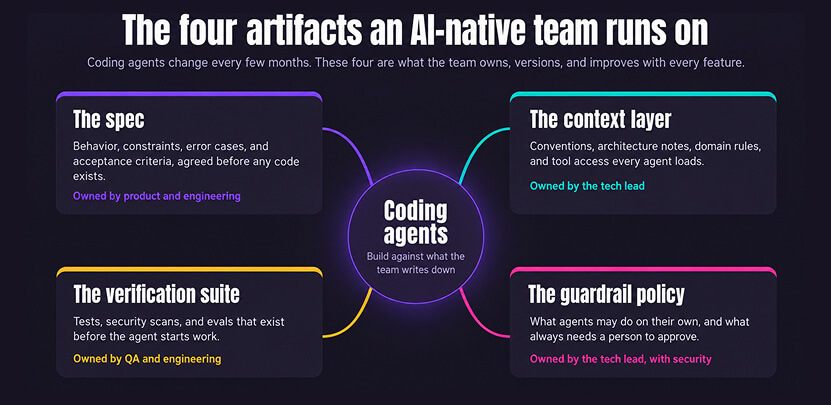
Tools change every few months. These four artifacts are what an AI-native engineering team actually maintains, and they keep working when the tools change. Assign each one an owner and review changes like code.
1. The spec
Spec-driven development puts a short, reviewable document in front of every non-trivial change. A useful spec covers the behavior users will see, the constraints the change must respect, the error cases, what is out of scope, and the acceptance criteria that define done. Compare “add a pause option” with “paused customers keep their plan price, are not billed during the pause, receive a reminder seven days before it ends, and cannot pause twice in twelve months.” The second version removes most of the decisions an agent would otherwise have to guess. Review the spec before agents run; it is the cheapest point to catch a wrong assumption.
2. The context layer
Context engineering is giving agents the knowledge a new hire would need: coding conventions, approved libraries, architecture decision records, a glossary of domain terms, and rules nobody writes in the code, such as “all money values are integers in cents.” Most teams keep this in a rules file at the repository root, often named AGENTS.md, plus connections to the systems agents need to read, such as the ticket tracker, the schema registry, and the design system. Keep the always-loaded portion short and load the rest only when a task needs it, because every line competes for the model’s attention.
3. The verification suite
Verification decides whether you can trust agent output, so it must exist before the agent starts. That means tests generated from acceptance criteria, type checks and linters in the agent’s loop, static analysis and dependency scanning in CI, and, for features that themselves use AI, evaluation sets built with the same AI agent evaluation methods used to score accuracy, reliability, and cost.
4. The guardrail policy
The guardrail policy states what agents may do on their own and what needs a person. A typical starting policy: agents can read the codebase and run tests in a sandbox; they cannot merge to the main branch, touch production data, or change authentication, payments, or personal data handling without human review. Widen the policy as the verification suite proves itself, one permission at a time.
How the AI-Native SDLC Changes at Each Stage
Each stage of software delivery shifts in two ways: where people spend their time, and which decisions they keep. Here is what the AI SDLC looks like when an AI-native engineering team runs it.
- Planning: Agents research the codebase, surface related code and past decisions, and draft options. People decide scope, priority, and what to leave out.
- Design: Agents draft implementation plans against the spec and architecture notes. People approve the plan and own the trade-offs: data model changes, new dependencies, and anything that touches other teams.
- Build: Split work into small tasks, each fitting one agent session and one reviewable diff. Several agents can work in parallel on separate tasks. People handle the parts the spec marks as needing judgment.
- Testing: Tests come first, generated from acceptance criteria. Agents run them in their own loop and fix failures before a person sees the change.
- Review: Review agents take the first pass on security, conventions, and spec coverage. Human reviewers focus on design, risk, and whether the change meets the business need.
- Release: Feature flags and gradual rollouts become the default because change volume rises and each release must be easy to reverse.
- Operations: Agents help triage incidents and draft fixes, and every incident feeds a new rule into the context layer. Features that include models need MLOps practices for versioning and monitoring, and agents running in production need an AgentOps discipline.
One rule holds across every stage: keep tasks small. Agents produce their best work on narrow, well-specified tasks, and reviewers catch more problems in a 200-line diff than in a 2,000-line one.
Guardrails That Keep Quality and Security Intact
Speed without verification moves problems downstream. The 2025 DORA report from Google Cloud found that 90% of technology professionals now use AI at work, and that AI adoption is linked to higher delivery throughput but also to lower delivery stability. DORA concludes that AI amplifies whatever a team already has, strengths and weaknesses alike.
Security shows the same pattern. In the Veracode 2025 GenAI Code Security Report, models tested on 80 coding tasks introduced security vulnerabilities in 45% of cases, and Java code failed more than 70% of the time. Code that compiles and passes functional tests can still be unsafe.
The guardrails that address both problems:
- Tests before merge, every time. No agent-generated change merges without passing the acceptance tests generated from its spec.
- Security scanning in the agent’s loop. Run static analysis and dependency checks while the agent works, so it fixes issues before a person reviews the change.
- Mandatory human review for sensitive code. Always assign a named human reviewer for authentication, authorization, payments, and personal data handling.
- Verified dependencies. Agents sometimes suggest packages that don’t exist or aren’t approved. Restrict installs to an allowlist or an internal registry.
- Least-privilege agents. Each agent gets its own credentials, scoped to its task, with every action logged.
- Untrusted input stays untrusted. Documents, tickets, and web pages an agent reads can contain instructions. Agents should never run commands they found in external content without approval.
- Sandboxed execution. Agents run code in isolated environments with no path to production data.
How to Measure AI-Native Engineering
The easiest numbers to collect are the least useful. The share of code written by AI and the number of lines shipped say nothing about whether customers got better software faster. Measure the system instead, and capture a baseline before the team changes how it works.
Delivery speed: Lead time for changes, measured between first commit and production, and spec-to-production time, measured between an approved spec and a live feature. The second captures the gains AI-native teams get from fewer clarifying loops.
Stability: Change failure rate and time to restore service. If these worsen while speed improves, verification isn’t keeping up.
Rework: The share of merged changes that are reverted or substantially rewritten within 30 days. Rising rework is the earliest sign that specs or context are too thin.
Review load: Pull requests and lines reviewed per engineer per week. AI-native teams often move the bottleneck from writing to reviewing; if review load climbs, invest in smaller tasks and review agents before adding more generation.
Security: Vulnerabilities found per release, split by where they were caught: in the agent’s loop, in CI, in human review, or in production. The goal is to push detection as early as possible.
Cost: Model and tool spend per merged change. Agent usage can grow quietly, and a change’s cost belongs in the same conversation as its speed.
Review these numbers monthly with the team, and treat any metric that improves while another degrades as a prompt to examine the process before celebrating.
Conclusion
AI-native engineering changes how work gets done more than team size. Engineers spend more of their day deciding what to build, setting the rules agents follow, and ensuring the result holds up in production. The code still matters; the thinking around it matters more now.
The best part is that the gains compound. A clearer spec produces better output, better output speeds up reviews, and every captured lesson makes the next feature easier to build. Tools will keep changing, but the habits of writing down intent, sharing context, and verifying every change carry over to whatever comes next. Every team already has AI in its workflow; the real question is how much of that workflow it is willing to rebuild around it.
FAQs
1) What is AI-native engineering?
AI-native engineering is a way of building software where AI agents do much of the implementation work, and the team’s specs, context, verification, and roles are designed around it. Engineers decide what to build, set constraints, and verify results; agents draft code, tests, documentation, and first-pass reviews.
2) How is AI-native development different from AI-assisted development?
In AI-assisted development, engineers do most of the work and use AI tools for suggestions and lookups. In AI-native development, agents do most of the implementation against written specs, and the team rebuilds its process around specifying, verifying, and reviewing that work.
3) What is spec-driven development?
Spec-driven development is the practice of writing a short, reviewable specification before generating any code. The spec states behavior, constraints, error cases, and acceptance criteria, and both agents and tests are built against it.
4) What is context engineering?
Context engineering is giving AI agents the project knowledge they need to produce code that fits conventions, architecture decisions, domain rules, and access to relevant systems. Teams usually keep it in versioned rule files and shared tool connections.
5) Is AI-generated code safe to put into production?
It can be, with the right controls. Independent testing in 2025 found security flaws in a large share of AI-generated code, so production use needs automated security scanning, spec-based tests, and human review of sensitive areas such as authentication and payments.
Why Choose [x]cube LABS?
[x]cube LABS works with enterprise teams to design and deploy AI agents across complex, regulated environments.
We help enterprises become AI-native, not by adding AI on top of existing systems, but by rebuilding the intelligence layer from the ground up. With 950+ products shipped and $5B+ in value created for clients across 15+ industries, here is what we bring to the table:
1. Autonomous AI Agents
We design and deploy agentic AI systems that sense, decide, and act without human bottlenecks, handling complex, multi-step workflows end-to-end with measurable resolution rates and no manual intervention.
2. Enterprise Voice AI
Our voice AI platform, Ello, puts production-ready voice agents in front of your customers in minutes. Zero-latency conversations across 30+ languages, with no call centers and no wait times.
3. AI-Powered Process Automation
We replace manual, error-prone workflows with intelligent automation across invoicing, compliance, customer service, and operations, freeing your teams to focus on work that requires human judgment.
4. Predictive Intelligence and Decision Support
Using machine learning and real-time data pipelines, we build systems that forecast demand, flag risk, optimize inventory, and surface strategic insights before your teams need to ask for them.
5. Connected Products and IoT
We design and build IoT platforms that turn physical devices into intelligent, connected systems with built-in real-time monitoring, remote management, and condition-based automation.
6. Data Engineering and AI Infrastructure
From data lakes and ETL pipelines to AI-ready cloud architecture, we build the foundation that makes everything else possible, scalable, reliable, and designed to grow with your business.
If you are looking to move from AI experimentation to AI-native operations, let’s talk.