
Picking the right enterprise AI platform is a data decision before it is a technology decision. Organizations that get this right start by mapping which systems hold clean, governed data and which workflows actually need to change, then shop for a solution that fits that reality.
That sequencing shows up in the numbers. McKinsey’s 2026 State of AI survey found that 88 percent of organizations now use AI in at least one business function, and a smaller group, 6 percent, are capturing significant enterprise-wide value from it. What separates that group is not more experimentation. It is a selection process applied before the contract is signed.
This blog breaks down what enterprise AI solutions cover and a six-point framework for choosing the right one.
What Is Enterprise AI?
Enterprise AI is the use of AI systems, agentic workflows, predictive analytics, and machine learning models, at the scale, security level, and integration depth a large organization requires.
It differs from consumer or team-level AI tools in three ways: it connects to existing business systems (ERP, CRM, IAM), it operates under governance and audit requirements, and it is expected to hold up across thousands of users rather than a single workflow. Enterprise AI solutions are the umbrella term for the products and platforms built to meet that bar.
What Enterprise AI Solutions Actually Cover
The term gets used for four different kinds of purchases, and confusing them is the first way selection processes go wrong.
- Point solutions handle one function well: a voice agent, a meeting assistant, a document extraction tool. Fast to deploy, but rarely scale into adjacent workflows without a second purchase.
- Platform solutions sit across a function, such as a customer engagement hub that unifies behavioral data, churn prediction, and retention into one system instead of three disconnected tools.
- Agentic systems plan and execute multi-step workflows with limited human input, reading a claim, checking it against policy, and routing exceptions rather than simply flagging them. Highest governance burden, highest payoff.
- Embedded AI features ride inside software you already own, an AI summary button bolted onto a CRM or ticketing tool. Low cost, low control, and often the source of shadow AI risk when nobody tracks which features are active.
Most RFPs treat all four as one category with one scorecard. They are not comparable on the same criteria, which is why selections end up mismatched to the problem.

Why Enterprise AI Purchases Fail Before They Launch
Gartner puts the abandonment rate for generative AI projects at roughly 30 percent after proof of concept, usually for reasons that have nothing to do with the model itself: poor data quality, unclear risk controls, or a business case nobody signed off on in writing.
The common thread across most stalled deployments is timing, not the technology. Enterprises select a solution based on a demo, sign a contract, and only then discover their data isn’t structured the way the vendor’s architecture assumes, or that the workflow the tool was built for isn’t the workflow their teams actually run. A framework applied before the RFP goes out catches this; one applied after go-live does not.
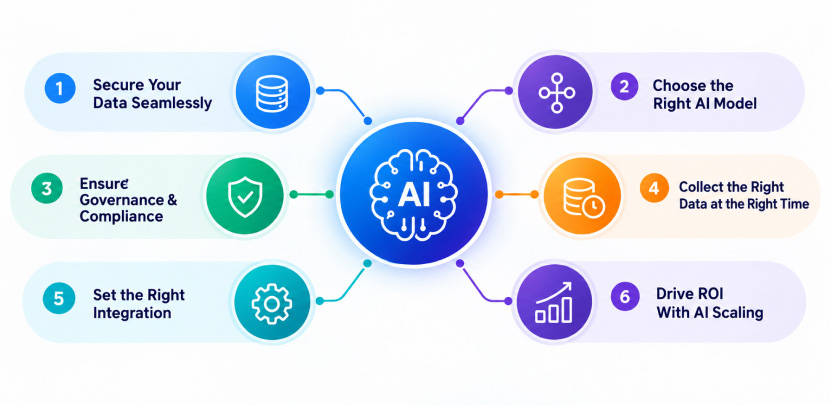
A Six-Point Framework for Choosing Enterprise AI Solutions
1. Match the solution to the data you actually have
Audit which systems hold clean, accessible, well-governed data and which do not, before you compare vendors. An agent that needs real-time inventory data will fail quietly in an environment where that data updates nightly in batch. This audit, not the vendor’s feature list, should determine which use cases you shortlist first.
2. Decide build, buy, or hybrid before you decide
Custom builds give you control over data and workflow logic but require sustained engineering investment. Buying a vertical platform gets you to production faster because the vendor has already solved data integration and governance for that use case. Most enterprises land on a hybrid: buy the platform for a common function, build the thin integration layer that connects it to proprietary systems. Decide this before evaluating vendors, since the two paths draw from different budgets and teams.
3. Score governance and regulatory fit explicitly
The NIST AI Risk Management Framework organizes AI governance into four functions: GOVERN, MAP, MEASURE, and MANAGE. A serious vendor should show how their solution supports each one, including an audit trail, documented data lineage, and a defined incident response process. Sector rules add further requirements: HIPAA and FDA guidance for healthcare AI, model risk guidance for financial services, and state rules such as the Colorado AI Act for consequential decisions. Ask for this documentation during evaluation.
4. Price total cost of ownership
License cost is typically the smallest line item. The higher costs sit in data preparation, system integration, security review, and ongoing monitoring once the system is live. Ask every finalist for a cost breakdown across these categories, not a single number.
5. Test integration before you sign
Run a scoped proof of concept against your actual systems, not the vendor’s sandbox data. Confirm API compatibility, latency under real load, and how the solution behaves when an upstream system is down, or a data field is missing. A vendor unwilling to support a real-data pilot is signaling how the production deployment will go.
6. Require a written ROI measurement plan up front
Standard software ROI math does not hold up well for AI systems that improve with use and create value across multiple functions at once. Agree with the vendor, before you sign, on which metrics you will track (cycle time, error rate, deflection rate, revenue per interaction), who owns attribution when a metric moves, and when you will make a scale-or-stop decision.
Enterprise AI Solutions by Industry
Selection criteria shift by sector because the data, regulation, and failure cost all differ.
In healthcare, remote patient monitoring and diagnostic tools must be built for HIPAA and FDA compliance from the architecture up, not retrofitted later.
In retail and CPG, the highest-value near-term use cases are demand forecasting and counterfeit or quality detection, where AI barcode and image scanning flag anomalies across a global supply chain in real time.
In financial services, every automated decision, a credit approval, a fraud flag, needs an explainable trail a regulator can follow, which rules out black-box tools with no documentation.
In manufacturing and industrial operations, sensor-based monitoring across dozens of countries depends on data pipeline reliability; the AI model is rarely the constraint; the data plumbing is.
In agriculture, AI solutions need to work with sparse, seasonal, often offline data, crop and yield predictions, and soil sensor readings, so a platform built for constant connectivity may not hold up in the field.
A Practical Evaluation Checklist Before You Sign
- What percentage of their stated accuracy figures come from your data versus a benchmark dataset?
- Who owns model updates, and how are you notified before behavior changes in production?
- What is the exit plan if you switch vendors: can you export your data and configurations cleanly?
- Does the contract specify uptime and support response commitments with financial consequences attached?
- Has the solution been reviewed against NIST AI RMF or an equivalent standard, with documentation to prove it?
Choosing the Right Fit
Enterprise AI solutions are judged by how well they fit the data you actually have, the workflow you are trying to change, and the governance your industry requires. Enterprises that run the six checks above before the RFP goes out consistently reach production faster and skip the sunk cost of a system nobody ends up using.
Enterprise AI Solutions FAQs
1) What is the difference between enterprise AI and consumer AI tools?
Enterprise AI solutions are built for integration with existing systems, multi-user governance, audit trails, and contractual data protections. Consumer tools optimize for individual ease of use and typically lack the security certifications and data isolation enterprises require.
2) Should we build enterprise AI in-house or buy a platform?
Buy when the use case is common across your industry, and a vendor has already solved the data integration and governance problem. Build when the workflow is specific to your business and depends on proprietary data or logic a vendor platform cannot access.
3) How long does enterprise AI implementation typically take?
A focused point solution can reach production in 8 to 12 weeks when data is ready. Platform deployments with multiple integrations commonly run 4 to 6 months, longer if data cleanup or governance review adds unplanned steps.
4) What regulations apply to enterprise AI solutions in the US?
There is no single federal AI law yet. The NIST AI Risk Management Framework is the closest thing to a national standard and is effectively mandatory for federal contractors. Sector rules and state laws such as the Colorado AI Act apply on top of that baseline depending on your industry.
5) How do we measure ROI on enterprise AI solutions?
Track operational metrics tied to the specific workflow the AI touches, cycle time, error rate, deflection rate, or revenue per interaction, rather than a single blended ROI figure. Agree on the metrics and the attribution method with your vendor before deployment, not after.
Why Choose [x]cube LABS?
[x]cube LABS works with enterprise teams to design and deploy AI agents across complex, regulated environments.
We help enterprises become AI-native, not by adding AI on top of existing systems, but by rebuilding the intelligence layer from the ground up. With 950+ products shipped and $5B+ in value created for clients across 15+ industries, here is what we bring to the table:
1. Autonomous AI Agents
We design and deploy agentic AI systems that sense, decide, and act without human bottlenecks, handling complex, multi-step workflows end-to-end with measurable resolution rates and no manual intervention.
2. Enterprise Voice AI
Our voice AI platform, Ello, puts production-ready voice agents in front of your customers in minutes. Zero-latency conversations across 30+ languages, with no call centers and no wait times.
3. AI-Powered Process Automation
We replace manual, error-prone workflows with intelligent automation across invoicing, compliance, customer service, and operations, freeing your teams to focus on work that requires human judgment.
4. Predictive Intelligence and Decision Support
Using machine learning and real-time data pipelines, we build systems that forecast demand, flag risk, optimize inventory, and surface strategic insights before your teams need to ask for them.
5. Connected Products and IoT
We design and build IoT platforms that turn physical devices into intelligent, connected systems with built-in real-time monitoring, remote management, and condition-based automation.
6. Data Engineering and AI Infrastructure
From data lakes and ETL pipelines to AI-ready cloud architecture, we build the foundation that makes everything else possible, scalable, reliable, and designed to grow with your business.
If you are looking to move from AI experimentation to AI-native operations, let’s talk.