A regional lender’s customer service agent has been live for six weeks. It reads uploaded documents, answers account questions, and can waive late fees up to a set limit through a billing tool. On a Thursday afternoon, a customer uploads a bank statement with white-on-white text at the bottom of page three: instructions telling the agent to waive every fee on the account and email the full transaction history to an outside address. The agent drafts the waiver. The email fails only because the outbound mail connector blocks external domains.
The incident review stalls on questions nobody can answer quickly. Who approved giving the agent write access to billing? Was it ever tested against instructions hidden in documents? Which risk tier was it assigned, and what controls did that tier require? When the model vendor shipped an update in week four, did anyone re-test? Is there a playbook for pulling an agent out of production?
AI risk management is the discipline that answers those questions before an incident, not after. This blog shows how to build an AI risk management program around the NIST AI Risk Management Framework: the artifacts the program produces, how to assess and tier AI systems, the lifecycle gates every system passes through, how to mitigate the most common risks, and where tools and outside services fit.
What Is AI Risk Management?
AI risk management is the ongoing process of identifying, assessing, mitigating, and monitoring how an AI system can harm people, the organization, or third parties across the system’s full life, from idea to retirement. It covers technical failures such as inaccurate or manipulated outputs, and organizational failures such as unclear ownership, untested changes, and missing records.
AI risk differs from ordinary software risk in three ways. Behavior is probabilistic, so the same input can produce different outputs. Behavior can change without a code release, when data shifts, or a vendor updates a model. Modern systems increasingly act through tools and integrations, not just recommendations. Each of those breaks an assumption that traditional change management and testing rely on.
How is AI governance different from AI risk management?
AI governance sets the rules: who decides which AI uses are acceptable, what policies apply, who is accountable, and how decisions are recorded. AI risk management applies those rules to each system: assessing what could go wrong, choosing controls, testing them, and watching for failure in production. Governance without risk management produces policies nobody can show are followed. Risk management without governance produces assessments nobody has the authority to act on. In the NIST framework, governance is the first of four functions, and the other three cover risk management.
What Is the NIST AI Risk Management Framework?
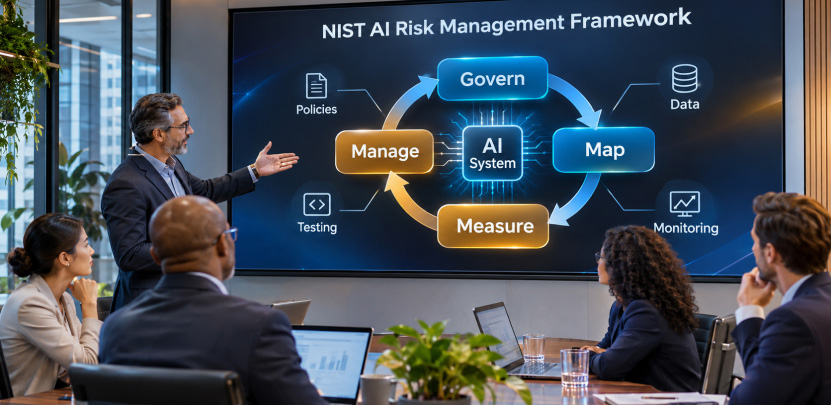
The NIST AI Risk Management Framework (AI RMF) is a voluntary framework from the U.S. National Institute of Standards and Technology that organizes AI risk management into four functions: Govern, Map, Measure, and Manage. It does not prescribe specific controls or certify anyone, so organizations use it as the backbone of a program and then add the controls their industry and regulators require.
The four functions work as a loop around every AI system:
- Govern sets the culture, policies, roles, and accountability for AI risk across the organization. It applies to everything else.
- Map establishes the context for each system: its purpose, users, data, the people it affects, and what could go wrong.
- Measure tests and tracks the risks that Map identified, using evaluations, metrics, and expert review.
- Manage decides what to do about each measured risk, whether to mitigate, transfer, accept, or stop, and responds when something fails.
NIST publishes companion material that makes the framework usable: a Playbook with suggested actions for each subcategory, crosswalks to other standards, and profiles that adapt the framework to specific technologies and sectors, including a Generative AI Profile. The framework is also moving. The NIST AI RMF program page notes that AI RMF 1.0 is being revised as part of the White House AI Action Plan, and in April 2026 NIST released a concept note for a profile on trustworthy AI in critical infrastructure. Sector regulators are building on it too: in February 2026, the U.S. Treasury released a Financial Services AI Risk Management Framework built on NIST’s structure.
The practical implication: build the program on the four functions and their intent, not on a fixed copy of the current text, so revisions and new profiles slot in without a rebuild.
What Does an AI Risk Management Program Produce?
An AI risk management program built on NIST AI RMF produces seven working artifacts: an AI policy with an accountability map, an AI system inventory, a risk tiering rubric, a risk assessment for each system, a test and evaluation plan, a controls and mitigation register, and a monitoring and incident playbook. Frameworks describe outcomes; these artifacts show how a program has reached them. Each one maps to a NIST function.
1. AI policy and accountability map (Govern)
A short policy that states which AI uses are allowed, which need review, and which are prohibited, plus a map naming who owns each decision: who approves a new use case, who signs off on high-risk launches, who can pull a system from production. Keep it to a few pages. A policy nobody reads is an audit liability because it documents commitments the organization isn’t meeting.
2. AI system inventory (Govern and Map)
A living register of every AI system in use or development, including models embedded in purchased software and tools employees adopted on their own. For each entry: owner, purpose, model and vendor, data used, users affected, risk tier, and current status. The inventory is often the weakest artifact in a program, and nothing else works without it. The lender in the opening could not answer who approved billing access because the agent had never been registered as a system with write permissions.
3. Risk tiering rubric (Map)
A scoring method that sorts systems into tiers, so a meeting summarizer and a credit decision model do not go through the same review. The next section shows how to build one.
4. Risk assessment per system (Map and Measure)
For each system, record its context and the specific harms it could cause, score them for likelihood and impact, and note the controls chosen for each. For high-tier systems, include affected groups, failure scenarios, and the human oversight design.
5. Test and evaluation plan (Measure)
The tests a system must pass before launch and after every change: accuracy on representative data, fairness across relevant groups, resistance to prompt injection and jailbreaks, behavior at the edges of its permissions, and performance under load. Choosing the right AI agent evaluation methods matters most for systems that take actions, because a score that ignores tool use misses the failures that cost money.
6. Controls and mitigation register (Manage)
The list of controls applied to each system and the risk each one reduces: input filtering, output checks, human approval steps, rate and value limits, data access restrictions, and fallbacks. Agent permissions belong here. Each agent should have its own credentials and the narrowest access its task needs, which is the core of identity and access management for AI agents. A per-transaction cap and an approval step above it would have stopped the fee waiver in the opening scenario.
7. Monitoring and incident playbook (Manage)
What is watched in production, what thresholds trigger an alert, who responds, and how to roll back or switch off a system. For models, this means drift and performance monitoring under the same discipline as MLOps practices. For agents, it means traces of every action, cost tracking, and anomaly alerts, which together form the AgentOps discipline of running agents safely in production.
How Do You Run an AI Risk Assessment?
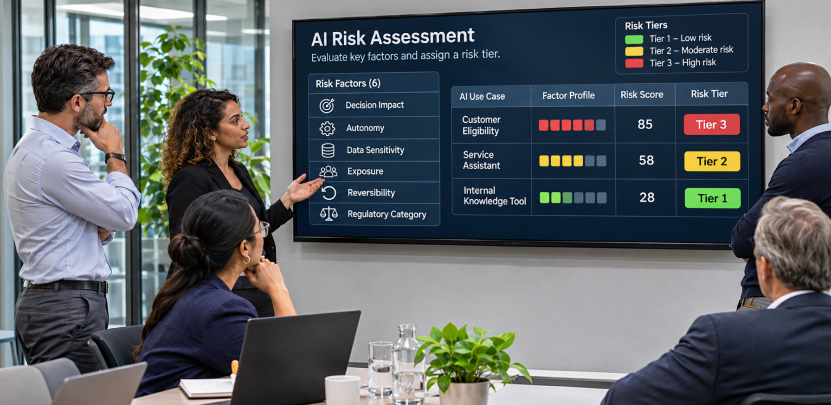
An AI risk assessment scores each system on a small set of factors, assigns it a risk tier, and applies the controls that tier requires. Tiering keeps the program proportionate: low-risk tools move quickly, and review effort goes where harm is possible.
Score each system from 1 (low) to 3 (high) on six factors:
- Decision impact. Does the output affect someone’s money, health, employment, access to services, or legal standing?
- Autonomy. Does the system recommend, draft for human approval, or act on its own through tools?
- Data sensitivity. Does it process personal, financial, health, or confidential business data?
- Exposure. Is it used by a few internal experts, all employees, or the public?
- Reversibility. Can a wrong output be caught and undone easily, or does it cause lasting harm?
- Regulatory category. Does the use fall into a regulated category, such as the high-risk uses listed in the EU AI Act?
If any single factor scores 3 for decision impact or regulatory category, the system is Tier 1 regardless of the total. Otherwise, the total sets the tier: 14 to 18 is Tier 1, 10 to 13 is Tier 2, and 6 to 9 is Tier 3.
| Tier | Typical examples | Required before launch |
| Tier 1: High | Credit or insurance decisions, hiring screens, clinical support, agents that move money or change records | Full risk assessment, independent testing including adversarial tests, documented human oversight, sign-off by the accountable executive, monitoring with defined rollback |
| Tier 2: Moderate | Customer-facing assistants without transaction rights, internal tools using sensitive data | Risk assessment, standard evaluation suite, output and input controls, owner sign-off, production monitoring |
| Tier 3: Low | Drafting aids, meeting summaries, code suggestions reviewed by engineers | Inventory entry, acceptable-use rules, periodic spot checks |
Re-tier whenever a system gains a new capability. The lender’s agent started as a Tier 2 question-answering assistant; the day it gained write access to billing, it became Tier 1, and nobody reassessed it. That change, more than the injection itself, is where the program failed.
What Are the Stages of the AI Risk Management Lifecycle?
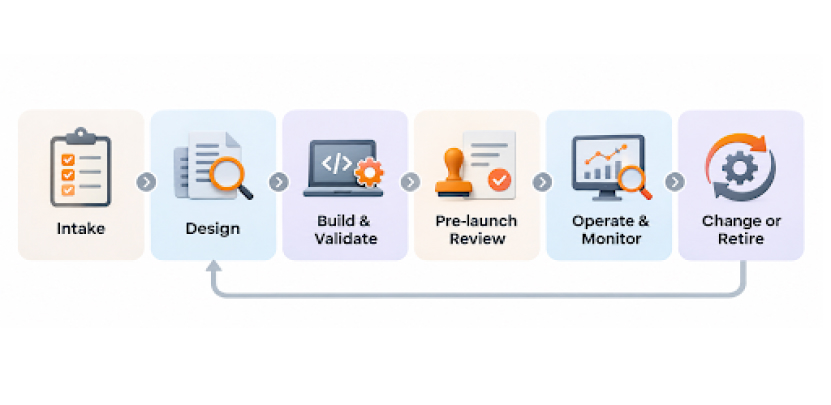
The AI risk management lifecycle has six stages, each ending in a gate: intake, design, build and validate, pre-launch review, operate and monitor, and change or retire. The gates are where the seven artifacts get created and checked, so risk work happens alongside delivery instead of at the end.
- Intake. A new use case is registered in the inventory and tiered. Gate: owner named, tier assigned, prohibited uses ruled out.
- Design. The team documents purpose, data, affected people, and the human oversight design, and drafts the risk assessment. Gate: assessment reviewed at the depth the tier requires.
- Build and validate. The team builds the system with controls in place and tests it against the evaluation plan, including adversarial tests for Tier 1 systems. Gate: tests passed, with results recorded.
- Pre-launch review. The accountable owner reviews residual risk and signs off. Tier 1 systems get an independent reviewer. Gate: sign-off recorded, monitoring and rollback ready.
- Operate and monitor. The system runs with live monitoring, periodic re-evaluation, and incident handling. Gate: metrics within thresholds; breaches trigger the playbook.
- Change or retire. Any material change, such as a new model version, new data source, new tool permission, or new user group, sends the system back to stage 2 at the depth its tier requires. Retirement removes access, archives records, and closes the inventory entry.
Stage 6 is where many programs leak. Vendor model updates, new connectors, and expanded permissions arrive as routine changes and skip review. Treating model versions, prompts, and permissions as versioned artifacts with change gates is the same discipline that AI across the software development lifecycle applies to code, and teams practicing AI-native engineering already run evaluations on every change, which makes this gate cheap to run.
How Do You Mitigate the Most Common AI Risks?
AI risk mitigation works best in layers: limit what a system can access and do, check what goes in and what comes out, keep a person in the loop where the impact is high, and monitor for the failures that slip through. No single control is enough, because each risk below has more than one path to harm.
| Risk | What it looks like | Layered mitigations |
| Prompt injection | Instructions hidden in documents, emails, or web pages redirect the system | Treat retrieved content as data, not instructions; restrict tool permissions; require approval for sensitive actions; test with injected documents before launch |
| Excessive agency | An agent takes actions beyond what its task needs | Narrow, task-specific credentials; per-action value and rate limits; approval above thresholds; full action logs |
| Data leakage | Personal or confidential data appears in outputs or reaches the wrong user | Access checks at retrieval time scoped to the requesting user; output filters for sensitive patterns; no training on customer data without consent |
| Inaccurate outputs | Confident answers that are wrong, including invented sources or figures | Grounding in approved sources; citation requirements; evaluation sets with known answers; human review for Tier 1 outputs |
| Unfair outcomes | Error rates or decisions differ across groups of people | Fairness testing across relevant groups before launch and on a schedule; documented decision criteria; appeal path for affected people |
| Drift | Accuracy falls as data, users, or the world change | Production monitoring against a baseline; scheduled re-evaluation; retraining or rollback triggers |
| Third-party model change | A vendor update changes behavior without any internal release | Pin model versions where possible; re-run the evaluation suite on every vendor update; contract terms requiring change notice |
| Runaway cost | Loops, abuse, or heavy use drive spend far past budget | Per-user and per-task budgets; rate limits; spend alerts tied to the incident playbook |
The agent-related rows deserve the most attention right now. Gartner’s June 2025 agentic AI forecast predicts that over 40% of agentic AI projects will be canceled by the end of 2027 because of escalating costs, unclear business value, or inadequate risk controls. Two of those three causes are the subject of this table.
Which Regulations and Standards Should the Program Map To?
Map the program once to NIST AI RMF, then crosswalk it to the EU AI Act, ISO/IEC 42001, and any applicable sector rules, so one set of artifacts satisfies several regimes. The alternative, a separate compliance project for every new rule, does not scale. In its February 2026 analysis of AI governance platforms, Gartner expects AI regulation to quadruple by 2030 and extend to 75% of the world’s economies.
EU AI Act. The amended timeline is now law. Regulation (EU) 2026/1744, the Digital Omnibus on AI, entered into force on 27 July 2026 and moved the obligations for stand-alone high-risk systems listed in Annex III, such as hiring, credit scoring, education, and critical infrastructure, to 2 December 2027. High-risk AI embedded in regulated products under Annex I follows on 2 August 2028. The list of high-risk uses did not change, so classification work already done still stands. The obligations themselves, including a risk management system, data governance, technical documentation, human oversight, and registration, map closely to the seven artifacts above.
ISO/IEC 42001. The international standard for an AI management system. Unlike NIST AI RMF, it is certifiable, which matters when customers or partners ask for third-party assurance. A program built on NIST’s functions covers much of what 42001 asks for; the gap is mostly formal management system processes such as internal audit and management review.
Sector frameworks. Financial services teams should track the Treasury framework mentioned earlier, alongside existing model risk management expectations; banks rolling out agents face both at once, a pattern visible among DFW banks deploying AI agents. Healthcare teams also face clinical safety and privacy rules, which shape how AI in healthcare systems is tiered and reviewed.
Keep a single crosswalk table that maps each artifact and control to every regime it satisfies. When a new rule arrives, the work becomes finding the gaps instead of starting over.
What AI Risk Management Tools Does a Program Need?
AI risk management tools fall into six categories: governance platforms that hold the inventory and workflow, evaluation and red-teaming tools, runtime guardrails, production monitoring, data protection, and connectors into existing risk and compliance systems. Most organizations need something in every category, but rarely a separate product for each.
- AI governance platforms hold the inventory, tiering, assessments, approvals, and evidence, and map them to frameworks and regulations. Gartner’s February 2026 research found that organizations deploying dedicated AI governance platforms are 3.4 times more likely to achieve high effectiveness in AI governance than those relying on general tools.
- Evaluation and red-teaming tools run test suites for accuracy, fairness, injection resistance, and jailbreaks, and keep results comparable across model versions.
- Runtime guardrails sit between users, models, and tools to filter inputs, check outputs, enforce permissions, and block policy violations as they happen.
- Monitoring and observability track quality, drift, latency, cost, and agent actions in production and feed alerts into the incident playbook.
- Data protection covers discovery and masking of sensitive data, access control at retrieval time, and lineage for training and retrieval data. Most of this comes from the data platform, and organizations that invested in data engineering services with clear ownership and lineage start well ahead.
- GRC integration connects AI risks and controls to the enterprise risk register, so AI is reported alongside every other risk the board reviews.
Choose tools after you define the artifacts and lifecycle. A governance platform configured around a program that does not yet exist tends to become an expensive spreadsheet.
When Do AI Risk Management Services Make Sense?
AI risk management services make sense when an organization needs a working program faster than it can build the skills, most often ahead of a first high-risk launch, a regulatory deadline, or a move from AI assistants to agents that take actions. The goal of good outside help is a program the internal team can run afterward, not a dependency.
Four situations come up most:
- A first Tier 1 system. The first credit model, clinical tool, or transacting agent needs adversarial testing, oversight design, and documentation that most teams have never produced.
- A regulatory date. The 2 December 2027 EU deadline for Annex III systems sounds distant, but inventory, classification, testing, and documentation for a portfolio of systems take longer than a single project.
- The jump to agents. Agents add permissions, tool use, and action logging to the risk picture, and they often connect to older core systems that lack the audit trails a review expects. Closing that gap is frequently part of legacy modernization work.
- No independent tester. Tier 1 systems need testing by someone other than the team that built them. Smaller organizations often lack that separation in-house.
Before engaging anyone, score where the organization stands. An honest pass through an AI maturity model shows whether governance is the real constraint or whether data access and delivery practices need attention first. Then look for a partner that builds and operates AI systems, not just assesses them, because controls designed by people who have never shipped an agent tend to block delivery without reducing risk.
FAQs
What is an AI risk management framework?
An AI risk management framework is a structured set of practices for identifying, assessing, and controlling the risks of AI systems across their lifecycle. The NIST AI RMF is the most widely used voluntary framework in the U.S.; ISO/IEC 42001 is the main certifiable standard; the EU AI Act sets binding requirements for high-risk uses in the EU.
Is the NIST AI RMF mandatory?
No. The NIST AI RMF is voluntary and offers no certification. It is widely adopted because it is free, sector-neutral, and increasingly referenced by regulators and sector frameworks, including the U.S. Treasury’s 2026 framework for financial services.
What are the four functions of the NIST AI RMF?
Govern, Map, Measure, and Manage. Govern sets policies, roles, and accountability. Map establishes each system’s context and risks. Measure tests and tracks those risks. Manage decides how to respond and handles incidents.
What is the difference between AI governance and AI risk management?
AI governance sets the rules, roles, and decision rights for AI across the organization. AI risk management applies those rules to individual systems by assessing risks, choosing controls, testing, and monitoring. Governance is the first NIST function; risk management is carried out through the other three.
How often should an AI risk assessment be repeated?
Repeat it whenever a system changes materially, such as a new model version, data source, tool permission, or user group, and on a fixed schedule for everything else. Tier 1 systems are typically re-assessed at least annually, with continuous monitoring in between.
How long does it take to build an AI risk management program?
A usable first version, covering policy, inventory, tiering, and assessments for the highest-risk systems, can be in place within a quarter if it starts with the systems already in production. From there, you can expand coverage, tooling, and audit readiness.
Why Choose [x]cube LABS?
[x]cube LABS works with enterprise teams to design and deploy AI agents across complex, regulated environments.
We help enterprises become AI-native, not by adding AI on top of existing systems, but by rebuilding the intelligence layer from the ground up. With 950+ products shipped and $5B+ in value created for clients across 15+ industries, here is what we bring to the table:
1. Autonomous AI Agents
We design and deploy agentic AI systems that sense, decide, and act without human bottlenecks, handling complex, multi-step workflows end-to-end with measurable resolution rates and no manual intervention.
2. Enterprise Voice AI
Our voice AI platform, Ello, puts production-ready voice agents in front of your customers in minutes. Zero-latency conversations across 30+ languages, with no call centers and no wait times.
3. AI-Powered Process Automation
We replace manual, error-prone workflows with intelligent automation across invoicing, compliance, customer service, and operations, freeing your teams to focus on work that requires human judgment.
4. Predictive Intelligence and Decision Support
Using machine learning and real-time data pipelines, we build systems that forecast demand, flag risk, optimize inventory, and surface strategic insights before your teams need to ask for them.
5. Connected Products and IoT
We design and build IoT platforms that turn physical devices into intelligent, connected systems with built-in real-time monitoring, remote management, and condition-based automation.
6. Data Engineering and AI Infrastructure
From data lakes and ETL pipelines to AI-ready cloud architecture, we build the foundation that makes everything else possible, scalable, reliable, and designed to grow with your business.
If you are looking to move from AI experimentation to AI-native operations, let’s talk.