Building AI agents has become significantly easier over the past few years. Organizations can now develop agents that answer customer questions, automate internal workflows, retrieve information across enterprise systems, and support business decisions with far less effort than before. The real challenge begins after deployment.
Production environments introduce changing data, evolving business rules, new integrations, and unpredictable user behavior. AI agents must continue making reliable decisions despite those changes. That requires more than good engineering. It requires operational discipline.
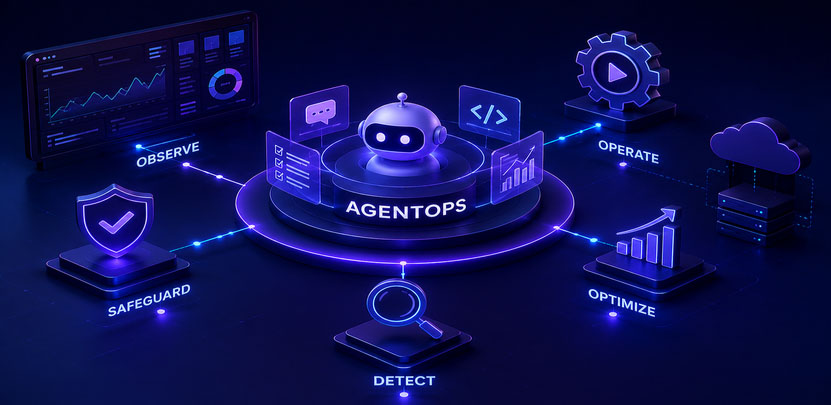
AgentOps provides that discipline by giving organizations the visibility, governance, and continuous oversight needed to operate AI agents in production.
As enterprises expand the use of autonomous AI, AgentOps is becoming a critical capability for maintaining reliability, accountability, and operational confidence at scale.
Production Is Where the Real Work Begins
An AI agent that performs well in testing won’t necessarily behave the same way in production.
Enterprise systems evolve continuously. APIs are updated. Permissions change. New data sources are introduced. Business processes are refined. Each of these changes can influence how an AI agent retrieves information, reasons through tasks, or executes workflows.
Unlike traditional applications that follow predefined logic, AI agents operate in dynamic environments where every interaction can affect future outcomes.
As organizations move from deploying individual AI agents to operating dozens across customer service, healthcare, financial services, retail, and manufacturing, reliability becomes an ongoing responsibility rather than a one-time deployment milestone.
The Operational Questions Enterprises Need to Answer
Once AI agents become part of everyday business operations, organizations begin asking different questions.
- Can every decision be explained?
- If an agent produces an unexpected outcome, can teams identify what information influenced that decision?
- When a workflow fails, can they trace the failure back to a prompt, an external system, or an integration?
- Is the agent consistently delivering the business outcomes it was designed to achieve?
- Who is responsible for reviewing performance as the agent continues learning and interacting with enterprise systems?
Infrastructure monitoring alone cannot answer these questions.
Operating AI agents requires visibility into how they behave, how they make decisions, and how their performance changes over time.
AgentOps Brings Operations Into the AI Lifecycle
Software engineering introduced DevOps to improve software delivery and operations. Machine learning introduced MLOps to manage models throughout their lifecycle.
AI agents introduce a different operational challenge.
Unlike models that generate predictions, AI agents retrieve information, use enterprise tools, coordinate workflows, and complete tasks with varying levels of autonomy. Their success depends not only on model performance but also on how reliably they operate within complex business environments. This is what AgentOps is designed to address.
Rather than treating deployment as the end of development, AgentOps AI establishes a continuous operational framework for observing, evaluating, governing, and improving AI agents throughout their lifecycle.
What Mature AgentOps Looks Like
Organizations don’t build reliable AI operations by responding to failures after they occur. They build them by making operational readiness part of every deployment.
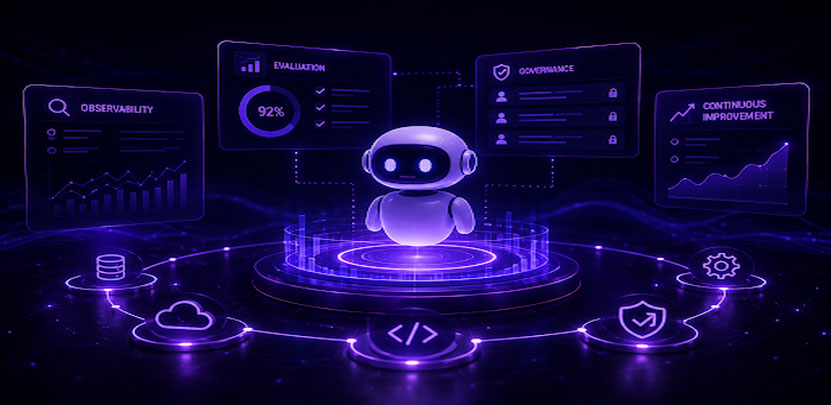
A mature AgentOps development strategy focuses on several key capabilities:
- Observability provides visibility into every significant interaction, including prompts, tool usage, workflows, and enterprise integrations.
- Evaluation measures whether agents continue delivering accurate results and meaningful business outcomes as production environments evolve.
- Governance establishes approval workflows, access controls, audit trails, and operational policies that help AI agents remain aligned with business requirements.
- Continuous improvement uses production insights to refine prompts, orchestration, workflows, and integrations without disrupting business operations.
Together, these capabilities allow organizations to manage AI agents with the same level of discipline applied to other business-critical systems.
Scaling AI Requires Scaling Operations
Managing a small number of AI agents is relatively straightforward. Scaling AI across multiple business functions is different.
Different agents access different enterprise systems, interact with different users, and support different workflows. Without standardized operational processes, maintaining consistency becomes increasingly difficult.
This is why enterprises are adopting AgentOps solutions that provide centralized visibility across production AI environments.
Instead of monitoring individual agents independently, organizations can evaluate operational health, governance, workflow execution, and business performance across their entire AI ecosystem.
Building AgentOps Into Enterprise AI
Organizations that successfully scale AI don’t wait until production issues appear before thinking about operations.
They establish operational expectations from the beginning.
That includes defining measurable success criteria, implementing observability across workflows, introducing governance for high-impact decisions, and continuously evaluating production performance.
These AgentOps best practices help organizations identify issues earlier, improve reliability over time, and create AI systems that can scale alongside the business.
Conclusion
The conversation around enterprise AI is changing.
Success will not be measured by how quickly organizations can build AI agents. It will be measured by how reliably those agents operate once they become part of everyday business processes.
AgentOps provides the operational discipline needed to support that shift. By combining observability, governance, evaluation, and continuous improvement, organizations can operate AI agents with greater confidence while reducing operational risk.
As AI becomes embedded across enterprise workflows, AgentOps will become a foundational capability for building AI systems that remain reliable long after deployment.
FAQs
What is AgentOps?
AgentOps is the discipline of operating, monitoring, governing, and continuously improving AI agents after they are deployed into production.
Why is AgentOps important?
AI agents operate in dynamic environments where data, systems, and business processes constantly change. AgentOps helps organizations maintain reliability, visibility, and governance throughout the AI lifecycle.
How is AgentOps different from MLOps?
MLOps focuses on managing machine learning models. AgentOps extends beyond models to manage autonomous AI agents that reason, interact with enterprise systems, and execute business workflows.
What are AgentOps best practices?
Common AgentOps best practices include implementing observability, continuously evaluating agent performance, establishing governance policies, maintaining audit trails, and using production insights to improve agent behavior over time.
How do AgentOps solutions support enterprise AI?
AgentOps solutions provide centralized visibility into AI agent performance, workflow execution, governance, and operational health, enabling organizations to manage AI agents reliably at enterprise scale.
Why Choose [x]cube LABS?
[x]cube LABS works with enterprise teams to design and deploy AI agents across complex, regulated environments.
We help enterprises become AI-native, not by adding AI on top of existing systems, but by rebuilding the intelligence layer from the ground up. With 950+ products shipped and $5B+ in value created for clients across 15+ industries, here is what we bring to the table:
1. Autonomous AI Agents
We design and deploy agentic AI systems that sense, decide, and act without human bottlenecks, handling complex, multi-step workflows end-to-end with measurable resolution rates and no manual intervention.
2. Enterprise Voice AI
Our voice AI platform, Ello, puts production-ready voice agents in front of your customers in minutes. Zero-latency conversations across 30+ languages, with no call centers and no wait times.
3. AI-Powered Process Automation
We replace manual, error-prone workflows with intelligent automation across invoicing, compliance, customer service, and operations, freeing your teams to focus on work that requires human judgment.
4. Predictive Intelligence and Decision Support
Using machine learning and real-time data pipelines, we build systems that forecast demand, flag risk, optimize inventory, and surface strategic insights before your teams need to ask for them.
5. Connected Products and IoT
We design and build IoT platforms that turn physical devices into intelligent, connected systems with built-in real-time monitoring, remote management, and condition-based automation.
6. Data Engineering and AI Infrastructure
From data lakes and ETL pipelines to AI-ready cloud architecture, we build the foundation that makes everything else possible, scalable, reliable, and designed to grow with your business.
If you are looking to move from AI experimentation to AI-native operations, let’s talk.