
A bank in Dallas has very different AI priorities from a software company building an AI product.
Financial institutions deal with regulated data, high transaction volumes, complex workflows, and decisions where accuracy matters. That makes the question less about whether AI can be used and more about where it can take on meaningful work without compromising control.
That is shaping AI for Financial Services Dallas. Across DFW, banks, wealth managers, insurers, and fintechs have the scale and operational complexity to put AI agents to work across customer service, relationship management, compliance, research, and back-office operations.
The opportunity becomes more tangible when agents are tied to specific work, such as preparing relationship managers for client meetings, reviewing documents for compliance, or handling routine service requests.
Why Dallas Is a Strong Market for Financial AI
Dallas-Fort Worth brings together banks, fintechs, wealth-management firms, insurers, and other financial businesses operating at significant scale. That concentration enables AI applications to support a wide range of enterprise use cases across customer operations, financial research, compliance, risk, and back-office workflows.
The nature of those workflows also makes DFW relevant for AI for Financial Services Dallas. Financial institutions handle large volumes of customer, transaction, market, and regulatory information, yet many processes still require teams to retrieve information, review documents, coordinate across systems, and make decisions within defined controls.
That creates a practical environment for Texas financial services AI, particularly where AI agents can handle multi-step work while keeping a human-in-the-loop for decisions that require judgment or regulatory accountability.

Where AI Agents Are Finding Practical Work
The most useful financial AI deployments tend to sit inside workflows that involve repetitive analysis, information retrieval, or multiple system interactions.
- Customer Service
Deloitte’s 2026 research found that 37% of US banking executives surveyed already use generative AI in contact centers, while another 37% plan to use it in 2026. Their leading expected benefit is higher customer satisfaction and net promoter scores, which 70% of respondents cited.
For banks in Dallas, these capabilities extend well beyond basic chatbots. Agents can retrieve account information, summarize customer histories, route complex requests, and support service teams with relevant information during an interaction.
- Relationship Management
Banking teams spend significant time researching prospects, preparing client information, and following up on opportunities.
McKinsey’s 2025 research involving 406 US and Canadian banking professionals found that 85% were already using AI in some form. The research also identified prospect prioritization, lead nurturing, and contextual outreach as areas where agentic AI can support frontline teams.
For DFW banks and wealth-management firms, this creates a practical use case for agents that prepare relationship managers before meetings and handle routine follow-up work afterward.
- Compliance and Financial Operations
Compliance teams work across large volumes of documents, policies, transactions, and regulatory requirements.
AI agents can assist with research, document review, KYC processes, due diligence, reconciliation, and exception handling, while retaining human approval for higher-risk decisions.
For Texas financial institutions, this is particularly relevant in workflows where reducing manual review can improve efficiency without removing human control over sensitive decisions.
- Research and Investment Intelligence
Financial teams spend significant time collecting market information, reviewing company documents, and preparing research.
AI agents can gather information from approved sources, summarize filings and research, compare relevant data, and prepare first-pass briefs for analysts and relationship teams. Human experts can then focus on interpretation, judgment, and client decisions.
What Makes DFW Fintech AI Different
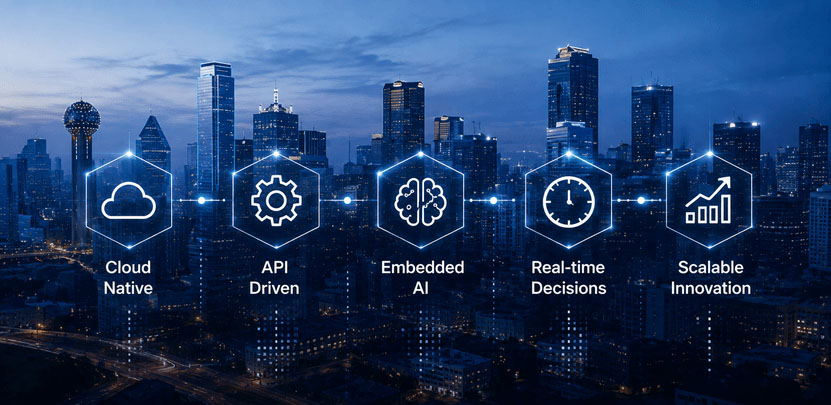
DFW fintechs can have more flexibility in how they introduce AI, particularly when their products and workflows were designed around modern cloud and API-based infrastructure.
That creates room for DFW fintech AI applications built directly into customer-facing products and financial workflows.
Deloitte’s 2026 financial-services research also points toward a larger shift: AI is moving into the architecture of financial products themselves. Its prediction suggests that AI-native products could account for up to 25% of institutional banking revenue among the largest US banks by 2030.
For Dallas fintechs, that opens opportunities to build AI into underwriting, payments, treasury management, financial research, and customer experiences rather than treating it as a separate feature.
The Integration Question Matters
The hardest part of AI for Financial Services Dallas may not be the AI model. It is the environment around it.
Financial institutions need AI agents to work within existing technology stacks, access the right information, respect permissions, and maintain clear records of their actions. An agent that can reason well but cannot safely interact with core banking, CRM, document, or compliance systems has limited operational value.
That makes architecture, data access, security, and governance central to every serious deployment.
Where Dallas Financial Institutions Can Start
A practical AI for Financial Services Dallas strategy starts with workflows where the business outcome can be measured.
Useful starting points include customer service resolution time, research hours saved, onboarding speed, manual review volume, and relationship manager productivity.
McKinsey estimates that agentic AI could reduce banks operating costs by 20% or more, equivalent to 9% to 15% of operating profits, if banks successfully scale the technology across relevant functions.
That gives DFW financial institutions a useful framework for prioritizing AI investments: identify the work, define the measurable outcome, establish the controls, and scale only after the economics are proven.
Conclusion
Dallas is well-positioned for the next phase of financial AI because its institutions already operate the kind of complex, data-intensive workflows that AI agents can take on.
The strongest opportunities will come from specific business outcomes: faster customer service, more productive relationship teams, streamlined compliance, and lower operational effort.
For Texas financial services AI, the next stage will depend on how effectively institutions connect autonomous capabilities with the systems, controls, and workflows already running their businesses.
The opportunity is to make those capabilities part of everyday financial operations, with clear boundaries, measurable outcomes, and human oversight where decisions require it.
FAQs
What is AI for Financial Services Dallas?
AI for Financial Services Dallas refers to the use of AI technologies, including AI agents, across banking, fintech, wealth management, insurance, and other financial operations in the Dallas-Fort Worth market.
How is AI being used in banking in Dallas?
AI in banking Dallas applications include customer service, relationship management, document analysis, compliance support, research, onboarding, and workflow automation.
What are financial AI agents used for in Texas?
Financial AI agents Texas organizations can deploy can handle tasks such as customer service support, KYC research, document review, prospect prioritization, and other multi-step financial workflows under defined controls.
Why is Dallas attractive for financial AI?
Dallas has a large concentration of banks, financial institutions, wealth-management firms, insurers, and fintech companies. That creates strong demand for AI applications that can work within complex enterprise environments.
What should financial institutions consider before deploying AI agents?
Financial institutions should evaluate data access, system integration, security, regulatory requirements, human oversight, and measurable business outcomes before putting agents into production.
Why Choose [x]cube LABS?
[x]cube LABS works with enterprise teams to design and deploy AI agents across complex, regulated environments.
We help enterprises become AI-native, not by adding AI on top of existing systems, but by rebuilding the intelligence layer from the ground up. With 950+ products shipped and $5B+ in value created for clients across 15+ industries, here is what we bring to the table:
1. Autonomous AI Agents
We design and deploy agentic AI systems that sense, decide, and act without human bottlenecks, handling complex, multi-step workflows end-to-end with measurable resolution rates and no manual intervention.
2. Enterprise Voice AI
Our voice AI platform, Ello, puts production-ready voice agents in front of your customers in minutes. Zero-latency conversations across 30+ languages, with no call centers and no wait times.
3. AI-Powered Process Automation
We replace manual, error-prone workflows with intelligent automation across invoicing, compliance, customer service, and operations, freeing your teams to focus on work that requires human judgment.
4. Predictive Intelligence and Decision Support
Using machine learning and real-time data pipelines, we build systems that forecast demand, flag risk, optimize inventory, and surface strategic insights before your teams need to ask for them.
5. Connected Products and IoT
We design and build IoT platforms that turn physical devices into intelligent, connected systems with built-in real-time monitoring, remote management, and condition-based automation.
6. Data Engineering and AI Infrastructure
From data lakes and ETL pipelines to AI-ready cloud architecture, we build the foundation that makes everything else possible, scalable, reliable, and designed to grow with your business.
If you are looking to move from AI experimentation to AI-native operations, let’s talk.