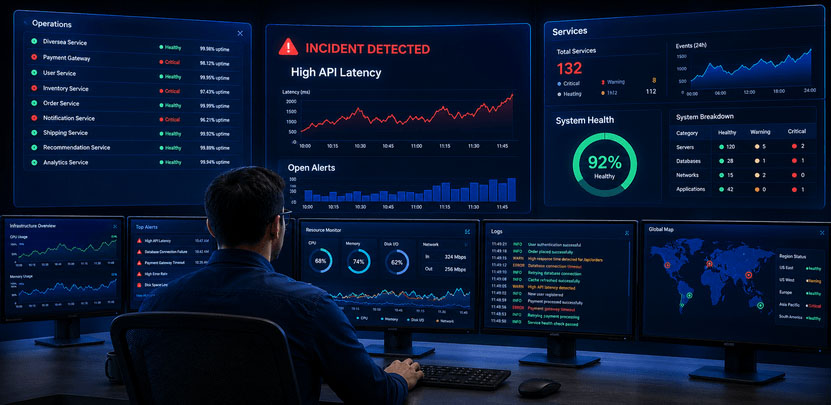
An incident hits production. Alerts start firing, engineers begin investigating, and the usual cycle of finding the cause, choosing a response, and executing a fix begins.
Now imagine an AI agent handling much of that workflow itself. It can investigate the incident, access approved tools, reason across system data, execute a response, and check whether the problem was actually resolved.
That is the core idea behind agentic AIOps: giving autonomous agents the ability to participate in IT operations, not simply observe them.
Gartner predicts that by 2029, 70% of enterprises will use agentic AI to operate IT infrastructure, signaling how quickly autonomous agents are moving into core infrastructure and operations.
What Is Agentic AIOps?
Agentic AIOps combines AIOps capabilities with autonomous AI agents that can pursue defined operational goals through multiple steps.
Traditional AIOps helps teams detect anomalies, correlate events, identify probable causes, and recommend actions. Agentic AIOps adds the ability to act on that information.
Consider an API experiencing high latency. An AIOps system might identify the anomaly and recommend investigating a recent deployment. An autonomous agent can inspect deployment records, query logs and traces, examine dependencies, determine the likely cause, and execute an approved rollback if the evidence supports it.
The defining capability is agency. The system can decide what information it needs, choose among permitted actions, and continue working toward an operational objective.
The Autonomous Agent at the Center
The shift becomes easier to understand when you look at what an agent actually does during an IT workflow.
A typical sequence looks like this:
Observe: Receive signals from monitoring and observability systems.
Investigate: Gather logs, metrics, traces, configuration data, and recent changes.
Reason: Evaluate the available evidence and determine the most likely explanation.
Act: Use approved tools to remediate or initiate another workflow.
Verify: Check whether the action produced the expected result.
Escalate: Hand the issue to an engineer when the situation exceeds its permissions or confidence threshold.
This creates a continuous operational loop. The agent handles defined tasks while people remain responsible for policies, exceptions, and higher-risk decisions. That is what makes AI agents for IT operations different from an AI system that simply summarizes an incident.
AIOps vs Agentic AIOps
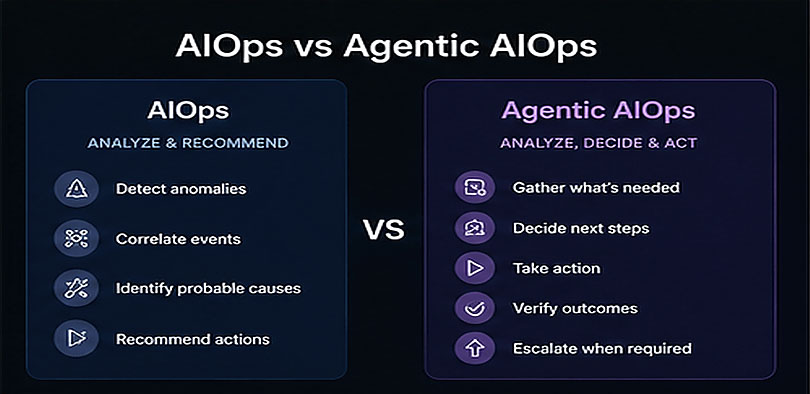
This difference matters most in environments where incidents span multiple systems and require several connected actions.
Where Autonomous Agents Can Take on IT Work
The strongest applications are workflows with clear objectives, repeatable decision patterns, and measurable outcomes.
- Incident Investigation
Agents can gather evidence across monitoring, observability, ITSM, and infrastructure systems before an engineer begins investigating.
Instead of manually assembling context, the agent can identify affected services, recent changes, related incidents, and probable causes.
- Automated Remediation
Known failures can trigger approved actions such as restarting services, scaling resources, clearing queues, or rolling back specific deployments.
The action remains constrained by predefined permissions and escalation rules.
- Change Impact Analysis
Before a release, an agent can examine dependencies, previous incidents, configurations, and historical performance to identify potential risks.
After deployment, it can monitor affected services and investigate unexpected behavior.
Agents can evaluate workload patterns, resource utilization, capacity requirements, and cost signals before recommending or executing infrastructure changes.
This is a practical application of autonomous IT operations, particularly where infrastructure decisions follow measurable patterns.
- IT Service Management
An agent can connect tickets with active incidents, historical problems, and operational telemetry. It can enrich tickets, identify related requests, prioritize work, and route issues based on context.
The Architecture Behind Agentic AIOps
An autonomous agent needs more than a capable model. It needs reliable context and controlled access to the systems it operates on.
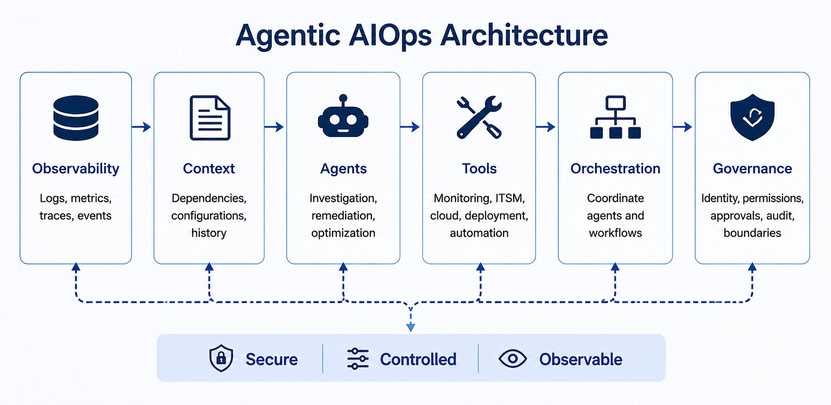
A typical agentic AIOps architecture includes:
Observability: Logs, metrics, traces, events, and infrastructure telemetry.
Context: Service dependencies, configurations, historical incidents, and business impact.
Agents: Specialized agents for investigation, remediation, optimization, and service management.
Tools: Controlled access to monitoring, ITSM, cloud, deployment, and automation systems.
Orchestration: Coordination between agents and operational workflows.
Governance: Identity, permissions, approvals, audit trails, and action boundaries.
Without these controls, autonomous execution can introduce operational risk faster than it removes manual work.
How Far Should Agents Be Allowed to Act?
The goal of agentic AIOps isn’t to give every agent unrestricted access to production.
Autonomy should correspond to risk. A low-impact service restart may be fully automated. A database configuration change may require approval. A security-sensitive action may need escalation to a specialist.
This creates bounded autonomy, where agents can act independently within clearly defined limits.
The same principle applies to self-healing IT systems. An agent should be able to detect a known failure, apply an approved fix, and verify recovery when the workflow is predictable and reversible. More complex situations should remain subject to human intervention.
What Agentic AIOps Platforms Need
As organizations operate multiple agents across different IT functions, managing them individually becomes difficult.
Agentic AIOps platforms need to bring operational data, agents, tools, workflows, and governance into a coordinated environment.
Key capabilities include:
- Cross-domain observability
- Agent orchestration
- Tool and API permissions
- Agent identity management
- Automated remediation
- Action tracing
- Human approval workflows
- Continuous evaluation
- Audit records
Teams should be able to see what an agent did, why it acted, which systems it accessed, and whether the outcome matched expectations.
That visibility becomes critical as the number of autonomous workflows grows.
What Happens to IT Teams?
Autonomous agents don’t remove the need for experienced engineers. They change where that expertise is applied.
Engineers can spend less time collecting evidence, correlating repetitive alerts, and executing standard recovery procedures. They can spend more time designing automation, defining policies, reviewing complex incidents, and improving operational resilience.
The human role moves closer to setting the boundaries within which agents operate.
A Practical Path to Agentic AIOps
Enterprises don’t need to automate their entire IT environment at once.
A strong starting point is a workflow with:
- A defined objective
- Predictable inputs
- Approved tools
- Reversible actions
- Measurable outcomes
- Clear escalation rules
An incident investigation workflow is a useful example. An agent can initially gather evidence and recommend a response. Once its recommendations prove reliable, selected remediation actions can be automated under defined policies.
This creates a controlled path toward greater autonomy without forcing every operational decision into an autonomous workflow.
Conclusion
Agentic AIOps gives IT operations a new operating model in which autonomous agents can investigate problems, reason across operational context, use enterprise tools, execute approved actions, and verify outcomes.
The opportunity lies in applying that autonomy where it can produce measurable value. Organizations that provide agents with the right context, controlled access, clear objectives, and defined escalation paths can automate more of the operational workload without giving up governance.
The result is IT operations that can respond faster, handle more complexity, and allow engineers to focus their expertise where autonomous systems still need human judgment.
FAQs
What is Agentic AIOps?
Agentic AIOps uses autonomous AI agents to investigate IT issues, make decisions, execute approved actions, and verify outcomes.
How does AIOps vs agentic AIOps differ?
Traditional AIOps primarily detects and analyzes problems. Agentic AIOps adds autonomous decision-making and execution within defined boundaries.
What can AI agents for IT operations do?
They can investigate incidents, analyze changes, execute approved remediation, optimize cloud resources, and support IT service workflows.
How do self-healing IT systems work?
They detect problems, determine an approved response, execute the fix, and verify whether the system recovered.
Does Agentic AIOps eliminate IT teams?
No. Engineers remain responsible for governance, complex decisions, policies, and defining where autonomous action is appropriate.
Why Choose [x]cube LABS?
[x]cube LABS works with enterprise teams to design and deploy AI agents across complex, regulated environments.
We help enterprises become AI-native, not by adding AI on top of existing systems, but by rebuilding the intelligence layer from the ground up. With 950+ products shipped and $5B+ in value created for clients across 15+ industries, here is what we bring to the table:
1. Autonomous AI Agents
We design and deploy agentic AI systems that sense, decide, and act without human bottlenecks, handling complex, multi-step workflows end-to-end with measurable resolution rates and no manual intervention.
2. Enterprise Voice AI
Our voice AI platform, Ello, puts production-ready voice agents in front of your customers in minutes. Zero-latency conversations across 30+ languages, with no call centers and no wait times.
3. AI-Powered Process Automation
We replace manual, error-prone workflows with intelligent automation across invoicing, compliance, customer service, and operations, freeing your teams to focus on work that requires human judgment.
4. Predictive Intelligence and Decision Support
Using machine learning and real-time data pipelines, we build systems that forecast demand, flag risk, optimize inventory, and surface strategic insights before your teams need to ask for them.
5. Connected Products and IoT
We design and build IoT platforms that turn physical devices into intelligent, connected systems with built-in real-time monitoring, remote management, and condition-based automation.
6. Data Engineering and AI Infrastructure
From data lakes and ETL pipelines to AI-ready cloud architecture, we build the foundation that makes everything else possible, scalable, reliable, and designed to grow with your business.
If you are looking to move from AI experimentation to AI-native operations, let’s talk.