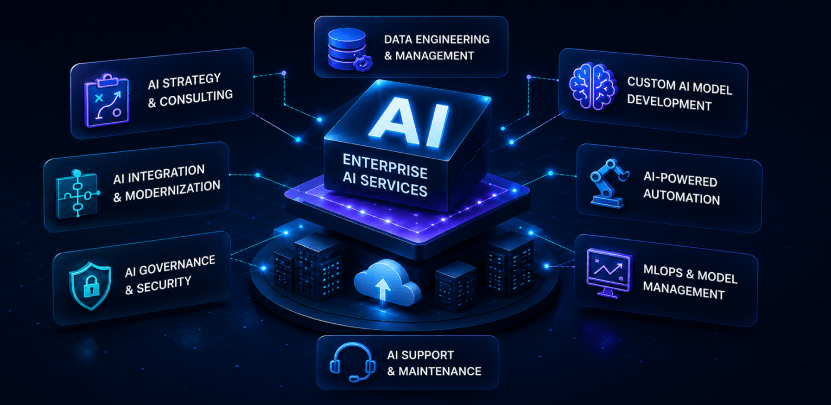
Artificial intelligence has moved far beyond pilot projects and proof-of-concept demos. Today, it sits at the core of how large organizations operate, compete, and grow. This shift has given rise to a specialized category of offerings known as enterprise AI services, the strategies, platforms, and technical capabilities that help businesses embed AI into everyday operations at scale.
If you lead technology, product, or digital transformation at a large organization, understanding enterprise AI services is essential to staying competitive.
This blog breaks down what these services actually involve, why they matter, and how to choose the right partner for your AI journey.
What Are Enterprise AI Services?
Enterprise AI services refer to the full spectrum of consulting, engineering, and managed offerings that help large organizations design, build, deploy, and scale artificial intelligence across their business functions. Unlike consumer-facing AI tools built for a single use case, enterprise AI solutions are engineered for complexity, multiple business units, legacy systems, strict compliance requirements, and massive data volumes.
These services typically span:
- AI strategy and consulting — identifying where AI can create measurable business value
- AI agents and agentic AI development — building autonomous systems that plan, decide, and act
- Generative AI integration — embedding large language models into products and workflows
- AI-native platform engineering — architecting systems built around AI from the ground up, rather than retrofitting it onto legacy infrastructure
- Data engineering and MLOps — the pipelines and infrastructure that keep models accurate and current
- Enterprise automation — using AI to streamline repetitive, high-volume processes
Put simply, enterprise AI services translate the promise of artificial intelligence into working systems that deliver ROI at organizational scale.

Why Enterprises Are Investing in AI Services Now
A few converging forces explain the surge in enterprise AI adoption:
1. Competitive pressure: Rivals across every industry are deploying AI agents, copilots, and automation to cut costs and accelerate decision-making. Standing still carries real risk.
2. Maturity of the technology: Generative AI, agentic AI frameworks, and enterprise-grade large language models have advanced quickly enough to handle production workloads reliably.
3. Talent and infrastructure gaps: Building AI capability in-house demands specialized skills in machine learning engineering, prompt design, and MLOps, skills many enterprises lack internally, making external AI consulting services valuable.
4. Rising customer expectations: Customers increasingly expect instant, intelligent, always-available support, a demand that voice AI agents and conversational AI platforms are built to meet.
Core Categories of Enterprise AI Services
1. AI Agents and Agentic AI
AI agents are software systems capable of perceiving context, reasoning through a problem, and taking action with minimal human intervention. Agentic AI extends this further by chaining multiple decisions and tool calls to complete complex, multi-step workflows. Think of an AI agent that handles an entire customer support ticket end-to-end, or one that autonomously manages inventory replenishment.
Enterprises use AI agents for:
- Customer service and voice-based support
- Sales qualification and lead follow-up
- IT helpdesk automation
- Supply chain and logistics decision-making
2. AI-Native Application Development
Many legacy enterprise systems bolt AI onto existing software as an afterthought. AI-native development flips this approach; applications are architected from the start with AI models, data pipelines, and continuous learning loops at their core. This produces faster performance, better personalization, and systems that improve over time rather than degrade under patchwork integrations.
3. Generative AI Services
Generative AI services cover the design and deployment of large language model applications, chatbots, content generation engines, code assistants, and document intelligence tools. For enterprises, this means fine-tuning models on proprietary data, building retrieval-augmented generation (RAG) pipelines, and ensuring outputs remain accurate and brand-aligned.
4. Live-Ops and Managed AI Services
Live-Ops as a Service covers the ongoing monitoring, retraining, and optimization of AI systems after launch. AI models drift over time as data patterns shift, so enterprises need continuous oversight to maintain high performance. This category includes real-time monitoring dashboards, automated retraining pipelines, and human-in-the-loop quality checks.
5. Data Engineering and MLOps
AI models are only as strong as the data feeding them. Enterprise AI services in this category include building scalable data pipelines, establishing data governance frameworks, and setting up MLOps infrastructure to safely and repeatedly version, test, and deploy models.
6. AI Strategy and Advisory
Before writing a single line of code, experienced AI partners help enterprises map business goals to AI opportunities, assess data readiness, estimate ROI, and build a phased roadmap. This advisory layer prevents costly missteps and keeps AI initiatives tied to measurable outcomes rather than experimentation for its own sake.

Key Benefits of Enterprise AI Services
Operational efficiency: Automation of repetitive, rules-based tasks frees employees to focus on higher-value work.
Faster decision-making: AI agents process and act on data in real time, compressing decision cycles from days to seconds.
Cost reduction: Intelligent automation lowers cost-to-serve across support, operations, and back-office functions.
Improved customer experience: Voice AI agents and conversational interfaces deliver round-the-clock, multilingual support at scale.
Competitive differentiation: Enterprises that embed AI deeply into products and operations build advantages that are difficult for slower-moving competitors to replicate.
Scalability: Cloud-native, AI-native architectures enable organizations to scale AI capabilities across regions and business units without having to rebuild from scratch.
Industries Leading Enterprise AI Adoption
- Banking, financial services, and insurance (BFSI): fraud detection, underwriting automation, and AI-powered customer support
- Retail and ecommerce: personalized recommendations, demand forecasting, and conversational commerce
- Travel and hospitality: Voice AI booking assistants and dynamic pricing engines
- Healthcare: clinical documentation, patient triage, and administrative automation
- Call centers and BPOs: AI-driven call center outsourcing, sentiment analysis, and agent-assist tools
How to Choose the Right Enterprise AI Services Partner
When evaluating vendors, enterprises should look for:
- Proven delivery experience across agentic AI, generative AI, and AI-native architecture
- Deep industry expertise relevant to your sector
- Strong data engineering and MLOps capability, since long-term AI performance depends on it
- A clear approach to governance and security
- Flexible engagement models from strategic advisory to full-scale build-and-manage services
- A track record of measurable business outcomes, rather than AI for its own sake
The Future of Enterprise AI Services
Agentic AI is set to become the dominant paradigm, with autonomous, multi-agent systems handling increasingly complex, cross-functional workflows. AI-native platforms will replace legacy retrofits as the default architecture for new enterprise software. Meanwhile, Live-Ops as a Service will grow in importance as enterprises realize that deploying AI is only the beginning; sustained value comes from continuous monitoring, tuning, and improvement.
Enterprises that treat AI as an ongoing capability, rather than a one-time project, will pull ahead of those that stop at initial deployment.
Enterprise AI Services vs. Off-the-Shelf AI Tools
A common question enterprise leaders raise is whether a ready-made AI tool can substitute for a dedicated enterprise AI services engagement. In most cases, off-the-shelf tools solve a narrow, single-purpose problem a chatbot widget, a writing assistant, a scheduling bot. Enterprise AI services, by contrast, address the harder challenge of integration: connecting AI capability to CRM systems, ERP platforms, proprietary databases, and multi-region compliance requirements, all while maintaining security and governance standards.
Off-the-shelf tools can offer a fast starting point for small teams testing an idea. Enterprises running mission-critical operations, however, generally need custom-engineered AI systems that account for scale, data sensitivity, and long-term maintainability, which is exactly where specialized enterprise AI services partners add value.
Final Thoughts
Enterprise AI services have evolved from experimental technology into a strategic necessity. From AI agents and agentic AI to AI-native architecture and generative AI integration, the opportunities to transform operations, customer experience, and decision-making are substantial, but capturing that value requires the right strategy, engineering expertise, and long-term operational support.
At [x]cube LABS, we partner with enterprises to design, build, and scale AI systems that deliver measurable business outcomes from agentic AI and AI-native product engineering to Live-Ops as a Service and full-scale digital transformation. If your organization is ready to move from AI experimentation to enterprise-grade AI deployment, our team is ready to help you build the roadmap.
FAQ’s
1) What is the difference between enterprise AI services and enterprise AI solutions?
The two terms are often used interchangeably. “Enterprise AI services” typically emphasize the engagement model consulting, development, and managed support. While “enterprise AI solutions” refer to the resulting systems and platforms delivered through that engagement.
2) How long does an enterprise AI implementation take?
Timelines vary widely based on scope. A focused AI agent deployment for a single business function may launch within a few months, while a full AI-native platform transformation across multiple business units can span a year or more, delivered in phased milestones.
3) Do enterprise AI services include ongoing support after deployment?
Yes, in most well-structured engagements. Live-Ops as a Service, model monitoring, and periodic retraining are essential to keeping AI systems accurate as data and business conditions evolve, treating deployment as the starting point rather than the finish line.
4) Which industries benefit most from enterprise AI services?
BFSI, retail, healthcare, travel and hospitality, and call center operations currently show the strongest adoption, though nearly every data-rich industry stands to gain from agentic AI and automation.
5) How should an enterprise measure ROI from AI initiatives?
Strong engagements define success metrics upfront cost-to-serve reduction, resolution time, conversion lift, or employee hours saved, and track them consistently rather than relying on anecdotal impressions of AI performance.
Why Choose [x]cube LABS?
[x]cube LABS works with enterprise teams to design and deploy AI agents across complex, regulated environments.
We help enterprises become AI-native, not by adding AI on top of existing systems, but by rebuilding the intelligence layer from the ground up. With 950+ products shipped and $5B+ in value created for clients across 15+ industries, here is what we bring to the table:
1. Autonomous AI Agents
We design and deploy agentic AI systems that sense, decide, and act without human bottlenecks, handling complex, multi-step workflows end-to-end with measurable resolution rates and no manual intervention.
2. Enterprise Voice AI
Our voice AI platform, Ello, puts production-ready voice agents in front of your customers in minutes. Zero-latency conversations across 30+ languages, with no call centers and no wait times.
3. AI-Powered Process Automation
We replace manual, error-prone workflows with intelligent automation across invoicing, compliance, customer service, and operations, freeing your teams to focus on work that requires human judgment.
4. Predictive Intelligence and Decision Support
Using machine learning and real-time data pipelines, we build systems that forecast demand, flag risk, optimize inventory, and surface strategic insights before your teams need to ask for them.
5. Connected Products and IoT
We design and build IoT platforms that turn physical devices into intelligent, connected systems with built-in real-time monitoring, remote management, and condition-based automation.
6. Data Engineering and AI Infrastructure
From data lakes and ETL pipelines to AI-ready cloud architecture, we build the foundation that makes everything else possible, scalable, reliable, and designed to grow with your business.
If you are looking to move from AI experimentation to AI-native operations, let’s talk.