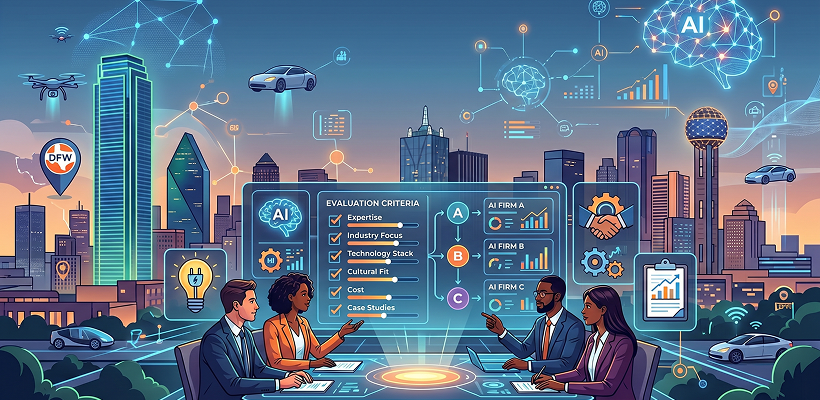
The Dallas-Fort Worth metroplex has quietly established itself as a powerhouse for practical, infrastructure-driven artificial intelligence. Unlike startup-heavy coastal ecosystems that often prioritize theoretical breakthroughs, the corporate landscape in North Texas demands measurable business outcomes. As DFW enterprises seek to transition from isolated pilots to sophisticated multi-agent frameworks, selecting the right partner from the growing pool of AI companies in Dallas has become a critical strategic decision.
The challenge for executive leadership in 2026 is navigating a saturated vendor market. The explosion of interest in autonomous agents and specialized machine learning models has led numerous legacy IT shops and custom software firms to rebrand themselves as specialized consultancies. To protect capital investments and ensure scalable deployment, enterprises must use a structured, rigorous evaluation framework tailored to the unique realities of Texas-scale operations.
The Unique Matrix of the Dallas AI Market
Evaluating a technology partner and AI consulting firms in Dallas requires understanding the local business environment. The DFW region is distinct because its primary economic drivers are deeply rooted in complex, high-velocity, and regulated industries:
- Logistics and Supply Chain: Serving as a primary inland port, the region relies heavily on real-time optimization and anticipatory distribution networks.
- Banking and Financial Services: Major financial institutions require robust security, strict compliance, and instantaneous decisioning layers.
- Healthcare and Life Sciences: Advanced hospital networks demand absolute clinical accuracy, data privacy, and explainable models.
Consequently, when assessing AI companies in Dallas, a generalized approach to software development is insufficient. Enterprises require a consulting partner that possesses both algorithmic expertise and deep operational familiarity with legacy infrastructure integration. The ideal partner must understand how to sit an intelligent orchestration layer directly on top of existing enterprise systems without disrupting core operations.
Key Evaluation Criteria for DFW Enterprise Leaders
To cut through marketing rhetoric, enterprise procurement and technology teams should evaluate prospective firms across five core technical pillars.

1. Agentic Architecture and Multi-Agent Mastery
In 2026, the industry has advanced past simple text-generation plugins. True enterprise value is unlocked through autonomous agents capable of execution, tool use, and multi-step reasoning. Ask prospective consultancies to demonstrate their experience in building multi-agent squads. Top AI companies in Dallas should be able to explain how they orchestrate communication between specialized entities, manage shared semantic memory, and prevent systemic errors like cascading algorithmic feedback loops.
2. Deep Integration Capabilities with Legacy Core Systems
An AI solution is only as valuable as the data it can access. DFW enterprises typically operate on robust, established ERPs, CRMs, and supply chain management systems. Your chosen consulting firm must possess strong data engineering foundations. They should demonstrate a proven track record of building secure, low-latency API pipelines that allow autonomous agents to read from and write to foundational data stores without compromising system stability.
3. Built-In Governance and Explainability Frameworks
In highly regulated sectors, the black-box model is a severe liability. If an AI agent flags a financial transaction or triages a medical case, your organization must be able to audit the precise reasoning path. Evaluate whether the consulting firm builds with Explainable AI frameworks from day one. They must provide clear documentation on how their models justify outputs, how they detect and mitigate algorithmic bias, and how they implement Human-in-the-Loop AI safety hooks for high-risk thresholds.
4. Experience Handling the Sim-to-Real Gap
If your enterprise operations involve physical assets, such as automated fulfillment centers in Fort Worth or connected hardware in Plano, the consulting firm must understand physical AI. Moving intelligence from a digital simulation into the messy physical world requires specialized experience in sensor fusion, tactile telemetry, and real-time world models. Ask for case studies where the firm has successfully bridged this gap, demonstrating fluid, adaptive automation in unpredictable physical environments.
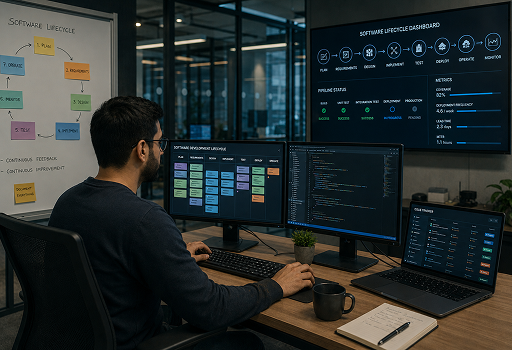
5. Rigorous Lifecycle Management and Sprawl Prevention
An unmanaged AI workforce can quickly lead to compute bloat, spiraling API costs, and security vulnerabilities. A mature consulting firm does not just build and deploy; they deliver an operational framework. Evaluate their strategy for agent lifecycle management. They should provide a centralized agent registry blueprint, clear token-level security scoping, and automated decommissioning protocols to ensure your digital ecosystem remains lean, safe, and cost-effective over time.
Red Flags to Watch Out For During Vendor Selection
During the request for proposal process and evaluation of top artificial intelligence companies in Dallas, look out for indicators that a vendor’s capabilities may not align with enterprise-grade requirements:
- The Single-Model Trap: Avoid firms that attempt to solve every business problem using a single, massive foundational model. Modern enterprise design relies on lean, cost-efficient, and highly specialized multi-agent networks.
- Lack of Data Sovereignty Strategies: If a consultant suggests uploading sensitive corporate data into a public cloud environment without outlining federated learning or advanced localized encryption options, treat it as an immediate security risk.
- Vague ROI Metrics: Specialized firms should speak the language of business metrics, defining success through reduced processing latency, lower error rates, optimized token usage, or quantifiable operational savings, rather than abstract technical performance scores.
Structuring the Partnership for Long-Term Innovation
The final phase of evaluation centers on how the consulting firm structures the engagement. Enterprise digital transformation is an ongoing evolutionary process rather than a one-time deployment.
The right partner will focus heavily on knowledge transfer, training your internal teams to manage, audit, and re-calibrate the agent squads post-deployment. By prioritizing architectural transparency, modular design, and robust governance, a strategic consultant ensures that your AI infrastructure remains a flexible, scalable asset that drives continuous growth.
Conclusion
The selection of an AI consulting partner is an architectural decision that will shape your enterprise’s operational velocity for the next decade. By focusing on multi-agent orchestration, legacy system integration, built-in explainability, and lifecycle governance, DFW technology leaders can confidently separate high-performing engineers from temporary market noise.
Dallas is built on scale, resilience, and operational discipline. Your artificial intelligence infrastructure should reflect those exact qualities, scaling your business safely and intelligently into the future.
FAQ
1. Why should DFW enterprises choose local AI companies in Dallas over coastal firms?
Local consultancies frequently possess a deeper understanding of the specific operational, regulatory, and logistical complexities inherent to major Texas industries like supply chain, energy, and finance, allowing them to deliver highly practical, production-ready solutions.
2. What is the importance of a multi-agent framework in enterprise AI consulting?
A multi-agent framework splits complex business processes into smaller, specialized tasks handled by discrete digital workers. This modular setup delivers much higher accuracy, better cost control, and greater operational flexibility than relying on a single, massive model.
3. How do AI consultants ensure data security during enterprise integration?
Top-tier consultants utilize secure data engineering practices, including identity-linked token scoping, role-based access controls, end-to-end encryption, and federated learning techniques that allow models to train safely without moving data out of protected corporate environments.
4. What role does Explainable AI play in vendor evaluation?
Explainable AI ensures that the consulting firm’s solutions are fully transparent and compliant with corporate governance. It requires the system to provide an auditable, human-readable log explaining exactly why an autonomous agent made a specific decision.
5. How can an enterprise prevent agent sprawl after deployment?
Prevention requires implementing a strict governance framework designed by your consulting partner, which includes a centralized enterprise agent registry, clear lifecycle tracking, and automated decommissioning protocols for temporary digital workers.
What [x]cube LABS Builds
We help enterprises become AI-native; not by adding AI on top of existing systems, but by rebuilding the intelligence layer from the ground up. With 950+ products shipped and $5B+ in value created for clients across 15+ industries, here is what we bring to the table:
1. Autonomous AI Agents
We design and deploy agentic AI systems that sense, decide, and act without human bottlenecks, handling complex, multi-step workflows end-to-end with measurable resolution rates and no manual intervention.
2. Enterprise Voice AI
Our voice platform Ello puts production-ready voice agents in front of your customers in minutes. Zero-latency conversations across 30+ languages, with no call centers and no wait times.
3. AI-Powered Process Automation
We replace manual, error-prone workflows with intelligent automation across invoicing, compliance, customer service, and operations, freeing your teams to focus on work that requires human judgment.
4. Predictive Intelligence and Decision Support
Using machine learning and real-time data pipelines, we build systems that forecast demand, flag risk, optimize inventory, and surface strategic insights before your teams need to ask for them.
5. Connected Products and IoT
We design and build IoT platforms that turn physical devices into intelligent, connected systems with built-in real-time monitoring, remote management, and condition-based automation.
6. Data Engineering and AI Infrastructure
From data lakes and ETL pipelines to AI-ready cloud architecture, we build the foundation that makes everything else possible, scalable, reliable, and designed to grow with your business.
If you are looking to move from AI experimentation to AI-native operations, let’s talk.