
An employee using AI to summarize a report is useful. An AI system connected to a company’s data, applications, workflows, and policies can change how the work itself gets done. That distinction sits at the heart of enterprise AI.
Enterprise AI brings AI into the systems and processes that run a business, giving organizations the ability to analyze proprietary information, automate operational work, support decisions, and increasingly execute tasks through AI agents.
The real challenge is making these systems reliable at scale, which requires more than choosing a capable model. Data, integration, security, governance, evaluation, and business workflows must all work together.
What Is Enterprise AI?
Enterprise AI refers to using AI across business operations, applications, data, and decision-making processes at organizational scale.
That includes traditional machine learning and predictive analytics, generative AI, computer vision, natural language processing, and increasingly agentic systems.
What separates enterprise AI from an individual AI application is the environment it operates in.
An enterprise system may need to work with proprietary data, connect with CRM and ERP platforms, follow security policies, respect user permissions, meet regulatory requirements, and maintain consistent performance across thousands of employees.
The technology therefore becomes part of a larger operating environment rather than functioning as an isolated application.
Enterprise AI vs. Everyday AI Tools
The difference is easiest to see in how the system interacts with the business.
A consumer AI tool might answer a question using information provided in a conversation.
An enterprise AI system may retrieve information from approved internal sources, apply business rules, update an application, generate a recommendation, and record the action for later review.
The underlying model may be similar. The surrounding architecture is very different.
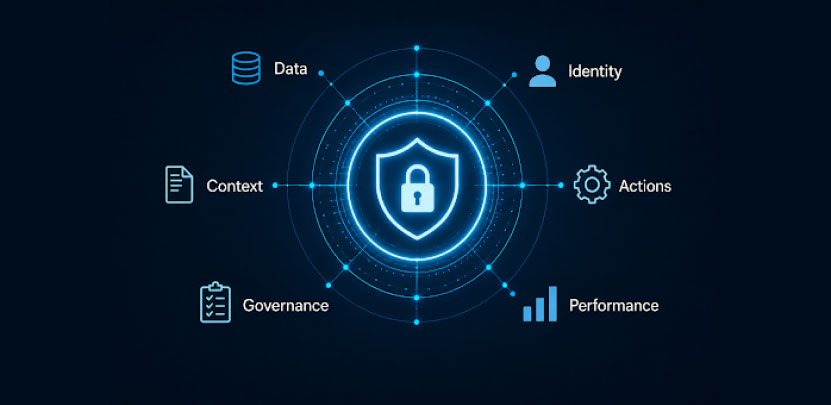
Enterprise deployment requires control over:
- Data: What information can the system access?
- Identity: Who is allowed to use it?
- Context: Which enterprise information should influence its output?
- Actions: What can the system actually change or execute?
- Governance: Which decisions require review or approval?
- Performance: How are accuracy and reliability evaluated over time?
These requirements become even more important when AI moves beyond generating responses and begins executing tasks.
What Makes AI Enterprise-Ready?
Enterprise readiness is less about choosing the most powerful model and more about building the infrastructure around it.
- Connected Data
AI needs access to relevant organizational information without exposing data beyond approved boundaries. Retrieval systems, data platforms, APIs, and knowledge repositories can provide models with current business context.
- Integration With Business Systems
An AI system that cannot interact with the applications where work happens has limited operational reach.
Enterprise deployments increasingly connect AI with CRM, ERP, HR, finance, supply-chain, IT, and customer-service systems.
- Security and Identity
Access should follow the same principle as any other enterprise system: users and AI agents should only receive the permissions required for their role and task.
- Evaluation and Monitoring
Enterprise AI needs continuous evaluation. Teams should track accuracy, latency, cost, reliability, and business outcomes rather than assuming that a model that performed well during a pilot will continue performing well in production.
- Governance
Governance covers data usage, model behavior, compliance, human approval, auditability, and accountability.
These components turn an AI capability into something an organization can operate and manage at scale.
Where Enterprise AI Creates Business Value
The strongest applications are tied to work that has a measurable outcome.
- Customer Operations
AI can summarize customer interactions, support service teams, personalize recommendations, and automate routine requests.
- Knowledge and Research
Enterprise AI can search internal knowledge, analyze documents, summarize large information sets, and provide employees with work-relevant context.
- Software Engineering
AI can assist with code generation, testing, documentation, debugging, and code review while integrating into existing development environments.
- Finance and Risk
Organizations can use AI for forecasting, fraud detection, document analysis, compliance workflows, and risk assessment.
- IT Operations
AI can analyze operational telemetry, investigate incidents, prioritize alerts, and support automated remediation.
- Supply Chain and Operations
Predictive models and AI agents can support demand forecasting, inventory decisions, procurement, logistics, and operational planning.
The common factor is not the AI technology itself. It is the connection between the capability and a business process.
Enterprise AI Adoption Is Moving Into a New Phase
AI adoption is expanding, but adoption alone does not show how deeply it has changed an organization.
Deloitte’s 2026 State of AI in the Enterprise reports that 34% of surveyed organizations are using AI to deeply transform their businesses by creating new products and services or reinventing core processes and business models. Another 30% are redesigning key processes around AI, while 37% are using AI at a more surface level, with little or no change to existing processes.
That gap highlights an important distinction in enterprise AI. Adding AI to an existing workflow can improve productivity, but redesigning the workflow around AI can change how the business operates.
For business and technology leaders, the next question is therefore less about where AI can be added and more about which processes should be rethought around what AI can actually do.
Enterprise AI Trends Shaping the Next Stage
Several enterprise AI trends are changing how organizations approach their AI strategies.
- AI Agents Become Part of Business Workflows
Generative AI started by producing content and answering questions. Agentic systems can plan and execute multi-step tasks across applications.
This expands AI’s role from information support to operational execution.
- AI Moves Closer to Enterprise Data
Organizations are investing in retrieval systems, data platforms, APIs, and knowledge architectures that allow AI systems to work with proprietary information.
The quality of the surrounding data environment increasingly determines the usefulness of the AI application.
- AI Infrastructure Becomes a Strategic Decision
Deloitte’s 2026 AI infrastructure survey found that 86% of surveyed enterprise leaders expect AI infrastructure budgets to increase over the next three years, with average budgets expected to more than triple.
That puts infrastructure, compute, data placement, and cost management firmly on the leadership agenda.
- Governance Moves Into the Architecture
As AI systems gain more access to enterprise data and applications, governance cannot remain a policy document sitting outside the technology stack.
Permissions, evaluation, monitoring, audit trails, and approval mechanisms need to be built into the systems themselves.
What Enterprise AI Adoption Requires
Successful enterprise AI adoption starts with a business problem, not a model.
A practical approach has five stages:
1. Identify the business outcome.
Define what should improve and how you will measure success.
2. Select the workflow.
Choose a process where AI can produce measurable value and where the required data is available.
3. Build the supporting architecture.
Connect the AI system to relevant data, applications, APIs, identity systems, and monitoring tools.
4. Establish operating controls.
Define permissions, evaluation criteria, escalation paths, human approval points, and governance responsibilities.
5. Scale based on evidence.
Expand successful use cases while continuously measuring cost, performance, adoption, and business impact.
This approach also prevents a common enterprise problem: creating multiple disconnected AI experiments that never become part of the operating model.

The Future of Enterprise AI
The future of enterprise AI will be shaped by how deeply AI becomes integrated into the way organizations operate.
Employees will work alongside AI systems that can retrieve information, generate outputs, analyze data, and execute defined tasks. AI agents will coordinate parts of workflows that previously required multiple manual handoffs.
At the same time, the organizations gaining the most value will need stronger foundations around data, identity, security, evaluation, and governance.
The strategic question for business and technology leaders is therefore becoming more specific:
Where can AI change the economics or effectiveness of an important business process, and what infrastructure is required to make that change reliable at scale?
That question provides a much stronger starting point than simply asking where AI can be added.
Conclusion
Enterprise AI is becoming a business capability built across data, applications, workflows, people, and technology infrastructure.
The organizations making meaningful progress are moving beyond isolated AI tools and building systems that can operate within real business environments, with access to relevant information, defined permissions, measurable outcomes, and appropriate governance.
For leaders, the priority is to identify where AI can materially change a business process and then build the technical and organizational foundation around that opportunity.
The scale of AI adoption will continue to grow. The competitive difference will increasingly come from what organizations build with it.
FAQs
What is enterprise AI?
Enterprise AI is the use of AI across business systems, data, workflows, and decision-making processes at organizational scale.
How is enterprise AI different from generative AI?
Generative AI creates content or responses. Enterprise AI refers to how AI is integrated, governed, and operated within a business environment.
What are the main enterprise AI use cases?
Common applications include customer service, knowledge management, software development, finance, IT operations, risk, and supply chain management.
What are the biggest barriers to enterprise AI adoption?
Common barriers include data quality, system integration, security, governance, skills, cost, and difficulty scaling successful pilots.
What are the key enterprise AI trends?
Major trends include agentic AI, deeper integration with proprietary data, AI infrastructure investment, and stronger governance requirements.
What does the future of enterprise AI look like?
AI will increasingly operate inside business workflows, supporting employees, automating tasks, and executing defined processes through increasingly capable AI agents.
Why Choose [x]cube LABS?
[x]cube LABS works with enterprise teams to design and deploy AI agents across complex, regulated environments.
We help enterprises become AI-native, not by adding AI on top of existing systems, but by rebuilding the intelligence layer from the ground up. With 950+ products shipped and $5B+ in value created for clients across 15+ industries, here is what we bring to the table:
1. Autonomous AI Agents
We design and deploy agentic AI systems that sense, decide, and act without human bottlenecks, handling complex, multi-step workflows end-to-end with measurable resolution rates and no manual intervention.
2. Enterprise Voice AI
Our voice AI platform, Ello, puts production-ready voice agents in front of your customers in minutes. Zero-latency conversations across 30+ languages, with no call centers and no wait times.
3. AI-Powered Process Automation
We replace manual, error-prone workflows with intelligent automation across invoicing, compliance, customer service, and operations, freeing your teams to focus on work that requires human judgment.
4. Predictive Intelligence and Decision Support
Using machine learning and real-time data pipelines, we build systems that forecast demand, flag risk, optimize inventory, and surface strategic insights before your teams need to ask for them.
5. Connected Products and IoT
We design and build IoT platforms that turn physical devices into intelligent, connected systems with built-in real-time monitoring, remote management, and condition-based automation.
6. Data Engineering and AI Infrastructure
From data lakes and ETL pipelines to AI-ready cloud architecture, we build the foundation that makes everything else possible, scalable, reliable, and designed to grow with your business.
If you are looking to move from AI experimentation to AI-native operations, let’s talk.