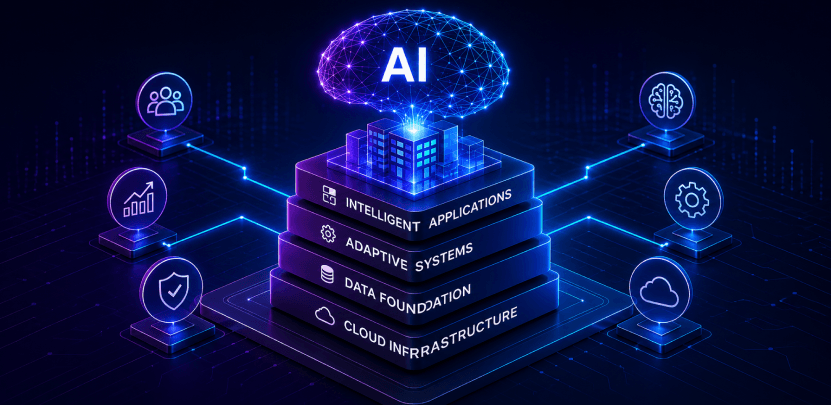
The evolution of enterprise software engineering has reached a critical inflection point. For the past decade, the standard for scalable technology was defined by cloud-native design; microservices, containerization, and elastic resource allocation. By 2026, however, simply being in the cloud is no longer a competitive advantage. The modern enterprise requires systems that do not just store data and run pre-written scripts, but systems that can reason, adapt, and execute multi-step operations autonomously. This shift marks the definitive rise of AI-Native architecture.
Building an enterprise system that thinks requires moving completely past the phase of bolted-on technology. In the early days of adoption, companies focused on creating applications that were AI-enabled; traditional software that made occasional API calls to external models for isolated tasks like summary generation or basic text formatting. An authentic AI-Native architecture completely inverts this paradigm. It treats machine learning models, autonomous agent frameworks, and dynamic data networks as the foundational operating core around which all other systems are organized.
Defining AI-Native Architecture
To architect a system that truly thinks, technology leaders must first understand the fundamental shift in logic. Traditional enterprise software is inherently deterministic. Programmers write precise, rigid rules defining exactly how a system must behave under every possible scenario. If a transaction occurs, then update the ledger; if an email matches a specific keyword, then route it to a specific inbox.
An AI-Native architecture replaces this static logic with probabilistic, model-driven reasoning. In these advanced systems, the software is designed to interpret natural language inputs, analyze complex operational contexts, retrieve relevant historical knowledge, and generate structured decisions dynamically. The system is no longer confined to a pre-programmed path. Instead, it acts as an active participant in business workflows, capable of managing real-world ambiguity and executing tasks without constant human intervention.

The Core Pillars of a System That Thinks
Transitioning to an intelligent enterprise operating model requires a complete redesign of the technology stack. Production-grade systems in 2026 are built across three foundational pillars that handle the flow of data, reasoning, and execution.
1. The Unified Knowledge Fabric
Traditional data architectures are notorious for creating isolated silos; sales metrics live in the CRM, operational logs exist in the ERP, and customer history sits in a separate support database. An AI-Native architecture relies on a shared, real-time data fabric that spans across all departments simultaneously.
This foundation requires extensive investment in GraphRAG (Graph Retrieval-Augmented Generation) and semantic vector pipelines. By mapping corporate information as a network of interconnected entities and ontological concepts, the system provides autonomous agents with deep cross-functional context. A procurement agent navigating a supply shortage can instantly see the marketing department’s active campaigns, the historical reliability metrics of alternative suppliers, and the real-time financial implications of changing an order, enabling highly informed operational decisions.
2. The Multi-Agent Orchestration Layer
In an intelligent enterprise, single-purpose software tools are replaced by coordinated multi-agent ecosystems. The orchestration layer serves as the management hub for this digital workforce, utilizing advanced frameworks to coordinate specialized digital workers.
Instead of trying to build one massive, fragile model to handle an entire department’s operations, developers assemble a crew of lean, highly specialized agents. Each agent is granted specific tool access, a clear operational goal, and distinct behavioral boundaries. The orchestration layer manages state persistence, monitors token efficiency, and structures communication paths between agents, ensuring that a financial auditing agent can seamlessly pass a verified discrepancy to a compliance agent without losing historical context or triggering runaway logic loops.
3. Autonomic Operations and Continuous Learning
Static software behaves exactly the same way regardless of how long it has been running or how much data has passed through it. An AI-Native architecture is built to be self-improving.
By integrating automated feedback loops and runtime telemetry, the system continuously analyzes real-world outcomes to refine its internal models. If a logistics agent notes that its delivery predictions deviate from reality due to seasonal weather shifts, the underlying world model updates its parameters autonomously. Furthermore, these systems utilize zero-touch operations to handle their own optimization, monitoring infrastructure health, managing resource caching, and diagnosing software vulnerabilities without relying on human-directed scripts.
Technical Architecture Comparison
| Architectural Dimension | Traditional / Cloud-Native Stack | AI-Native Architecture |
| Logic Foundation | Deterministic if/then rules | Probabilistic reasoning models |
| Data Interaction | Structured, transactional databases | Multimodal semantic vector fabrics |
| Workflow Execution | Human-initiated, manual operations | Autonomous agentic execution loops |
| System Behavior | Static until manually updated | Continuous self-improvement and learning |
| Security Paradigm | Role-based user access controls | Identity-linked agent token scoping |
Strategic Implementation: Moving From Pilot to Production
Building a system that thinks is an evolutionary engineering process that requires strict discipline across your development and data pipelines.
Structuring Data for Machine Comprehension
Before an enterprise can deploy a multi-agent workforce, its digital estate must be audited for machine readability. This means moving beyond standard data ingestion to create robust API layers and clear metadata schemas. Autonomous agents do not navigate software the way humans do; they require structured endpoints, clean documentation, and well-defined schemas to interact with legacy core systems safely. Your data strategy must prioritize making every corporate repository visible and accessible to the AI orchestration layer.
Embedding Safety by Design and Human Oversight
Total autonomy without strict governance is a massive institutional liability, especially in highly regulated sectors like banking or medicine. A production-ready AI-Native architecture must feature built-in compliance frameworks from day one.
This requires implementing strict token-level security scoping within your Identity and Access Management infrastructure, ensuring that an agent can only access the specific data fields required for its immediate task. Furthermore, engineers must embed explicit intervention triggers that support Human-in-the-Loop AI safety hooks. When an agent reaches a high-value financial threshold or encounters completely unprecedented data anomalies, the system must automatically pause execution, save its state checkpoint, and present a natural language reasoning summary to a human supervisor for final validation.

Conclusion
The transition to an AI-Native architecture marks the maturity of artificial intelligence in the enterprise landscape. We are no longer just building productivity tools that offer suggestions or autocomplete sentences; we are engineering living systems of intelligence that can manage complex business processes end-to-end.
By prioritizing a unified data fabric, mastering multi-agent orchestration, and establishing clear governance guardrails, technology leaders can move past isolated technological experiments to build a resilient, scalable infrastructure. The future belongs to enterprises that can think, learn, and adapt at the speed of algorithms, turning foundational intelligence into a sustainable engine for long-term growth.
FAQ
1. What exactly is an AI-Native Architecture?
An AI-Native architecture is a software system designed from the ground up with artificial intelligence as its core operating layer, replacing traditional, static code patterns with probabilistic reasoning and autonomous agent workflows.
2. How does this differ from standard embedded AI?
Embedded AI adds machine learning capabilities as isolated features or external plugins inside an existing application. An AI-native setup means the entire platform, including its permissions model, data fabric, and execution loops, is structurally designed around AI-driven decision-making.
3. Why are multi-agent frameworks critical to this architecture?
Multi-agent frameworks allow developers to break down massive corporate processes into smaller, specialized tasks managed by discrete digital workers. This modular approach delivers significantly higher accuracy, lowers token compute costs, and provides greater operational flexibility than relying on a single model.
4. How do enterprise systems maintain data privacy in an AI-native setup?
Enterprises secure their networks using advanced engineering practices such as federated learning, data anonymization pipelines, and strict identity-linked token scoping, allowing models to process information safely without exposing sensitive records to external public environments.
5. What are zero-touch operations in intelligent infrastructure?
Zero-touch operations refer to the system’s ability to autonomously handle its own configuration, monitoring, performance optimization, and failure recovery, reducing the need for manual IT intervention and keeping system uptime highly predictable.
For a comprehensive technical blueprint on how enterprise architects are aligning these advanced multi-agent orchestrations with corporate governance and security standards, you can watch this talk on enterprise architecture for the Intelligent Era. This engineering session breaks down agentic workflows, GraphRAG structures, and compliance frameworks, offering practical insight for technology leaders looking to design a robust, scalable system that thinks.
Why Choose [x]cube LABS?
[x]cube LABS works with enterprise teams to design and deploy AI agents across complex, regulated environments.
We help enterprises become AI-native, not by adding AI on top of existing systems, but by rebuilding the intelligence layer from the ground up. With 950+ products shipped and $5B+ in value created for clients across 15+ industries, here is what we bring to the table:
1. Autonomous AI Agents
We design and deploy agentic AI systems that sense, decide, and act without human bottlenecks, handling complex, multi-step workflows end-to-end with measurable resolution rates and no manual intervention.
2. Enterprise Voice AI
Our voice AI platform, Ello, puts production-ready voice agents in front of your customers in minutes. Zero-latency conversations across 30+ languages, with no call centers and no wait times.
3. AI-Powered Process Automation
We replace manual, error-prone workflows with intelligent automation across invoicing, compliance, customer service, and operations, freeing your teams to focus on work that requires human judgment.
4. Predictive Intelligence and Decision Support
Using machine learning and real-time data pipelines, we build systems that forecast demand, flag risk, optimize inventory, and surface strategic insights before your teams need to ask for them.
5. Connected Products and IoT
We design and build IoT platforms that turn physical devices into intelligent, connected systems with built-in real-time monitoring, remote management, and condition-based automation.
6. Data Engineering and AI Infrastructure
From data lakes and ETL pipelines to AI-ready cloud architecture, we build the foundation that makes everything else possible, scalable, reliable, and designed to grow with your business.
If you are looking to move from AI experimentation to AI-native operations, let’s talk.