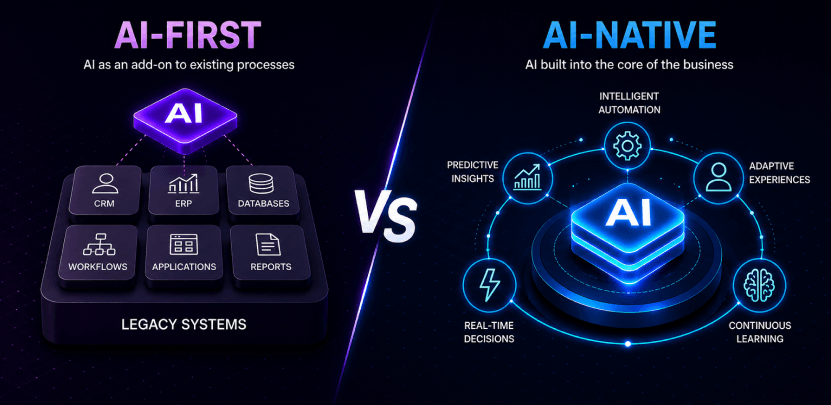
AI adoption has become nearly universal, with 88 percent of organizations using it somewhere in the business, according to McKinsey’s State of AI 2025 survey. Real financial impact has yet to follow at the same pace. MIT’s Project NANDA research found that 95 percent of generative AI deployments had no measurable effect on profit and loss, and McKinsey found that only 5.5 percent of companies see AI meaningfully affect enterprise-wide EBIT. The gap between those numbers is the AI-First vs AI-Native question in miniature.
Most enterprises assume that adopting AI and building around AI amount to the same journey. The data above says otherwise. This blog unpacks AI-First vs AI-Native, explains why the difference matters far more than a semantic argument, and offers a practical framework for deciding where your organization should sit on that spectrum.
AI-First vs AI-Native: The Core Definitions
AI-First describes an organization or product that treats artificial intelligence as a top priority when building new capabilities, features, or workflows. The underlying systems, however, typically predate that priority. AI gets layered into existing software, processes, and organizational structures, enhancing what already exists rather than replacing it.
AI-Native describes a system, product, or organization built from day one around AI as the core architecture. Remove the AI, and the product loses its reason to exist. There is no legacy foundation underneath. Intelligence is baked into the data pipelines, decision logic, and operating model itself.
A simple test many strategists use, sometimes called the removal test, makes the distinction concrete. Take away the AI component from a product. If what remains still functions, just with fewer smart features, you are looking at an AI-First system. If nothing meaningful remains without the AI, you are looking at something AI-Native.

Why the Two Terms Get Confused So Often
Executives, analysts, and vendors use these AI-First and AI-Native labels, and that creates real strategic risk. A company may market itself as AI-Native while running Copilot features bolted onto a decade-old codebase. Another company may quietly build AI-Native infrastructure while calling itself AI-first out of habit.
The confusion matters because each path demands a different level of investment, a different talent strategy, and a different tolerance for organizational disruption. Treating them as synonyms leads leadership teams to underestimate what a true AI-Native transformation actually requires.
How AI-First Strategies Work in Practice
Organizations pursuing an AI-First approach add intelligent features to systems that already serve customers and employees well. Familiar examples include predictive text in an email client, a recommendation engine layered onto an existing ecommerce platform, or an AI assistant embedded inside a legacy CRM.
This approach offers genuine advantages:
- Speed of adoption: Teams add AI capabilities without rearchitecting core systems.
- Lower initial risk: Existing workflows continue to run while new AI features are tested.
- Faster time to value: Early wins build organizational confidence and executive buy-in.
The tradeoff shows up later. Because the underlying architecture remains largely unchanged, AI-First initiatives often plateau. Insights arrive faster, but decisions may still travel through the same manual approval chains and disconnected systems that existed before AI entered the picture. The organization thinks about AI constantly, yet operates no differently.
How AI-Native Systems Work in Practice
AI-Native organizations design their architecture around continuous learning, autonomous agents, and data flows built for intelligence from the start. Instead of asking how AI can improve an existing process, AI-Native teams ask what the process should look like given what AI now makes possible.
This produces structurally different outcomes:
- Autonomous execution: AI agents plan and act across multi-step workflows rather than assisting a human through each step.
- Continuous adaptation: Systems learn from new data and feedback loops in real time, rather than waiting for scheduled updates.
- Redesigned economics: Fewer manual handoffs and coordination layers can lower operating costs meaningfully as scale increases.
The tradeoff here is upfront cost and complexity. AI-Native transformation demands new data infrastructure, new governance models, and often a fundamental redesign of how teams are organized around outcomes.
What the Adoption Gap Actually Reveals
The stats above are worth sitting with for a moment, because they explain exactly why AI-Native thinking is gaining ground among enterprise leaders who have already tried the AI-First route and hit a ceiling.
McKinsey’s research goes a layer deeper than the headline adoption number. Roughly one-third of organizations have progressed beyond pilots into genuine scaled deployment, and the companies seeing real EBIT impact share a common trait. They redesigned workflows end-to-end rather than layering AI onto processes that stayed the same underneath. That single factor, workflow redesign, separates the small group of high performers from the much larger group still stuck in pilot mode.
MIT’s findings point to the same root cause from a different angle. Zero measurable profit-and-loss impact rarely means that the AI models themselves underperform. It usually means the surrounding architecture, governance, and decision pathways never actually changed, so the AI adds visible activity without adding compounding value. Adding AI features to legacy systems produces motion. It fails to guarantee value at scale unless the foundation underneath moves too.
Comparing AI-First and AI-Native Side by Side
| Dimension | AI First | AI Native |
| Foundation | Existing systems and workflows | Built around AI from inception |
| Speed to launch | Fast | Slower, requires redesign |
| Cost profile | Lower upfront investment | Higher upfront, better long-term economics |
| Talent needs | Feature-level AI skills | Deep ML engineering, MLOps, agentic AI expertise |
| Scalability | Often plateaus | Compounds with scale |
| Example | An AI-powered chatbot was added to a legacy website | A voice AI agent platform built entirely around conversational intelligence |
When AI-First Makes Sense
An AI-First strategy is well-suited to organizations that need quick wins, have a limited budget for large-scale rearchitecture, or seek a lower-risk entry point into AI adoption. Enterprises with significant legacy infrastructure, regulatory constraints, or complex multi-decade technology stacks often start here out of practical necessity rather than ambition.
For many companies, AI-First represents a sensible first chapter in a longer AI maturity journey, provided leadership treats it as a starting point rather than a destination.
When AI-Native Makes Sense
AI-Native architecture fits organizations that are building new products, launching new business lines, or navigating a competitive landscape where legacy players are already redesigning their operating models around AI agents. Voice AI platforms, agentic customer engagement tools, and modern SaaS products built in the past two years increasingly launch AI-Native by default, since building on legacy foundations offers little advantage for a brand-new codebase.
Established enterprises can also move toward AI-Native selectively, rebuilding specific high-value workflows such as customer support, underwriting, or supply chain planning around agentic AI, even while other parts of the business remain AI-First for longer.
Why This Distinction Matters for Enterprise Strategy
Choosing between AI-First and AI-Native carries consequences far beyond terminology:
- Budget planning: AI-Native transformation requires sustained multi-year investment, while AI-First initiatives can show results within a single quarter.
- Talent strategy: AI-Native systems demand deep expertise in agentic AI, MLOps, and data engineering, well beyond prompt engineering skills.
- Competitive positioning: Industries where AI-Native challengers are emerging, such as voice AI and customer engagement, face faster disruption than industries where AI still plays a supporting role.
- Governance and risk: AI-Native systems require continuous monitoring and Live-Ops support, since autonomous agents make decisions with far less human review than AI-First tools.
Getting this decision right shapes how quickly an enterprise can respond to market shifts and how defensible its competitive position remains over the coming years.

Building an AI-Native Future, One Step at a Time
At [x]cube LABS, we help enterprises move deliberately along this spectrum, whether that means layering intelligent AI-First capabilities onto existing platforms today or engineering true AI-Native systems, complete with autonomous agents, agentic workflows, and Live-Ops support, for tomorrow. The goal is never to chase a label. It is to build AI capability that compounds in value as your organization scales.
If your team is weighing AI-First versus AI-Native for your next initiative, our engineering and strategy teams can help you map the right path based on your data readiness, industry dynamics, and growth goals.
FAQ’s
1) Is AI-First the same as AI-Native?
The two terms are related but describe different levels of AI maturity. AI-First means AI sits high on the priority list within systems that already existed before AI arrived. AI-Native means AI is the foundation itself, and the product or organization would lose its purpose entirely without it.
2) Can a company move from AI-First to AI-Native over time?
Yes, and this is the common path for most established enterprises. Many organizations begin with an AI-First approach to build early wins and organizational confidence, then gradually redesign specific high-value workflows around AI-Native principles as data infrastructure and governance mature.
3) Which approach delivers a faster return on investment?
AI-First initiatives typically show measurable results sooner, since teams add capability to systems that already work. AI-Native investments take longer to deliver initial value, but tend to compound as the business scales
4) Does AI-Native always mean higher cost?
Upfront costs are higher for AI-Native builds due to the architectural redesign involved. Over a multi-year horizon, though, AI-Native systems can lower operating costs by reducing manual coordination, which often improves the total cost picture compared with maintaining a patchwork of AI-First add-ons.
Why Choose [x]cube LABS?
[x]cube LABS works with enterprise teams to design and deploy AI agents across complex, regulated environments.
We help enterprises become AI-native, not by adding AI on top of existing systems, but by rebuilding the intelligence layer from the ground up. With 950+ products shipped and $5B+ in value created for clients across 15+ industries, here is what we bring to the table:
1. Autonomous AI Agents
We design and deploy agentic AI systems that sense, decide, and act without human bottlenecks, handling complex, multi-step workflows end-to-end with measurable resolution rates and no manual intervention.
2. Enterprise Voice AI
Our voice AI platform, Ello, puts production-ready voice agents in front of your customers in minutes. Zero-latency conversations across 30+ languages, with no call centers and no wait times.
3. AI-Powered Process Automation
We replace manual, error-prone workflows with intelligent automation across invoicing, compliance, customer service, and operations, freeing your teams to focus on work that requires human judgment.
4. Predictive Intelligence and Decision Support
Using machine learning and real-time data pipelines, we build systems that forecast demand, flag risk, optimize inventory, and surface strategic insights before your teams need to ask for them.
5. Connected Products and IoT
We design and build IoT platforms that turn physical devices into intelligent, connected systems with built-in real-time monitoring, remote management, and condition-based automation.
6. Data Engineering and AI Infrastructure
From data lakes and ETL pipelines to AI-ready cloud architecture, we build the foundation that makes everything else possible, scalable, reliable, and designed to grow with your business.
If you are looking to move from AI experimentation to AI-native operations, let’s talk.