Agentic AI data engineering uses autonomous AI systems to manage and optimize data workflows without constant human oversight. These systems understand goals and act independently.
You don’t need to babysit pipelines or fix ETL jobs every time something breaks. The system works toward outcomes on its own.
Why It Matters in 2025
Data volume, velocity, and variety are growing faster than most teams can manage. You’re dealing with real-time data feeds, shifting source formats, API updates, and pressure to deliver insights instantly. But most data workflows still rely on manual patches and rigid scheduling. That gap between speed and stability is killing productivity.
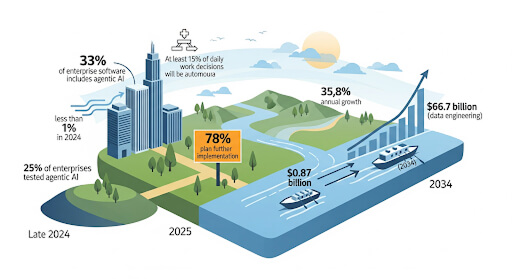
- A study says over 25% of enterprises tested agentic AI in late 2024. By 2025, 78% plan further implementation.
- Gartner predicts that by 2028, 33% of enterprise software will include agentic AI, up from less than 1% in 2024; and by then, at least 15% of daily work decisions will happen autonomously.
- Market growth reflects this shift. The agentic AI in the data engineering market was $0.87 billion in 2024 in the U.S. It’s growing at 35.8% annually and is expected to reach $66.7 billion by 2034.
Agentic AI data engineering matters because it addresses the underlying issues. These systems work continuously, adapt automatically, and reduce your ops burden. In 2025, staying competitive means making your pipelines smarter, faster, and able to recover without human intervention. Agentic AI data engineering doesn’t just keep up—it moves ahead.
You need systems that act, not just notify.
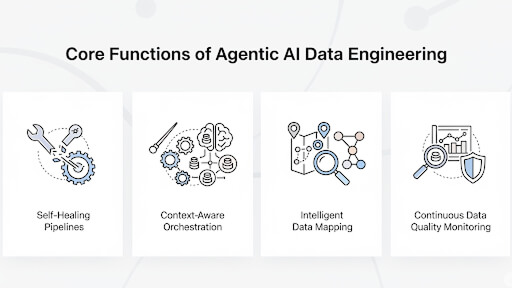
Core Functions of Agentic AI Data Engineering
Self‑Healing Pipelines
The AI monitors pipelines continuously. When source schemas change or jobs fail, the system updates the logic and resumes processing automatically.
For example, a CSV gains a new column. Instead of crashing, the agent modifies the transformation logic and keeps things running.
Context‑Aware Orchestration
Instead of fixed schedules, agentic systems adapt execution based on context.
If a data source is late, pipelines pause or reroute.
If demand spikes, the system scales resources automatically.
You get resilient workflows that don’t rely on perfect timing.
Intelligent Data Mapping
The AI infers schema relationships by studying metadata and content. It suggests or applies mappings without human coding.
That removes hours of manual alignment work and cuts mapping errors to almost zero.
Continuous Data Quality Monitoring
The system defines and enforces quality rules on its own. It catches anomalies, fixes issues, or alerts only when action is needed.
Over time, it learns to reduce false positives and improve precision.
Real‑World Examples
Snowflake + Agentic Workflow Automation
A Fortune 500 retailer once managed 1,200+ pipelines. After adding agentic AI on Snowflake:
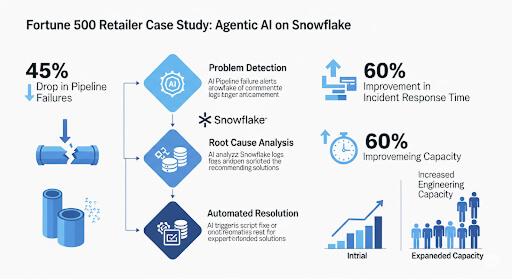
- Pipeline failures dropped by 45%
- Incident response time improved by 60%
- Engineering capacity increased significantly
The AI now detects issues, initiates fixes, and launches jobs when upstream data arrives early.
Airbyte with Self‑Updating Connectors
Airbyte adopters test AI that rewrites connector logic when APIs change. No manual updates. No broken pipelines.
This approach eliminates connector downtime and lets integrations adapt automatically.
Databricks + Agentic Metadata Fixers
Databricks embeds AI agents to monitor metadata drift. When lineage breaks or formats shift, AI either repairs the issue or flags the problem.
This boosts audit readiness and trust in your data maps.
Benefits You Get
Faster Response Times: Your system fixes errors immediately, without waiting for alerts or engineer intervention.
Lower Operational Overhead: You swap firefighting for engineering. Teams focus on delivering improvements instead of fixing issues.
Higher Data Quality: Issues surface in real time, not downstream in reports. That reduces bad analytics and wrong decisions.
Scalable Automation: The system learns from usage. As you onboard more sources, the AI adapts without manual tuning.
Trends & Stats You Should Know
- In 2025, 82% of companies use AI agents in production daily; 53% of those agents handle sensitive data.
- 62% of organizations expect over 100% ROI from agentic AI deployments in early 2025.
- Only 22% of firms are fully ready with clean, unified data needed for AI agents; 78% lack required data readiness.
- 75% of AI initiatives fail to scale due to data variety and integration complexity.
- Agentic AI adoption is growing fast: from under 1% in 2024 to 33% of enterprise software by 2028.
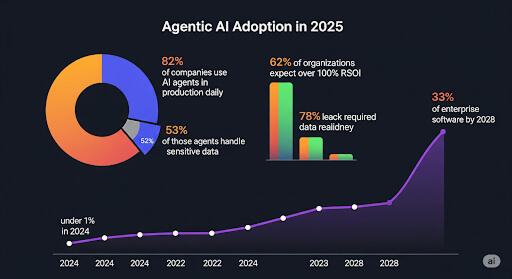
These numbers show the gap between hype and capabilities. Agentic AI data engineering is particularly effective for individuals who prioritize establishing solid data foundations.
How to Begin with Agentic AI Data Engineering
You don’t need to overhaul your stack.
- List your pipelines. Choose ones that fail often or change frequently.
- Add monitoring agents. Tools like OpenLineage, Great Expectations, and Alation’s agent SDK help you add autonomy.
- Start small. Enable schema-change detection, auto‑retries, or adaptive scheduling.
- Expand by trust. Once you see improvements, extend agentic logic to more pipelines.
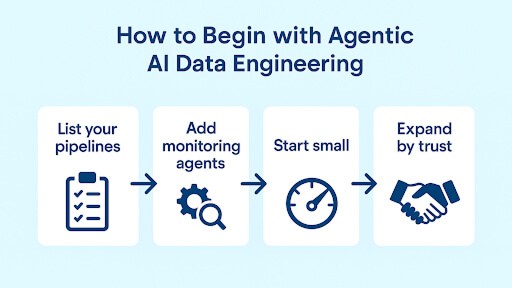
Add agentic AI data engineering one layer at a time. Let it prove itself before wider roll‑out.
Expert Insights
“We don’t need more alerts. We need systems that take action.”
Anjali Rao, VP Data Engineering, StreamLab Analytics
“Agentic AI gives time back to engineers. It handles ops so humans can innovate.”
Kevin Dorsey, CTO, QuantEdge Systems
Final Takeaways
Agentic AI data engineering isn’t just a trend, it’s the real solution to brittle pipelines, constant schema changes, and overloaded teams. It detects and fixes errors automatically, adjusts to new data sources without breaking, and keeps your data clean without manual intervention.
Instead of spending time on routine fixes, your team can focus on building real data products. If you’re ready to stop firefighting and start scaling, agentic AI data engineering is the way forward. Start small, build trust in the system, and expand from there.
FAQs
1. How is agentic AI different from traditional automation?
Traditional automation follows fixed rules. Agentic AI understands goals and makes decisions in real time.
2. Is agentic AI secure?
Yes, if implemented with proper controls. Agents follow strict role-based access and log all actions.
3. Will this replace data engineers?
No. It enhances their work by removing repetitive, low-value tasks.
4. Can I use it with legacy systems?
Yes. Wrappers and APIs allow agentic AI to work with older systems.
5. What skills does my team need?
Familiarity with AI concepts, workflow orchestration tools, and observability platforms helps.
How Can [x]cube LABS Help?
At [x]cube LABS, we craft intelligent AI agents that seamlessly integrate with your systems, enhancing efficiency and innovation:
- Intelligent Virtual Assistants: Deploy AI-driven chatbots and voice assistants for 24/7 personalized customer support, streamlining service and reducing call center volume.
- RPA Agents for Process Automation: Automate repetitive tasks like invoicing and compliance checks, minimizing errors and boosting operational efficiency.
- Predictive Analytics & Decision-Making Agents: Utilize machine learning to forecast demand, optimize inventory, and provide real-time strategic insights.
- Supply Chain & Logistics Multi-Agent Systems: Improve supply chain efficiency through autonomous agents managing inventory and dynamically adapting logistics operations.
- Autonomous Cybersecurity Agents: Enhance security by autonomously detecting anomalies, responding to threats, and enforcing policies in real-time.
- Generative AI & Content Creation Agents: Accelerate content production with AI-generated descriptions, visuals, and code, ensuring brand consistency and scalability.
Integrate our Agentic AI solutions to automate tasks, derive actionable insights, and deliver superior customer experiences effortlessly within your existing workflows.
For more information and to schedule a FREE demo, check out all our ready-to-deploy agents here.