A trading card publisher plans forty drops a year. Each one needs pack odds set, new variant art produced, a promo calendar built, and a lifecycle campaign that keeps collectors spending between events. Hand that to a generalist e-commerce support team, and by the twelfth drop the calendar is winning. This is the problem live-ops solves, and it looks different in sports and collectibles than it does anywhere else.
What LiveOps Means for Sports and Collectibles Brands
LiveOps, short for live operations, is the ongoing work of running a product after launch: pricing and economy decisions, new content and promotions, fan or player engagement, and the data that shows whether any of it is working. In mobile gaming, live-ops usually means limited-time events, battle passes, and A/B-tested offers layered onto a game that already shipped.
Sports and collectibles businesses run on the same operating model, but the unit of work is different. Instead of a game update, it is a card drop, a season launch, a promo tied to a live match, or a new pick’em contest. The economy is a pack, not an in-app purchase. The content calendar tracks a league schedule, not a sprint cycle. And the audience spans season-ticket-level superfans and casual bettors who show up once a month, so the lifecycle strategy has to work for both.

Why the Term Gets Confused
Search “live ops” and the results split into two unrelated categories. One covers contact-center staffing: flexible, on-demand customer service agents who scale up during peak call volume. The other covers game live operations: economy design, content cadence, and player engagement inside a live product.
Sports and collectibles operators need pieces of both, plus something neither category fully covers: a pack or promo economy that behaves like a product, a design pipeline that produces creative at drop-day volume, and a fan lifecycle engine that keeps people engaged between events. Treating live-ops as a staffing problem misses the economy and creative work. Treating it as a pure mobile-game problem misses the licensing calendar, the compliance layer in betting and DFS, and the collector behavior that does not map cleanly onto free-to-play mechanics.
The Five Components Every Sports LiveOps Program Needs
Economy and pricing
Pack odds, rarity tiers, virtual currency balance, and promo pricing determine how much revenue a drop generates and how fair collectors perceive it to be. Get the economy wrong and either the brand leaves money on the table, or players decide the packs are rigged. This needs modeling and testing, not a spreadsheet updated once a quarter.
Drop and content calendar
Sports live-ops runs on external triggers: a season opener, a playoff run, a licensing window, a new set release. The calendar has to absorb those dates without slipping, which means creative production has to scale independently of headcount.
Fan and collector lifecycle
Engagement spikes on event day and falls off afterward. A lifecycle program (segmentation, messaging, loyalty mechanics, win-back campaigns) is what keeps a collector active in the weeks between drops instead of re-acquiring the same person every time a new set launches.
Data and testing
Every pricing change, promo format, and new content type should be tested against a control before it rolls out broadly. Retention, revenue per active user, and sell-through rate are the numbers that show whether a program is compounding or flat.
Delivery and quality control
None of the above matters if the pipeline cannot ship on schedule. That means SLAs from brief to publish, peer review before handoff, and a team structure that scales output without scaling headcount at the same rate.
How LiveOps Differs Across Sports Verticals
Sports streaming and media
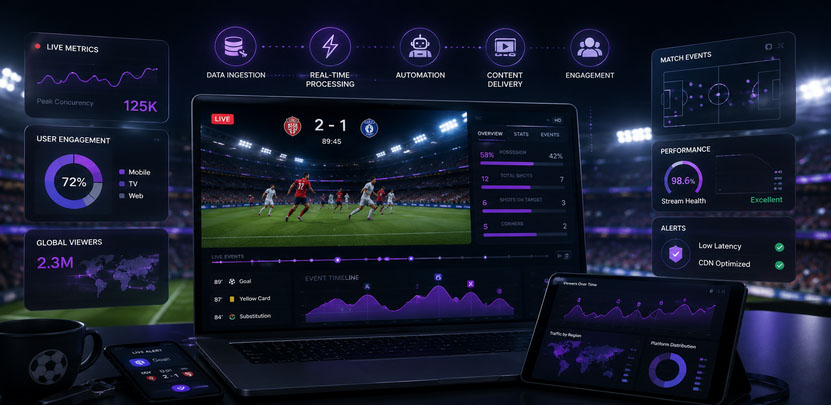
Streaming platforms run live-ops around match schedules, regional rights, and subscriber lifecycle. One global sports streaming platform, for example, operates infrastructure for more than 20 million subscribers across 200+ countries, which means the operations layer has to handle regional content windows, localization, and demand spikes tied to live events rather than a static release calendar.
Trading cards and digital collectibles
This is the purest live-ops-as-economy model: a card publisher’s revenue is a direct function of pack odds, drop frequency, and secondary market health. The sports trading card segment alone is projected to add close to $5.7 billion in value between 2026 and 2030, growing at a 9.4% CAGR, according to Technavio. Blockchain-based platforms add another layer on top of the economy: minting speed, proof-of-authenticity, and marketplace uptime become live-ops metrics alongside pack odds. This work increasingly sits inside broader retail and CPG AI programs rather than a standalone game-ops function.
Sports betting, DFS, and fantasy
The global fantasy sports market is valued at roughly $42 billion in 2026, with the daily fantasy segment growing faster than the category overall. Live-ops here means seasonal promo cadence, gamified loyalty tied to real-game outcomes, and retention work that has to survive the off-season, when engagement naturally drops, and a weaker operator loses the player entirely. This vertical also carries a regulatory layer that most game-focused live-ops playbooks skip: bonus structures, odds boosts, and responsible-gambling messaging are governed state by state in the US, and a promo calendar built without that review baked in creates rework later.
Common LiveOps Mistakes in Sports and Collectibles
Treating every drop like the first one.
Pack odds and promo pricing that worked for a launch set often need retuning by the third or fourth release, once collectors have a baseline for what a fair pull looks like. Teams that never revisit pricing tend to see sell-through slide even as production quality holds steady.
Sizing creative capacity for an average week, not a peak one.
A design team built for normal volume cannot absorb a licensing-driven spike, a playoff run or a new set launch, without slipping the calendar or cutting corners on quality review.
Running lifecycle campaigns off a single segment.
Whale collectors, mid-tier spenders, and at-risk churners respond to different triggers. A loyalty program built around the highest spenders tends to under-serve the mid-tier audience that makes up most of the revenue base.
Skipping compliance review until after the promo is built.
In betting and DFS, folding compliance into the drafting stage costs far less than reworking a promo after legal flags it, and it keeps the calendar on schedule.
The Metrics That Show a LiveOps Program Is Working
Retention is the clearest signal, and the bar is higher than most teams assume. Ampere Analysis found that Fortnite retained 56% of its June players through September, Roblox retained 59% of its console audience over the same window, and Apex Legends held 49%. Sports and collectibles programs should track the same shape of metric: Day-7 and Day-30 retention after a drop, not just launch-day downloads or signups.
Beyond retention, the numbers that matter are revenue per active user during live events versus baseline, sell-through rate against forecast, daily active participation during a seasonal campaign, and cycle time from creative brief to publish. Pack-to-secondary-market price ratio and average revenue per active collector round out the picture: tracking these alongside retention shows whether growth is coming from new collectors or the same collectors spending more, a distinction that changes what the next quarter’s calendar should prioritize. A program that cannot report these numbers monthly is being run on instinct, not data.
Building an In-House LiveOps Team vs. a Managed LiveOps Partner
An in-house team gives full control and institutional knowledge that lives inside the company. It also means hiring five distinct skill sets: economy design, creative production, lifecycle marketing, data analysis, and delivery management, and keeping all five staffed through both peak drop season and the quiet months between.
A managed live-ops partner absorbs that staffing problem and brings a pipeline already tested against other drop calendars. Agentic tooling is part of why that pipeline can scale without a proportional headcount increase, a shift playing out across SaaS-adjacent operations more broadly, not just live-ops. The tradeoff is that institutional knowledge, such as live question logs, platform-specific edge cases, and client cadence rhythms, takes time to build with any partner, in-house or external. The strongest partnerships handle this directly: start with a scoped pilot, prove throughput, then expand into a standing program rather than a full commitment on day one.
How to Evaluate a LiveOps Partner
A few questions separate a partner that runs a program from one that delivers a project. Does the team run economy, creative, and delivery under one roof, or hand off pieces to different vendors? Does pricing and economy design sit inside the engagement, or is that left entirely to the client? Can they show retention and revenue numbers from a comparable program, not just creative samples? And can they start with a fixed-scope pilot so you see throughput before committing to a full program?
FAQ
What is the difference between live-ops and live service?
Live service describes a product built to be updated continuously after launch. Live-ops is the operational discipline (economy, content, lifecycle, and data) that runs inside a live-service product day to day.
Do sports betting and DFS platforms need the same live-ops approach as trading card brands?
The components overlap (economy, calendar, lifecycle, data, delivery), but the specifics differ. Betting and DFS live-ops centers on seasonal promo cadence and compliance-aware messaging, while trading card live-ops centers on pack odds and drop-day creative volume.
What team roles does a sports LiveOps program actually need?
At minimum: an economy or product lead who owns pricing and odds, a design function that can produce creative at drop volume, a lifecycle marketer who runs segmentation and retention campaigns, a data analyst who tests and reports, and a delivery lead who owns cadence and quality control.
How is retention measured in a live-ops program?
The standard measures are Day-7 and Day-30 retention after a drop or event, plus daily active participation during a seasonal campaign. Comparing these across drops shows whether the lifecycle program is compounding engagement or just riding event-day spikes.
Should a growing collectibles brand build live-ops in-house or bring in a managed partner?
It depends on drop volume and calendar predictability. Brands running a handful of releases a year can often manage in-house. Once the calendar hits weekly or biweekly cadence across multiple product lines, staffing and creative throughput usually outpace what an in-house team can sustain without a proportional headcount increase.
How [x]cube LABS Can Help
[x]cube LABS runs managed live-ops pods for trading-card, digital collectibles, and sports and entertainment platforms: an economy lead, design studio, lifecycle marketer, data analyst, and delivery lead operating as one unit against a weekly cadence. One 10-year program with a top-3 global trading-card publisher produced a 650% lift in Day-7 collector retention and 3x weekly revenue during live events. A second program scaled a digital collectibles platform from four apps to seven without missing a release window, processing more than 2,700 tickets and hitting 114% sell-through against target, with more than 31,570 design deliverables shipped in two months using AI-assisted production tooling.
The same pod model runs on Upshot.ai, [x]cube LABS’ engagement and gamification platform, which also powers engagement programs for consumer brands across sports, apparel, and consumer goods. The underlying blockchain work is proven at scale as well: an NFT marketplace built for a leading sports collectibles brand on AWS and Hyperledger Sawtooth cut minting wait times from 24 hours to minutes, a 10x improvement. The same operating discipline applies outside pure collectibles economies as well. [x]cube LABS has also built sports streaming infrastructure supporting more than 20 million subscribers across 200+ countries for a global media platform.