
A retail company spent eleven months building a demand-forecasting model that beat its old system’s error rate by 18 percent. Three weeks after launch, nobody could say whether it still held that accuracy, because no one owned watching it. The same company’s infrastructure team could tell you, within minutes, exactly when a checkout API had a rough stretch last quarter, because that team had spent years building the tooling to catch it.
That gap, between watching infrastructure and models, is where AIOps and MLOps split, and it is where most of the confusion about the two terms comes from.
AIOps applies artificial intelligence to IT operations, ingesting logs, metrics, and traces to detect anomalies, cut alert noise, and automate incident response across infrastructure. MLOps is the discipline for building, deploying, and maintaining machine learning models in production: data versioning, training pipelines, deployment, and drift monitoring. AIOps answers “Is the system up?” MLOps answers “Is the model still right?” Most enterprises running production AI at scale need both, run by different teams, connected at specific points.
What AIOps Actually Does
AIOps (AI for IT Operations) is a monitoring and remediation discipline. It applies machine learning to the flood of operational telemetry that modern infrastructure produces, so that IT and site reliability teams stop drowning in alerts and start catching problems before customers do.
In a working AIOps setup, the system typically handles:
- Anomaly detection: Flagging deviations in latency, error rate, throughput, or resource use against a learned baseline, rather than a fixed threshold that breaks the first time traffic patterns change.
- Alert correlation and noise reduction: Collapsing hundreds of individual alerts from different tools into one incident, so an on-call engineer sees “database connection pool exhausted” instead of forty downstream symptoms.
- Root cause analysis: Tracing an incident back through dependency graphs and change history to the actual trigger, such as a deployment, a config change, or an upstream vendor outage.
- Automated or assisted remediation: Triggering a known runbook (restart a service, roll back a deployment, scale a resource) without waiting for a human to diagnose first.
What MLOps Actually Does
MLOps (Machine Learning Operations) is the set of practices and infrastructure that takes a machine learning model from a data scientist’s notebook to a production system that keeps working after launch day. It borrows the discipline of software CI/CD and applies it to something software engineering was never built to handle: models that degrade on their own, quietly, as the real world drifts away from the data they were trained on.
A functioning MLOps pipeline typically covers:
- Data and feature versioning: Tracking exactly which data and which engineered features produced a given model, so results are reproducible and traceable.
- Training pipeline automation: Retraining models on a schedule or a trigger instead of manually, with experiment tracking so teams can compare runs.
- Model registry and deployment: Version-controlling models the way engineering teams version-control code, and rolling out new versions through staged deployment (shadow, canary, full).
- Drift and performance monitoring: Watching accuracy, precision, recall, or business KPIs in production, not just at training time, because a model can run without errors while getting steadily worse at its job.
- Retraining and rollback triggers: Automatically kicking off retraining, or rolling back to a previous model version, when monitored performance crosses a defined threshold.
AIOps vs MLOps at a Glance
| Primary goal | Keep infrastructure and applications running | Keep machine learning models accurate in production |
| What it monitors | Logs, metrics, traces, infrastructure health | Model inputs, predictions, drift, accuracy metrics |
| Owned by | IT operations, SRE, platform engineering | Data science, ML engineering, applied AI teams |
| Core loop | Detect anomaly → correlate → diagnose → remediate | Train → deploy → monitor → retrain |
| Success metric | MTTD, MTTR, incident volume, uptime | Model accuracy, drift rate, prediction quality, business KPI lift |
| Representative tools | Dynatrace, Datadog, Moogsoft, BigPanda, ServiceNow | MLflow, Kubeflow, SageMaker, Vertex AI, Weights & Biases |
| Fails silently as | A slow memory leak or creeping latency | A model that keeps running but gets steadily less accurate |
Where AIOps and MLOps Actually Overlap
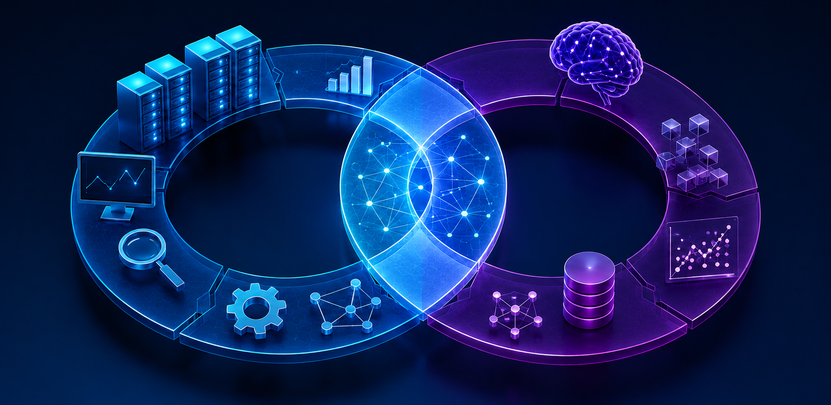
The two disciplines meet at one specific point: an AIOps platform is itself a machine learning system, and an MLOps pipeline runs on infrastructure that needs to stay healthy.
The anomaly-detection model inside an AIOps platform was trained on historical telemetry and can drift when traffic patterns or architecture shift. A team that treats it as “just a monitoring tool” and never re-checks its detection accuracy will eventually get false positives that erode trust in every alert it raises.
The reverse is just as common. A recommendation model can have perfect precision and still fail a customer because the inference service is timing out under load or a downstream API is down. That is an infrastructure problem wearing an ML costume, and it belongs to AIOps applied to the model’s serving layer. This is the seam most comparison articles skip, and where enterprises lose the most time, because the team owning model accuracy and the team owning infrastructure health rarely talk until something breaks between them.
Where LLMOps Fits
A third term shows up in this conversation: LLMOps. It is not a rebrand of MLOps or AIOps. LLMOps addresses what classic MLOps was not built for: prompt versioning, retrieval pipeline management for RAG systems, token cost tracking, hallucination evaluation, and guardrail enforcement.
The practical relationship: LLMOps borrows MLOps’ deployment discipline and adds a layer specific to generative and agentic systems. An enterprise running a customer-facing AI agent needs AIOps for serving infrastructure, MLOps for any classical models feeding that agent (routing, intent classification), and LLMOps for the language model itself. Treating all three as one bucket is how enterprises end up monitoring the wrong thing when an agent misbehaves in production.
Why Enterprises Need Both
The either-or framing is common in vendor content because it is easier to sell one platform than two disciplines. In practice, the decision is not which one to adopt, but how to sequence investment.
If production ML models are running today with no formal drift monitoring, that gap is more urgent, a model silently degrading in a live financial or customer-facing system is a business risk that compounds weekly and is invisible to standard infrastructure dashboards. If infrastructure complexity is scaling and alert fatigue is already causing missed incidents, AIOps pays back faster, because MTTR reduction shows up in the next incident, not the next quarter.
Most mid-size and large enterprises need both within twelve to eighteen months of starting either, because the two failure modes compound: unmonitored drift plus unmanaged alert noise means a degraded model can trigger a wave of downstream errors an overwhelmed on-call team cannot triage, because they cannot tell a model problem from an infrastructure problem.

Conclusion
AIOps and MLOps answer two different questions: is the system up, and is the model still right? Both matter in any enterprise running production AI at scale, and neither team can answer the other’s question well, because the skills and failure signals are different.
The retail company from the opening did not need to choose between watching its infrastructure and watching its models. It needed to build both, sequenced by where the risk actually was. That is the decision in front of most enterprises today, not AIOps or MLOps, but which one to fund first and how soon the second follows.
Why Choose [x]cube LABS?
[x]cube LABS works with enterprise teams to design and deploy AI agents across complex, regulated environments.
We help enterprises become AI-native, not by adding AI on top of existing systems, but by rebuilding the intelligence layer from the ground up. With 950+ products shipped and $5B+ in value created for clients across 15+ industries, here is what we bring to the table:
1. Autonomous AI Agents
We design and deploy agentic AI systems that sense, decide, and act without human bottlenecks, handling complex, multi-step workflows end-to-end with measurable resolution rates and no manual intervention.
2. Enterprise Voice AI
Our voice AI platform, Ello, puts production-ready voice agents in front of your customers in minutes. Zero-latency conversations across 30+ languages, with no call centers and no wait times.
3. AI-Powered Process Automation
We replace manual, error-prone workflows with intelligent automation across invoicing, compliance, customer service, and operations, freeing your teams to focus on work that requires human judgment.
4. Predictive Intelligence and Decision Support
Using machine learning and real-time data pipelines, we build systems that forecast demand, flag risk, optimize inventory, and surface strategic insights before your teams need to ask for them.
5. Connected Products and IoT
We design and build IoT platforms that turn physical devices into intelligent, connected systems with built-in real-time monitoring, remote management, and condition-based automation.
6. Data Engineering and AI Infrastructure
From data lakes and ETL pipelines to AI-ready cloud architecture, we build the foundation that makes everything else possible, scalable, reliable, and designed to grow with your business.
If you are looking to move from AI experimentation to AI-native operations, let’s talk.
FAQ
1. Is AIOps a replacement for MLOps?
No. AIOps monitors infrastructure and applications; MLOps manages the machine learning model lifecycle. They solve different problems, though the tooling can share a platform.
2. Can one team own both AIOps and MLOps?
Yes, particularly in mid-size companies, but the team needs both SRE-style operational skills and ML engineering skills, not one team doing double duty on the assumption that it is all the same job.
3. How does LLMOps change this picture?
LLMOps adds a layer specific to generative and agentic systems, covering prompt management and output evaluation. It sits alongside AIOps and MLOps rather than replacing either.
4. Which should we invest in first: AIOps or MLOps?
It depends on where the current risk sits. If production models run without drift monitoring, start there. If alert fatigue is already causing missed incidents, start with AIOps.
5. What tools support both AIOps and MLOps in one platform?
Very few actually do both well. Some observability platforms are extending into ML monitoring, and some ML platforms are adding infrastructure health checks, but most enterprises still run separate tooling connected through shared dashboards rather than one unified system.