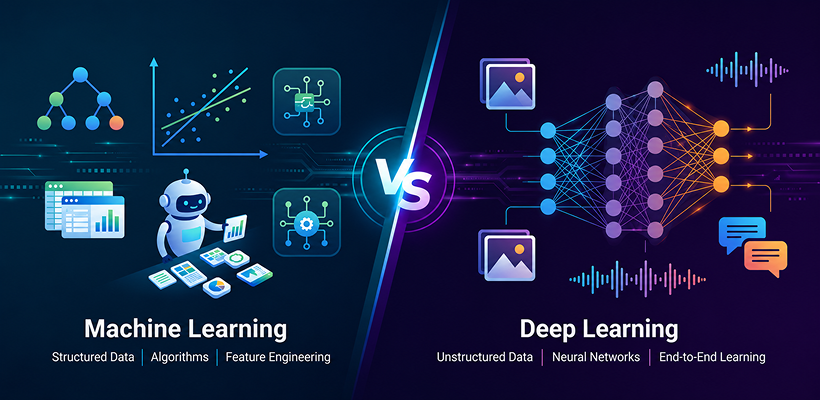
Every week, someone in a boardroom confidently declares their company needs deep learning to solve a problem. Half the time, they’re right. The other half, a well-tuned linear regression model, would have done the job in a fraction of the time, cost, and complexity. This is the central tension at the heart of the machine learning vs. deep learning debate, not which is better, but which is actually right for the task at hand.
This blog gives you a grounded, practical understanding of both approaches. By the end, you’ll know exactly when to reach for classic machine learning, when deep learning is worth the investment, and how to make that call without second-guessing yourself.
Understanding the AI Hierarchy
Before diving into the technical nuances, let’s clarify how these technologies relate to one another.
- Artificial Intelligence (AI): The broadest umbrella term. It refers to any technique that enables computers to mimic human intelligence, including logic, if-then rules, and decision trees.
- Machine Learning (ML): A subset of artificial intelligence. Instead of manually coding rules, machine learning uses algorithms to parse data, learn from it, and make informed decisions or predictions.
- Deep Learning (DL): A specialized subset of machine learning. It relies on multi-layered artificial neural networks to mimic the human brain’s structure and solve highly complex, unstructured problems.
The Golden Rule: All deep learning is machine learning, but not all machine learning is deep learning.
What Is Machine Learning?
Machine learning (ML) is a collection of algorithms that learn patterns from structured data and make predictions or decisions without being explicitly programmed to do so. At its core, the idea is elegantly simple: feed the system labeled examples, and it figures out the rules on its own.
Traditional ML algorithms include:
- Linear and Logistic Regression
- Decision Trees and Random Forests
- Support Vector Machines (SVM)
- Gradient Boosting (XGBoost, LightGBM)
- K-Nearest Neighbors and Naive Bayes

These models tend to work exceptionally well on structured, tabular data such as spreadsheets, databases, financial records, and sensor logs. They’re fast to train, relatively interpretable, and don’t require enormous computational resources. You can run a solid random forest model on a laptop.
One of the most underrated advantages of traditional machine learning is interpretability. When a loan application is rejected by a decision tree model, you can trace the exact path the model took. When a neural network makes the same decision, explaining why becomes significantly harder, a challenge that has real regulatory and ethical implications.
What Is Deep Learning?
Deep learning is a specialized branch of machine learning that uses artificial neural networks with many layers, hence “deep”, to learn hierarchical representations of data. Inspired loosely by the structure of the human brain, these networks comprise millions or billions of parameters that are adjusted during training via a process called backpropagation.
The key architectures that have defined the deep learning era include:
- Convolutional Neural Networks (CNNs) — for image recognition and computer vision
- Recurrent Neural Networks (RNNs) and LSTMs — for sequential data and time series
- Transformers — for natural language processing, powering tools like GPT and BERT
- Generative Adversarial Networks (GANs) — for image synthesis and data generation
- Diffusion Models — for high-quality image and audio generation

What makes deep learning genuinely revolutionary is its ability to perform automatic feature engineering. Classic machine learning requires a human expert to decide which features (variables) to feed into the model. A deep neural network, given enough data and compute, can discover those features on its own, including ones no human would have thought to look for.
This is why deep learning dominates in domains like computer vision, speech recognition, and natural language understanding, fields where the raw input (pixels, audio waveforms, raw text) contains enormous amounts of information that’s extraordinarily difficult to manually engineer into clean features.
Machine Learning vs. Deep Learning: A Direct Comparison
| Feature | Machine Learning (Traditional) | Deep Learning |
| Data Requirements | Performs well on small to medium datasets (thousands of records). | Requires massive datasets (millions of data points) to be effective. |
| Data Type | Prefers structured data (tables, numbers, spreadsheets). | Excels at unstructured data (images, video, audio, raw text). |
| Human Intervention | Requires extensive manual feature engineering by data scientists. | Automatically learns features from raw data. |
| Training Time | Quick to train (minutes to a few hours on a standard CPU). | Lengthy training process (days to weeks on expensive GPUs). |
| Hardware Dependencies | Can run efficiently on standard, consumer-grade computers. | Requires specialized hardware (GPUs, TPUs, high-VRAM clusters). |
| Interpretability / Explainability | High (“White-box” models where decisions can be mathematically traced). | Low (“Black-box” models where internal logic is incredibly complex). |
When to Choose Machine Learning
For the vast majority of day-to-day business problems, machine learning remains the superior, more practical choice.
Ideal Scenarios for Machine Learning:
- Your data lives in spreadsheets and databases: If your data is structured, neatly tabular, and organized by columns and rows, traditional ML models will almost always be faster and more cost-effective.
- You have limited data: If your dataset consists of thousands of entries rather than hundreds of thousands, ML algorithms will yield more stable, reliable results.
- You are on a budget: If you cannot afford expensive GPU cloud instances or a massive team of specialized deep learning researchers, ML allows you to build working solutions rapidly using existing development staff.
- You need quick deployment: Because training takes minutes rather than days, you can rapidly prototype, test, and iterate on ML models.
When to Choose Deep Learning
Deep learning shines at complex, human-like tasks involving sensory perception, natural language, or highly intricate patterns that humans cannot easily quantify.
Ideal Scenarios for Deep Learning:
- You are dealing with unstructured data: If your primary inputs are video feeds, images, audio files, or massive corpora of unformatted text, deep learning is practically a necessity.
- You need to solve high-dimensional problems: Tasks like real-time language translation or autonomous driving involve too many moving parts and shifting variables for traditional feature engineering to keep up.
- You have access to massive data and compute infrastructure: If your organization sits on a mountain of data and has the budget to provision high-performance computing clusters, DL can unlock capabilities that feel like magic.
A Framework for Decision Making
If you are looking at a project proposal right now, apply this 4-step framework to determine whether to invest in machine learning or deep learning.
Step 1: Evaluate Your Data Asset
Look closely at what data you have available right now. Is it clean, tabular, and manageable? Choose machine learning. Is it a massive pile of raw video, text documents, or unorganized audio files? Choose deep learning.
Step 2: Define Your Accuracy and Risk Tolerance
Does a mistake cost a human life or a multi-million dollar regulatory fine? If so, can you afford to use a “black box”? If strict auditability and explainability are required by law or safety standards, default to machine learning unless you have specialized tools to monitor and interpret neural networks.
Step 3: Assess Available Resources
Calculate your total cost of ownership (TCO). Do you have the budget for data labeling services, cloud GPU architectures, and specialized AI engineers? If your resources are lean, start with a classic machine learning approach. It is always better to have a highly optimized random forest model in production than a half-baked, under-resourced neural network sitting in a sandbox.
Step 4: Start Small (The Hybrid/Evolutionary Approach)
You don’t have to pick a side and stay there forever. The smartest engineering teams often start with a simple machine learning model to establish a performance baseline. Once the baseline is established, if data volumes grow significantly over time, gradually introduce deep learning components to determine whether the marginal increase in accuracy justifies the added complexity and cost.
Final Thoughts
The machine learning vs. deep learning debate is, at its heart, a false dichotomy. They are complementary tools, each with distinct strengths, limitations, and ideal use cases. The most dangerous path is defaulting to deep learning because it sounds more impressive, or dismissing it because it sounds complicated.
Ask the right questions first: How much data do you have? Does your input data have spatial or sequential structure? Do you need to explain your model’s decisions? What are your compute constraints? Answer those honestly, and the right approach becomes much clearer.
The smartest AI practitioners aren’t the ones who always use the fanciest models, they’re the ones who know exactly which tool to pick up and when to put it down. Master that judgment, and you’ll consistently build systems that are faster, more cost-effective, and more aligned with what your stakeholders actually need.
FAQs
1. What is the main difference between Machine Learning and Deep Learning?
Machine learning uses algorithms to learn patterns from structured data, guided by human-engineered features. Deep learning is a subset of ML that uses multi-layered neural networks to automatically extract features from raw, unstructured data like images, audio, and text.
2. Do I need a lot of data to use Deep Learning?
Yes, deep learning models typically require tens of thousands to millions of labeled samples to perform well. With limited data, traditional machine learning algorithms like Random Forest or XGBoost will almost always deliver better results.
3. Is Deep Learning always better than Machine Learning?
Not at all. For structured, tabular datasets, classical ML models frequently outperform deep learning while being faster and cheaper to train. Deep learning only has a clear edge when dealing with unstructured data or very large datasets.
4. What is transfer learning, and how does it relate to Deep Learning?
Transfer learning allows you to take a pre-trained deep learning model (like BERT or ResNet) and fine-tune it on your smaller dataset. It dramatically lowers the data and compute barrier, making deep learning accessible even when you don’t have millions of training samples.
What [x]cube LABS Builds
We help enterprises become AI-native; not by adding AI on top of existing systems, but by rebuilding the intelligence layer from the ground up. With 950+ products shipped and $5B+ in value created for clients across 15+ industries, here is what we bring to the table:
1. Autonomous AI Agents
We design and deploy agentic AI systems that sense, decide, and act without human bottlenecks, handling complex, multi-step workflows end-to-end with measurable resolution rates and no manual intervention.
2. Enterprise Voice AI
Our voice platform Ello puts production-ready voice agents in front of your customers in minutes. Zero-latency conversations across 30+ languages, with no call centers and no wait times.
3. AI-Powered Process Automation
We replace manual, error-prone workflows with intelligent automation across invoicing, compliance, customer service, and operations, freeing your teams to focus on work that requires human judgment.
4. Predictive Intelligence and Decision Support
Using machine learning and real-time data pipelines, we build systems that forecast demand, flag risk, optimize inventory, and surface strategic insights before your teams need to ask for them.
5. Connected Products and IoT
We design and build IoT platforms that turn physical devices into intelligent, connected systems with built-in real-time monitoring, remote management, and condition-based automation.
6. Data Engineering and AI Infrastructure
From data lakes and ETL pipelines to AI-ready cloud architecture, we build the foundation that makes everything else possible, scalable, reliable, and designed to grow with your business.
If you are looking to move from AI experimentation to AI-native operations, let’s talk.