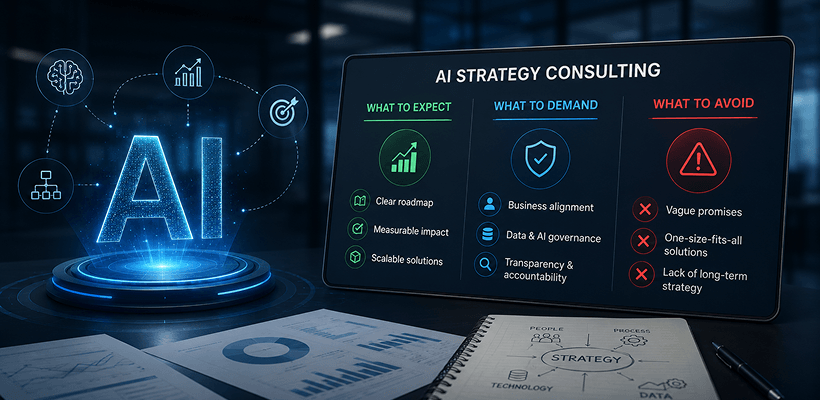
In 2026, the corporate landscape has transitioned from a state of cautious curiosity about artificial intelligence to a state of rapid execution. Organizations are no longer wondering if they should integrate AI; instead, they are actively deploying multi-agent systems, establishing enterprise agent registries, and rewriting their core operational playbooks. This massive wave of implementation has turned AI strategy consulting into one of the most critical advisory sectors in the world.
However, because the market has matured so quickly, the gap between high-value strategic guidance and generic, copy-paste advice has widened significantly. For enterprise leaders looking to chart a course for the next three to five years, navigating a consulting engagement requires a clear, uncompromising framework. To protect your capital investments and secure a true competitive advantage, you must know exactly what a modern advisory firm should deliver, what deliverables to demand, and what structural red flags to avoid.

What to Expect: The Realities of a Modern Engagement
A mature advisory engagement in 2026 looks vastly different than the basic “technology roadmaps” of a few years ago. When partnering with a reputable consultancy, your leadership team should expect a deeply analytical, multidisciplinary process that bridges corporate strategy with advanced computer science.
Comprehensive Workflow Discovery and Agent Mapping
An AI strategy cannot be built in a vacuum; it must be grounded in the granular reality of your daily business operations. Expect the consulting team to embed themselves within your business units to conduct comprehensive workflow discovery. They should analyze your processes to identify high-volume, repetitive tasks that are ripe for automation, mapping exactly where specialized agent squads can be deployed to reduce processing latency and operational overhead.
Technical Debt and Infrastructure Audits
An intelligent system is only as good as the infrastructure supporting it. A strategic consultancy will dedicate significant time to auditing your current technology stack. They will evaluate your data engineering pipelines, cloud architecture, and legacy core systems to determine whether your enterprise is ready to support real-time data streaming, vector database integrations, and complex multi-agent orchestration without disrupting daily operations.
Total Cost of Ownership (TCO) Projections
AI infrastructure comes with unique financial realities, specifically regarding token consumption and model training costs. Your consulting partner should provide detailed financial models that outline the long-term TCO of your proposed AI ecosystem. This includes projecting API compute expenses, forecasting the operational savings generated by a digital workforce, and calculating a definitive timeline for your return on investment.
What to Demand: Non-Negotiable Enterprise Deliverables
To ensure your strategic partnership yields actionable value rather than theoretical slide decks, you must demand a specific set of highly technical, production-ready deliverables.
1. A Modular, Multi-Agent Architecture Blueprint
Do not settle for a high-level conceptual diagram. Demand a detailed, modular architectural blueprint that specifies how your future AI systems will be structured. The documentation should define the exact role, goal, and tool boundaries for individual autonomous agents, while clearly outlining the orchestration layer and the semantic memory frameworks required to coordinate their work.
2. A Strict AI Governance and Ethical Guardrail Framework
Total autonomy without strict control is a massive institutional liability. You must demand a comprehensive governance framework that outlines how your organization will manage digital workers. This must include explicit blueprints for an enterprise agent registry, clear token-level security scoping, and detailed intervention triggers defining exactly when an agent must pause and seek human authorization via a Human-in-the-Loop AI interface.

3. An Extensible Data Strategy and Compliance Roadmap
Data is the lifeblood of artificial intelligence. Your consultants must deliver a rigorous data strategy that outlines how your corporate information will be securely ingested, cleaned, and vectorized. Furthermore, given the strict global regulatory landscape, the deliverable must include a compliance roadmap mapping your data pipelines to major frameworks like the EU AI Act, ensuring absolute privacy, data sovereignty, and auditable transparency through Explainable AI methodologies.
Technical Performance Matrix: Evaluating Strategic Options
| Strategic Component | The Baseline Standard | What True Leaders Deliver |
| Model Strategy | Recommending a single foundational LLM | Designing custom, hybrid multi-model routers |
| Workflow Focus | Identifying isolated user tasks for automation | Architecting end-to-end autonomous business pipelines |
| Data Architecture | Standard centralized data lake recommendations | Implementing federated learning and real-time vector pipelines |
| Security Blueprint | Basic API authentication protocols | Identity-linked token scoping and sandboxed execution loops |
| Human Interface | Simple post-facto review dashboards | Stateful checkpointing for real-time human intervention |
What to Avoid: Critical Red Flags in Vendor Selection
As you evaluate prospective firms, look out for key indicators that a consultancy may be relying on outdated methodologies or surface-level marketing fluff.
- The Single-Vendor Monopolization: Avoid consultancies that attempt to lock your enterprise into a single foundational model provider or a specific closed-source software platform. Modern enterprise strategy requires absolute flexibility, utilizing open-source frameworks and multi-model routing to prevent vendor lock-in and optimize token costs.
- Vague, Non-Quantifiable ROI Metrics: If an advisory firm pitches its strategy using abstract concepts like “enhanced employee synergy” or “digital-first optimization” without pinning success to hard operational metrics, treat it as an immediate red flag. True strategists define milestones through reduced transaction latency, lower error rates, or quantifiable compute efficiency gains.
- Ignoring the Change Management Lifecycle: Technology is only half the battle; culture is the driver. Avoid firms that deliver a technical roadmap without a dedicated strategy for human change management. If your frontline staff views autonomous agents as a threat rather than a tool to supercharge their capabilities, adoption will stall, and your investment will fail.
Structuring the Engagement for Sustainable Growth
The final measure of a successful AI strategy consulting partnership is how the consultancy prepares your organization for self-sufficiency. Enterprise digital transformation is not a static project with a fixed endpoint; it is an ongoing evolutionary process.
The ideal advisory firm will focus heavily on knowledge transfer. They will work alongside your leadership to establish an internal AI Center of Excellence (CoE), training your technical and operational teams to manage, audit, and recalibrate your autonomous agent workforce long after the initial consulting engagement concludes. This ensures that your intelligent infrastructure remains a lean, highly secure, and continuously evolving asset that drives long-term market dominance.
Conclusion
Navigating the landscape of AI strategy consulting requires moving past market hype and demanding absolute technical accountability. By aligning your engagements around rigorous workflow discovery, detailed architectural blueprints, strict governance frameworks, and clear, quantifiable metrics, enterprise leaders can confidently separate world-class engineering strategists from temporary market noise.
The organizations that establish clear, structured, and ethically grounded AI roadmaps today are the ones that will define the operational pace of their industries tomorrow. Step into the next era of automation with absolute clarity, absolute control, and a strategy built to scale.
FAQ
1. What should be the primary focus of an enterprise AI strategy?
The primary focus should be on building a unified, scalable infrastructure that supports modular, multi-agent workflows across your core business lines, rather than creating isolated, single-purpose tools that create data silos and integration issues.
2. How do consulting firms calculate the ROI of an AI deployment?
Firms calculate ROI by quantifying reductions in operational processing hours, mitigation of costly human errors, optimization of computing token expenses, and creation of new high-margin revenue streams, such as internal Retail Media Networks or automated content delivery systems.
3. What is the role of an AI Center of Excellence (CoE)?
An AI Center of Excellence is a centralized internal department tasked with governing your enterprise’s AI initiatives. It establishes development standards, maintains the corporate agent registry, manages token-level security scoping, and ensures ongoing regulatory compliance across all business units.
4. How does Explainable AI impact corporate strategy?
Explainable AI is a critical regulatory and operational requirement. It ensures that every decision made by an autonomous agent—such as a credit score adjustment or a logistics reroute—is backed by a human-readable log explaining the exact logic used, protecting the organization from compliance risks and legal liabilities.
5. Why is vendor lock-in a significant risk in AI consulting?
Relying on a single proprietary model or platform leaves your enterprise vulnerable to sudden pricing changes, API deprecations, or performance shifts. A robust strategy uses extensible frameworks and open-source models, allowing you to swap underlying technologies as the market evolves.
Why Choose [x]cube LABS?
[x]cube LABS works with enterprise teams to design and deploy AI agents across complex, regulated environments.
We help enterprises become AI-native, not by adding AI on top of existing systems, but by rebuilding the intelligence layer from the ground up. With 950+ products shipped and $5B+ in value created for clients across 15+ industries, here is what we bring to the table:
1. Autonomous AI Agents
We design and deploy agentic AI systems that sense, decide, and act without human bottlenecks, handling complex, multi-step workflows end-to-end with measurable resolution rates and no manual intervention.
2. Enterprise Voice AI
Our voice AI platform, Ello, puts production-ready voice agents in front of your customers in minutes. Zero-latency conversations across 30+ languages, with no call centers and no wait times.
3. AI-Powered Process Automation
We replace manual, error-prone workflows with intelligent automation across invoicing, compliance, customer service, and operations, freeing your teams to focus on work that requires human judgment.
4. Predictive Intelligence and Decision Support
Using machine learning and real-time data pipelines, we build systems that forecast demand, flag risk, optimize inventory, and surface strategic insights before your teams need to ask for them.
5. Connected Products and IoT
We design and build IoT platforms that turn physical devices into intelligent, connected systems with built-in real-time monitoring, remote management, and condition-based automation.
6. Data Engineering and AI Infrastructure
From data lakes and ETL pipelines to AI-ready cloud architecture, we build the foundation that makes everything else possible, scalable, reliable, and designed to grow with your business.
If you are looking to move from AI experimentation to AI-native operations, let’s talk.