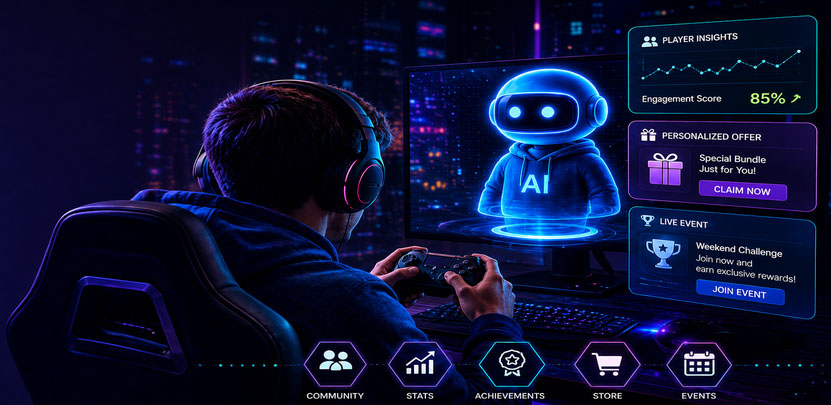
3 a.m., and a limited-time event in a live-service title is underperforming across every region except Southeast Asia, where a competing game just launched a rival promotion. A human LiveOps team would catch this in the morning standup, hours after the window to react has closed. An agent watching the same telemetry adjusts the reward curve and pushes a targeted push notification before the team’s coffee finishes brewing.
That gap, hours versus seconds, is the real story behind LiveOps in games right now. Day 1 retention on a strong 2026 mobile title sits around 27%, dropping to single digits by Day 30, and the studios closing that curve are not the ones with the biggest LiveOps headcount. They are the ones whose systems can read player behavior and respond to it without a human in the loop for every decision.
What Does LiveOps Actually Mean?
LiveOps is the discipline of operating a game as a continuously updated service rather than a fixed, shipped product. It covers four connected functions: retention (keeping players coming back), monetization (converting engagement into revenue without damaging trust), events (time-boxed content that gives players a reason to return this week, not eventually), and economy management (keeping in-game currencies and item drop rates balanced as the player base and content grow).
What has changed is not the definition. It is the operating model underneath it. Through 2023 and 2024, LiveOps ran on hand-built segmentation rules: “players inactive for 3 days get offer X.” That model breaks down at scale because player behavior does not sort neatly into a handful of static buckets, and rules built for one cohort go stale within weeks as the meta shifts.
Publishers are now moving LiveOps mechanics toward reusable, portfolio-wide systems rather than bespoke builds per title, which is only practical when the decision-making layer, not just the content pipeline, is automated.
What is LiveOps in Games?
LiveOps in games is the practice of running a game as an ongoing service, adjusting content, pricing, and events after launch based on player behavior, rather than shipping a finished product and moving on. A battle pass that renews every season, a limited-time in-game event tied to a holiday, or a store offer that changes based on a player’s spend history are all LiveOps in action.
The term applies across genres and platforms. Titles like Fortnite, Genshin Impact, and Clash Royale are built around it: the core game rarely changes, but the events, economy, and offers around it update constantly to keep players returning. Mobile free-to-play titles rely on it even more heavily, since acquisition costs are high and most revenue comes from retaining and monetizing the players already in the game rather than acquiring new ones. What used to be a handful of scheduled updates a year has become a continuous operating rhythm, which is exactly the workload AI agents are now built to carry.

Where AI Agents Fit in the LiveOps Stack
An AI agent in this context is software that perceives a signal (a player’s session pattern, spend history, or churn risk score), decides on an action within defined guardrails, executes it, measures the result, and adjusts. That loop, running continuously across millions of player states, is what separates agentic LiveOps from a rules engine.
Retention
Reactive retention sends a win-back email after a player has already uninstalled the app. An agent-driven model scores churn risk from behavioral signals, reduced session frequency, abandoned purchase flows, drop in social activity, and intervenes while the player is still in the game with a relevant offer, a difficulty adjustment, or a nudge toward an undiscovered feature. Personalized interventions built on real behavioral signal, not blanket promotions, are the difference between a retention program that works and one that reads as generic marketing with a player’s name inserted.
Monetization
A monetization agent does not run a single sales calendar for the entire player base. It tracks spend elasticity per segment and adjusts offer composition, bundle pricing, and timing within limits a producer sets, then reports what moved and what did not. This is where LiveOps intersects with player trust, an agent optimizing purely for short-term revenue will eventually produce pay-to-win perception and accelerate churn, so the guardrails a studio defines (price floors, frequency caps, cosmetic-first defaults) matter as much as the model itself.
Events
Seasonal events, tournaments, and limited-time modes have historically required a cross-functional team to plan, build, and monitor in real time during launch windows. Event agents can handle a meaningful share of that load: triggering event start and end times based on regional activity curves, adjusting reward drop rates mid-event if participation lags, and flagging anomalies (a broken quest chain, an exploited economy sink) to a human before players notice at scale.
Economy and Trust
Underneath retention and monetization sits the economy: currency sinks and sources, drop tables, matchmaking fairness, and anti-cheat. Agentic systems built for this layer can sweep tens of millions of trust and safety events and prescribe interventions across millions of concurrent players without the latency a manual review process introduces. A single security incident or a currency imbalance that goes unnoticed for a week can undo months of retention work, which is why studios are increasingly treating LiveOps infrastructure and trust and safety as one connected system rather than two separate teams.
Build, Buy, or Assemble
Most studios do not choose between “build everything” and “buy a platform.” The practical path is to assemble agents around an existing analytics and content pipeline. A churn-prediction agent that reads your existing telemetry, a pricing agent that respects your existing store architecture, and an event-orchestration agent that triggers your existing content management system. The integration work, not the model, is usually where projects stall.
Studios that treat this as a systems integration problem, with clear guardrails, audit logs, and rollback paths for every autonomous action, ship faster than studios that try to build a single monolithic LiveOps AI from scratch.
FAQ
1. What is the difference between LiveOps and game as a service?
Game as a service describes a business model in which a game is sold and updated continuously rather than shipped once. LiveOps is the operational discipline that makes the model work day-to-day, covering retention, monetization, events, and economy management.
2. Can small studios use AI agents for LiveOps, or is this only for large publishers?
Agent-based LiveOps scales both up and down. A small studio can deploy a single churn-prediction or offer-personalization agent against existing telemetry without building a full in-house team, which is often more achievable than hiring the analysts a manual model would require.
3. Does AI-driven LiveOps replace game producers and community managers?
No. Agents handle the volume of decisions that do not require judgment, such as scoring, scheduling, and tuning within guardrails a human sets. Producers and community managers still decide what the game should feel like and set the boundaries within which agents operate.
4. How do AI agents avoid creating pay-to-win monetization?
Through explicit guardrails set by the studio, price floors, purchase frequency caps, and a bias toward cosmetic or convenience offers over power. An agent optimizing without those constraints will find short-term revenue at the cost of long-term trust.
5. What data does a studio need before deploying LiveOps agents?
Clean, real-time telemetry on session behavior, purchase history, and progression is the baseline. Agents are only as good as the signal they read, so studios with fragmented or delayed data pipelines should fix that first.
How [x]cube LABS Can Help
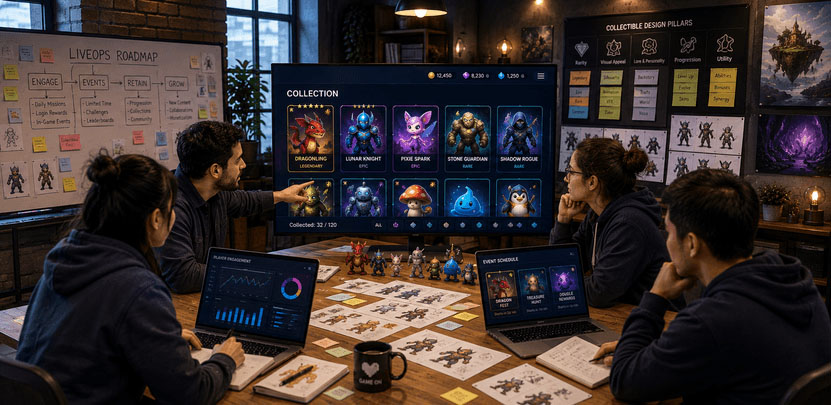
[x]cube LABS runs managed live-ops pods for trading-card, digital collectibles, and sports and entertainment platforms: an economy lead, design studio, lifecycle marketer, data analyst, and delivery lead operating as one unit against a weekly cadence. One 10-year program with a top-3 global trading-card publisher produced a 650% lift in Day-7 collector retention and 3x weekly revenue during live events. A second program scaled a digital collectibles platform from four apps to seven without missing a release window, processing more than 2,700 tickets and hitting 114% sell-through against target, with more than 31,570 design deliverables shipped in two months using AI-assisted production tooling.
The same pod model runs on Upshot.ai, [x]cube LABS’ engagement and gamification platform, which also powers engagement programs for consumer brands across sports, apparel, and consumer goods. The underlying blockchain work is proven at scale as well: an NFT marketplace built for a leading sports collectibles brand on AWS and Hyperledger Sawtooth cut minting wait times from 24 hours to minutes, a 10x improvement. The same operating discipline applies outside pure collectibles economies as well. [x]cube LABS has also built sports streaming infrastructure supporting more than 20 million subscribers across 200+ countries for a global media platform.