The enterprise approach to artificial intelligence has experienced a profound shift. Organizations are moving beyond isolated generative text wrappers to deploy production-grade autonomous agent squads. This transition requires a highly robust underlying technology stack. As IT architects and technology leaders design systems to handle automated financial transactions, precision medicine workflows, or predictive logistics networks, selecting the correct AI agent development framework has become the most critical architectural decision of the year.
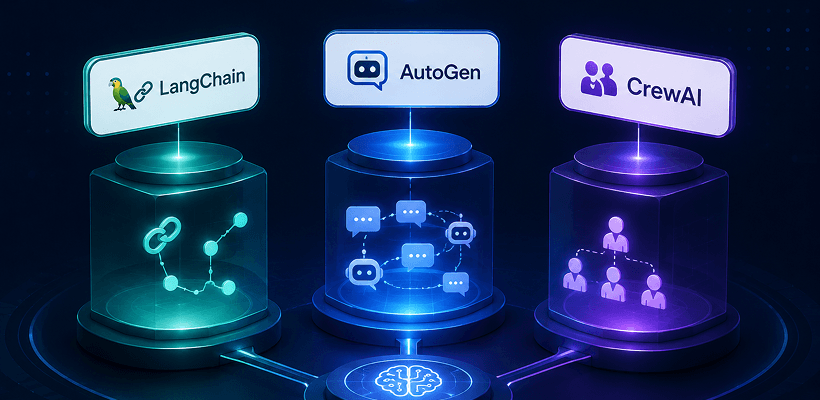
The vendor landscape is filled with competing libraries, each promising seamless integration and total autonomy. However, three ecosystems have emerged as the primary contenders for enterprise-grade applications: LangChain (specifically its stateful orchestration layer, LangGraph), Microsoft’s AutoGen, and CrewAI. Choosing between them requires moving past simple hobbyist comparisons and evaluating how these frameworks handle real-world challenges like state persistence, token efficiency, deterministic control, and human oversight.
1. LangChain / LangGraph: The Graph-Based Production Workhorse
LangChain has long been established as the largest and most flexible framework for building LLM applications. In 2026, when developers build complex agents within the LangChain ecosystem, they rely on LangGraph. This specialized layer structures agentic workflows as explicit state machines.
Core Architecture and Mental Model
LangGraph models business operations using directed graphs where nodes represent distinct actions (such as calling a database or running an LLM reasoning loop), and edges define the control flow. The defining feature is its first-class support for cyclic reasoning; agents can continuously loop, self-correct, and retry a task until a specific success condition is met.
Enterprise Strengths
- Deterministic Control: For industries like banking or compliance, unpredictable agent behavior is an unacceptable risk. LangGraph allows developers to enforce rigid, graph-defined pathways, ensuring the agent never strays into unauthorized tools.
- Production Observability: LangChain features native integration with LangSmith. This provides an exhaustive tracing system that records every single tool call, intermediate token cost, and latency spike, giving DevOps teams deep visibility into system performance.
- Advanced State Management: With stable persistence tools like PostgresSaver, LangGraph excels at long-running operations where an agent must maintain its context across weeks or months of asynchronous tasks.
When to Choose It
LangChain and LangGraph represent the default choice for engineering teams that require absolute architectural control, enterprise-grade debugging tools, and a massive library of pre-built integrations across various vector databases and cloud providers.
2. Microsoft AutoGen: The Conversational Multi-Agent Pioneer
Originally born out of Microsoft Research and substantially upgraded with event-driven architecture, AutoGen treats artificial intelligence as a collaborative, text-based workforce.
Core Architecture and Mental Model
The framework functions on a message-centric communication paradigm. Instead of mapping a process as a rigid graph, developers create distinct agent personas that literally send messages to each other within a sandboxed chat room to solve complex problems.
Enterprise Strengths
- Code Execution Environments: AutoGen features native support for sandboxed code execution. If a data analysis task requires a custom Python script, an agent can write the script, run it in a secure environment, inspect the errors, and rewrite the code autonomously.
- Conversational Problem Solving: The peer-to-peer negotiation style is highly effective for open-ended problem solving, such as simulating market strategies, stress-testing cybersecurity protocols, or conducting multi-perspective software code reviews.
- Deep Microsoft Stack Alignment: For enterprises heavily invested in Azure AI Foundry or Microsoft 365 infrastructure, AutoGen integrates smoothly into existing enterprise security protocols and cloud environments.

When to Choose It
Select AutoGen if your primary use case involves heavily conversational multi-agent dynamics, autonomous code generation, or if your enterprise operates within a heavily Microsoft-aligned cloud infrastructure.
3. CrewAI: The Role-Based Prototyping Accelerator
CrewAI has experienced massive adoption by focusing on a highly intuitive developer experience and a structured approach to business process automation.
Core Architecture and Mental Model
CrewAI models its framework after a traditional corporate department. Developers define a crew of agents, assigning each digital worker a specific role, a clear goal, and a detailed backstory (e.g., Senior Research Analyst or Content Editor). Tasks are then assigned sequentially or hierarchically across the crew.
Enterprise Strengths
- Rapid Time-to-Market: The declarative API minimizes boilerplate code, allowing a small engineering team to take a multi-agent system from concept to a working prototype in just a few days.
- Human-Readable Configurations: The role-and-task mental model is descriptive enough that business analysts, product managers, and non-technical stakeholders can read the agent configurations and understand the operational flow.
- Built-In Collaboration Primitives: Features like automatic task delegation mean agents can autonomously ask other specialized crew members for assistance without developers needing to manually program the routing logic.
When to Choose It
CrewAI is the optimal choice for operations teams that want to quickly automate clear, role-driven business pipelines, such as marketing content distribution, customer email triaging, or standard competitive research workflows.
Technical Feature Matrix: Cross-Framework Comparison
| Architectural Dimension | LangChain (LangGraph) | Microsoft AutoGen | CrewAI |
| Primary Design Model | Stateful Directed Graphs | Conversational Message Passing | Role-Based Crew Hierarchies |
| Development Speed | Moderate (Requires explicit wiring) | Balanced (Verbose configurations) | High (Minimal boilerplate code) |
| Execution Determinism | High (Strict node transitions) | Moderate (Relies on conversation caps) | Variable (Delegation can branch out) |
| Native Code Execution | Manual configuration required | High (Secure built-in sandboxes) | Basic tool execution loops |
| Human-in-the-Loop AI | First-class, persistent checkpoints | Functional through proxy patterns | Basic validation wrappers |
| Token Cost Predictability | Highly predictable via explicit paths | High risk of runaway chat loops | Moderate (Sequential is predictable) |
Critical Enterprise Selection Factors
Choosing your AI agent development framework requires looking past code ergonomics and focusing on long-term operational costs and governance requirements.
Managing Token Consumption and Runaway Loops
In a large enterprise environment, an unmonitored agent workflow can become a massive liability. AutoGen’s conversational model and CrewAI’s hierarchical delegation can occasionally result in runaway loop chatter, where agents repeatedly ping each other without resolving the task, rapidly inflating your API bills. LangGraph mitigates this by forcing developers to define hard, structural boundaries within the state graph, providing a cleaner path to cost predictability.
Implementing Human-in-the-Loop AI Safety Hooks
Total autonomy is rarely safe for high-stakes business operations. When a financial agent triggers a transaction above a certain value, the system must pause. LangGraph leads the market in this category, featuring native, first-class checkpointing that lets you completely freeze the state graph, wait for a human manager to approve or modify the data via an interface, and seamlessly resume execution.

Conclusion: Matching Frameworks to Strategic Goals
There is no single winner in the framework landscape; the right choice depends entirely on the shape of your operational workload.
If your organization is building highly intricate, stateful digital pipelines that require deterministic execution, deep observability, and bulletproof human approval steps, LangChain and LangGraph provide the most mature production environment. If you require flexible, research-driven systems that can autonomously write and execute code within a Microsoft ecosystem, AutoGen is the logical path. For organizations looking to accelerate deployment times and map workflows directly to clear, role-based departmental structures, CrewAI offers the fastest route to real-world utility.
By matching the unique technical strengths of these frameworks to your specific business constraints, technology leaders can build a highly coordinated, secure, and profoundly impactful digital workforce that scales safely into the future.
FAQ
1. Can you use LangChain and CrewAI together?
While early versions of CrewAI relied on LangChain components for basic tool connections, modern iterations have evolved into independent, self-contained frameworks. It is highly recommended to select one primary orchestration layer to prevent unnecessary dependency conflicts.
2. Which framework is easiest for a team transitioning from traditional software engineering?
CrewAI features the lowest barrier to entry because its role-task-crew mental model maps directly to how humans describe workflows, requiring significantly less boilerplate code than graph-based alternatives.
3. How does LangGraph handle system failures compared to AutoGen?
LangGraph handles errors through explicit, graph-native routing where developers define exactly what node an agent should visit if a tool call fails. AutoGen relies on conversational self-correction, where an agent explains the error to its peer to find an alternative approach.
4. Are these open-source frameworks safe for handling sensitive customer data?
The frameworks themselves are open-source libraries that run locally on your servers or private cloud. Security depends entirely on how your team designs data engineering guardrails, controls API access tokens, and implements secure data isolation.
5. What role does LangSmith play in agent development?
LangSmith is a dedicated observability platform for the LangChain ecosystem. It allows developers to visually inspect graph execution traces, monitor API costs, grade response quality, and catch logic loops before code is pushed to production.
Why Choose [x]cube LABS?
[x]cube LABS works with enterprise teams to design and deploy AI agents across complex, regulated environments.
We help enterprises become AI-native, not by adding AI on top of existing systems, but by rebuilding the intelligence layer from the ground up. With 950+ products shipped and $5B+ in value created for clients across 15+ industries, here is what we bring to the table:
1. Autonomous AI Agents
We design and deploy agentic AI systems that sense, decide, and act without human bottlenecks, handling complex, multi-step workflows end-to-end with measurable resolution rates and no manual intervention.
2. Enterprise Voice AI
Our voice AI platform, Ello, puts production-ready voice agents in front of your customers in minutes. Zero-latency conversations across 30+ languages, with no call centers and no wait times.
3. AI-Powered Process Automation
We replace manual, error-prone workflows with intelligent automation across invoicing, compliance, customer service, and operations, freeing your teams to focus on work that requires human judgment.
4. Predictive Intelligence and Decision Support
Using machine learning and real-time data pipelines, we build systems that forecast demand, flag risk, optimize inventory, and surface strategic insights before your teams need to ask for them.
5. Connected Products and IoT
We design and build IoT platforms that turn physical devices into intelligent, connected systems with built-in real-time monitoring, remote management, and condition-based automation.
6. Data Engineering and AI Infrastructure
From data lakes and ETL pipelines to AI-ready cloud architecture, we build the foundation that makes everything else possible, scalable, reliable, and designed to grow with your business.
If you are looking to move from AI experimentation to AI-native operations, let’s talk.