Introduction
Many organizations have already introduced AI into their operations. They use it to generate content, automate repetitive tasks, or improve customer support. While these initiatives create value, they don’t necessarily make a business AI-native.
An AI-native organization approaches technology differently. AI is built into products, workflows, and decision-making from the beginning rather than being added after processes are already established.
This shift is changing how enterprises design software, deliver services, and operate at scale. Understanding what it means to become AI-native is becoming an important consideration for organizations planning their next phase of growth.
What Does AI-Native Really Mean?
An AI-native business is designed around intelligence rather than traditional software workflows.
Instead of asking where AI can fit into an existing process, organizations begin by asking how AI can perform, improve, or orchestrate that process from the start.
This mindset influences everything from product design and operational workflows to customer experiences and business decisions.
Many organizations are investing in AI to improve individual workflows or automate specific tasks. Becoming AI-native requires a broader perspective. AI becomes part of how products are designed, how decisions are made, and how business processes operate across the organization.
That shift extends beyond the introduction of new tools. It involves redesigning systems, workflows, and operating models so that intelligence is embedded into everyday business operations rather than applied only where opportunities arise.
AI-Native Is More Than Technology
Becoming AI-Native involves more than adopting new tools.
It requires organizations to rethink how information moves, how decisions are made, and how software interacts with people and systems.
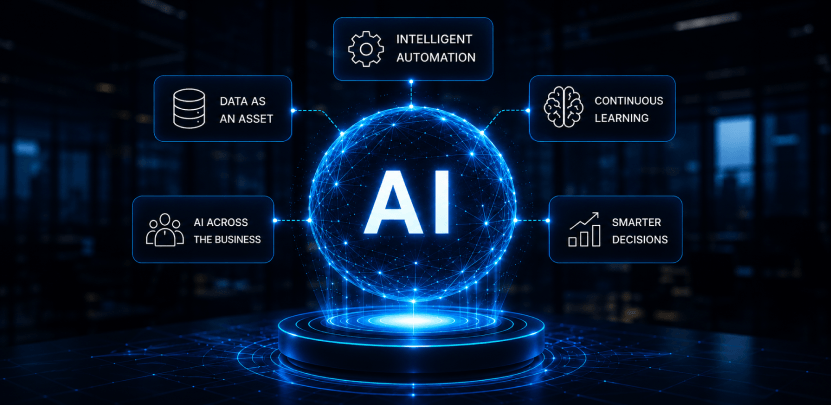
Several characteristics define an AI-native organization:
- AI supports business decisions across multiple functions.
- Data is treated as a strategic operational asset.
- Intelligent automation is integrated into everyday workflows.
- AI capabilities continue to improve through ongoing learning and feedback.
Together, these elements create a foundation where AI becomes part of the operating model rather than an isolated capability.
Building an AI-Native Architecture
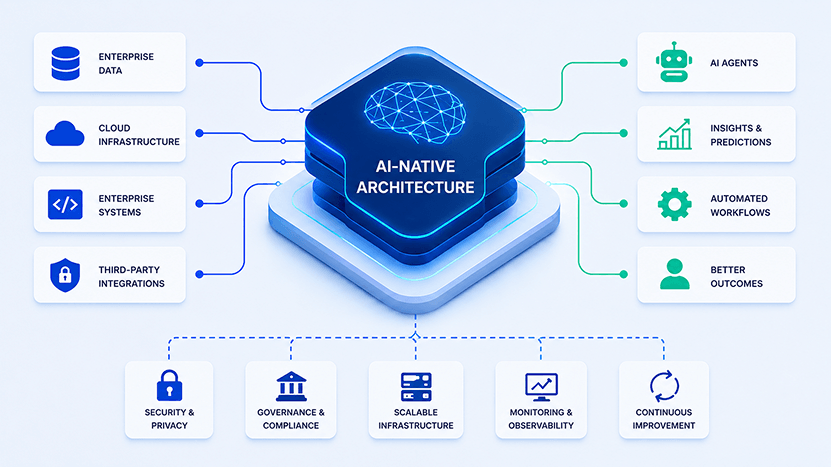
A strong AI-native architecture provides the technical foundation that allows intelligent systems to operate consistently across the enterprise.
Rather than connecting AI to isolated applications, organizations build architectures that enable models, data, enterprise systems, and AI agents to work together.
A typical AI-native architecture includes:
- Centralized access to enterprise data
- Secure APIs and system integrations
- Scalable AI infrastructure
- Governance and monitoring capabilities
- Support for autonomous workflows
Without these foundational components, organizations often struggle to expand AI initiatives beyond individual use cases.
How AI-Native Software Development Changes Product Strategy
Traditional software development focuses on building features.
AI-native software development focuses on building software that can reason, adapt, and continuously improve.
This changes how products are designed.
Applications increasingly incorporate intelligent recommendations, workflow automation, predictive decision-making, and AI-powered user experiences as core functionality rather than optional enhancements.
For development teams, AI-native software development also introduces new considerations around data quality, model lifecycle management, testing, and governance alongside traditional engineering practices.
Where AI-Native Applications Create Business Value
The impact of AI-native applications extends across nearly every enterprise function.
- Customer service teams can automate issue resolution while maintaining context across interactions.
- Finance teams can improve forecasting and accelerate operational workflows.
- Healthcare organizations can streamline administrative processes and support clinical decision-making.
- Manufacturers can optimize production planning using real-time operational data.
The value of AI-native applications lies in their ability to combine intelligence and execution rather than simply present information to users.
Why AI-Native Agentic Systems Matter
As AI capabilities continue to mature, organizations are beginning to adopt AI-native agentic systems that can coordinate tasks across multiple business processes.
Unlike standalone AI assistants, AI-native agentic systems are designed to interact with enterprise applications, retrieve information, make decisions within defined boundaries, and complete multi-step workflows with limited human intervention.
This evolution allows organizations to automate increasingly complex operations while maintaining governance and oversight.
Planning the Transition to an AI-Native Business
Moving toward an AI-native operating model is rarely achieved through a single implementation.
Most organizations begin by identifying high-value business processes where AI can improve speed, accuracy, or efficiency.
From there, they establish the infrastructure, governance, and data foundations needed to support broader adoption.
The organizations making the greatest progress are those that align technology investments with measurable business outcomes instead of pursuing AI for its own sake.
Conclusion
Becoming AI-native is about more than adopting AI tools. It requires organizations to rethink how software is designed, how decisions are made, and how work is executed across the enterprise.
Building an AI-native architecture, adopting AI-native software development practices, developing intelligent AI-native applications, and introducing AI-native agentic systems all contribute to that transition.
Organizations that approach AI as part of their operating model rather than as an additional feature will be better positioned to adapt as technology, customer expectations, and business priorities continue to evolve.
FAQs
1. What does AI-Native mean?
An AI-Native organization builds AI into its products, operations, and decision-making processes from the outset rather than adding AI capabilities later.
2. What is AI-native architecture?
AI-native architecture refers to the technical foundation that enables AI models, enterprise data, applications, and intelligent systems to work together securely and efficiently.
3. How is AI-native software development different from traditional software development?
AI-native software development focuses on creating applications that incorporate intelligence, adaptability, and continuous learning as core capabilities instead of treating AI as an add-on feature.
4. What are AI-native applications?
AI-native applications are software solutions designed with AI as a fundamental component, enabling automation, intelligent decision-making, and personalized user experiences.
5. What are AI-native agentic systems?
AI-native agentic systems consist of autonomous AI agents that can plan, reason, interact with enterprise systems, and execute multi-step workflows with minimal human intervention.
Why Choose [x]cube LABS?
[x]cube LABS works with enterprise teams to design and deploy AI agents across complex, regulated environments.
We help enterprises become AI-native, not by adding AI on top of existing systems, but by rebuilding the intelligence layer from the ground up. With 950+ products shipped and $5B+ in value created for clients across 15+ industries, here is what we bring to the table:
1. Autonomous AI Agents
We design and deploy agentic AI systems that sense, decide, and act without human bottlenecks, handling complex, multi-step workflows end-to-end with measurable resolution rates and no manual intervention.
2. Enterprise Voice AI
Our voice AI platform, Ello, puts production-ready voice agents in front of your customers in minutes. Zero-latency conversations across 30+ languages, with no call centers and no wait times.
3. AI-Powered Process Automation
We replace manual, error-prone workflows with intelligent automation across invoicing, compliance, customer service, and operations, freeing your teams to focus on work that requires human judgment.
4. Predictive Intelligence and Decision Support
Using machine learning and real-time data pipelines, we build systems that forecast demand, flag risk, optimize inventory, and surface strategic insights before your teams need to ask for them.
5. Connected Products and IoT
We design and build IoT platforms that turn physical devices into intelligent, connected systems with built-in real-time monitoring, remote management, and condition-based automation.
6. Data Engineering and AI Infrastructure
From data lakes and ETL pipelines to AI-ready cloud architecture, we build the foundation that makes everything else possible, scalable, reliable, and designed to grow with your business.
If you are looking to move from AI experimentation to AI-native operations, let’s talk.