
Real-time generative AI, which creates content on the spot, has many uses. It powers customer service chatbots and helps make creative content, showing how flexible it can be. We need to know what it can and can’t do to make the most of real-time generative AI applications. This balanced view helps us use it to develop new and exciting ways to use it.
In this blog post, we’ll look at the main ideas behind real-time generative AI, what’s good about it, what problems it faces, and how different industries use it.

Challenges of Real-Time Generative AI
Latency and Response Time
Real-time apps need quick responses. A Generative AI application that creates content when it needs to do complex math can slow things down and make real-time use tricky.
Ways to speed things up: Making models smaller, cutting out unnecessary parts, and using special hardware can help speed up responses.
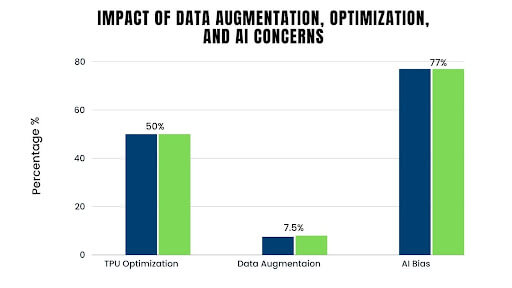
A study found that optimizing a large-scale generative AI model for TPUs could reduce inference time by 40-60%.
Computational Resources
Resource-hungry models: Generative AI applications making new, significant content need much computing power to learn and work.
More hardware: Limits on available computers (CPUs, GPUs, TPUs) can limit the size and complexity of real-time AI apps.
Using the cloud: Tapping into cloud platforms gives access to more computing power when needed. A study by OpenAI estimated that training a large-scale generative AI model can require thousands of GPUs.
Data Limitations
Data quality and quantity: The quality and amount of training data significantly impact the performance of generative AI models.
Data privacy: Gathering and using big datasets can make people worry about privacy.
Data augmentation: Methods like augmentation can help overcome data limits and improve models’ performance in different situations.
A study by Stanford University found that using data augmentation techniques can improve the accuracy of image classification models by 5-10%.
Ethical Considerations
Bias and fairness: Generative AI models can continue to pass on biases from their training data, which can lead to unfair or biased outputs.
Misinformation and deepfakes: The fact that generative AI applications can make very real-looking fake content makes people worry about false information and deepfakes.
Transparency and explainability: Understanding how generative AI models make choices is critical to ensuring these systems are responsible and fixing possible biases.
A Pew Research Center survey found that 77% of respondents are concerned about potential bias in AI systems.
Techniques for Optimizing Real-Time Performance
Model Optimization
Pruning Is Removing unneeded links and weights from the model to make it smaller and less complex to compute.
Quantization: Lowering the accuracy of number representations in the model to save space and time for calculations.
Distillation: Shifting knowledge from a big, intricate model to a more compact, efficient one.
- A study by Google AI found that pruning convolutional neural networks can reduce size by up to 90% without significant accuracy loss.
- Quantization can reduce model size by up to 75% while maintaining reasonable accuracy.
- Knowledge distillation has been shown to improve the accuracy of student models by 3-5%.
Hardware Acceleration
GPUs: Graphics Processing Units are processors that work in parallel, speeding up matrix operations and other computations often seen in deep learning.
TPUs: Tensor Processing Units are custom-built hardware for machine learning tasks offering big performance boosts for specific jobs.
- A study by TensorFlow found that GPUs can accelerate training time for deep learning models by 30-50%.
- TPUs have been shown to achieve 30-50% speedup compared to GPUs for large-scale training tasks.
Cloud-Based Infrastructure
Scalability: Cloud-based platforms can scale resources fast to meet real-time application needs.
Cost-efficiency: Pay-as-you-go pricing helps optimize costs for changing workloads.
Managed services: Cloud providers offer services to manage machine learning and AI, making it easier to deploy and manage.
- A survey by McKinsey & Company found that 80% of organizations use cloud-based platforms for AI development.
- Cloud-based AI platforms can reduce development time by 30-40% and improve time-to-market.
Efficient Data Pipelines
Batch processing: This method processes data in batches for better throughput.
Streaming processing: This approach handles data as it comes in real-time.
Data caching: This technique stores often-used data in memory to retrieve it faster.
Optimizing data pipelines can reduce latency by 20-30% and improve real-time performance.
Case Studies and Real-world Applications
Generative AI applications have an impact on many industries. Here are some standout cases:
- Healthcare:
- Drug discovery: Creating new drug candidates with wanted features.
- Medical image analysis: Making fake medical images to train AI models and boost datasets.
- A study by Nature Communications showed that generative AI applications impact drug discovery, making it 30% more productive.
- Entertainment:
- Video game development: Making lifelike characters, worlds, and plots.
- Music composition: Writing original music in different styles.
- A study by OpenAI proved that generative AI applications can write music that sounds just like human-made pieces.
- Marketing and Advertising:
- Product design: Developing new ideas for products and how they look.
- McKinsey & Company’s research shows that generative AI applications can improve the effectiveness of marketing campaigns by 10-20%.
- Personalized content generation: Making content for each customer based on what they like and do.
Success Stories and Challenges Faced
- Success Story: OpenAI’s DALL-E 2: This powerful text-to-image model creates lifelike and imaginative images showing how generative AI applications can transform the art and design world.
- Challenge: Data Quality: Good varied training data plays a crucial role in making generative AI application models work well.
- Success Story: NVIDIA’s GauGAN: Architects and urban planners use this landscape creation tool to make realistic views of planned projects.
- Challenge: Ethical Considerations: To use generative AI applications, we must tackle biases, false information, and fake videos or images.
Industry-Specific Applications
- E-commerce: Creating product descriptions suggesting items and crafting personalized marketing campaigns.
- Finance: Producing synthetic financial data to train fraud detection models and assess risk.
- Education: Developing personalized educational materials and tests.
- Manufacturing: Enhancing product design and streamlining manufacturing processes.
When companies in different fields tap into generative AI’s potential, they can find new ways to grow, boost their productivity, and make their customers happier.

Future Trends and Challenges
Emerging Technologies and Techniques
- Hybrid models: Mixing generative AI applications with other methods, like reinforcement learning and neural-symbolic AI, to build stronger and more adaptable models.
- Multimodal generative AI applications: Creating models that produce content in different forms, such as text, pictures, and sound.
- Explainable AI: Making generative AI models more see-through and understandable to gain trust and tackle ethical issues.
A McKinsey & Company report predicts hybrid AI models will make up 50% of AI uses by 2025.
Ethical Considerations and Responsible Development
- Bias reduction: Tackling prejudices in datasets and AI models to ensure fair and equal treatment.
- False information and synthetic media: Creating methods to spot and limit the production and circulation of damaging content.
- Data protection and system safety: Safeguarding confidential information and stopping unauthorized entry into AI platforms.
A Pew Research Center poll revealed that 73% of participants worry about AI’s potential misuse for harmful purposes.
How AI Might Change Society
- Economic growth: Generative AI application has the potential to create new industries and job opportunities.
- Social change: Generative AI applications can help tackle social issues like poverty, inequality, and healthcare.
- Ethical implications: The widespread use of generative AI applications raises critical ethical questions about how it affects society.
A study by McKinsey & Company suggests that AI could add USD 13 trillion to the world economy by 2030.
We must address these challenges and welcome new technologies to ensure that generative AI applications are developed and deployed responsibly and helpfully.

Conclusion: The Future of Generative AI
Generative AI applications are a rapidly evolving field with the potential to revolutionize various industries and aspects of society. From creating realistic images and videos to powering natural language understanding and drug discovery, generative AI applications are becoming increasingly sophisticated and diverse.
While challenges exist, such as ethical considerations and computational resources, the benefits of generative AI applications are significant. We can drive innovation, improve efficiency, and address pressing societal challenges by harnessing its power.
As research and development continue to advance, we can expect to see even more groundbreaking applications of generative AI applications in the future. It is essential to embrace this technology responsibly and ensure its development aligns with ethical principles and societal values.
FAQs
1. What are generative AI applications?
Generative AI applications use algorithms to create new content, such as images, text, or audio. They can be used for tasks like generating realistic images, writing creative content, or even composing music.
2. What are the names of the models used to create generative AI applications?
Some of the most popular models used in generative AI include:
- Generative Adversarial Networks (GANs): These models use two competing neural networks to generate realistic data.
- Variational Autoencoders (VAEs): VAEs use a probabilistic approach to create new data points.
- Transformer models: Transformers, like GPT-3, are large language models capable of generating human-quality text.
3. What is one thing current generative AI applications cannot do?
While generative AI has made significant strides, it still needs to work on understanding and generating genuinely original ideas. It often relies on patterns learned from existing data and may need help to produce genuinely novel or groundbreaking content.
How can [x]cube LABS Help?
[x]cube has been AI-native from the beginning, and we’ve been working with various versions of AI tech for over a decade. For example, we’ve been working with Bert and GPT’s developer interface even before the public release of ChatGPT.
One of our initiatives has significantly improved the OCR scan rate for a complex extraction project. We’ve also been using Gen AI for projects ranging from object recognition to prediction improvement and chat-based interfaces.
Generative AI Services from [x]cube LABS:
- Neural Search: Revolutionize your search experience with AI-powered neural search models. These models use deep neural networks and transformers to understand and anticipate user queries, providing precise, context-aware results. Say goodbye to irrelevant results and hello to efficient, intuitive searching.
- Fine Tuned Domain LLMs: Tailor language models to your specific industry for high-quality text generation, from product descriptions to marketing copy and technical documentation. Our models are also fine-tuned for NLP tasks like sentiment analysis, entity recognition, and language understanding.
- Creative Design: Generate unique logos, graphics, and visual designs with our generative AI services based on specific inputs and preferences.
- Data Augmentation: Enhance your machine learning training data with synthetic samples that closely mirror accurate data, improving model performance and generalization.
- Natural Language Processing (NLP) Services: Handle sentiment analysis, language translation, text summarization, and question-answering systems with our AI-powered NLP services.
- Tutor Frameworks: Launch personalized courses with our plug-and-play Tutor Frameworks that track progress and tailor educational content to each learner’s journey, perfect for organizational learning and development initiatives.
Interested in transforming your business with generative AI? Talk to our experts over a FREE consultation today!