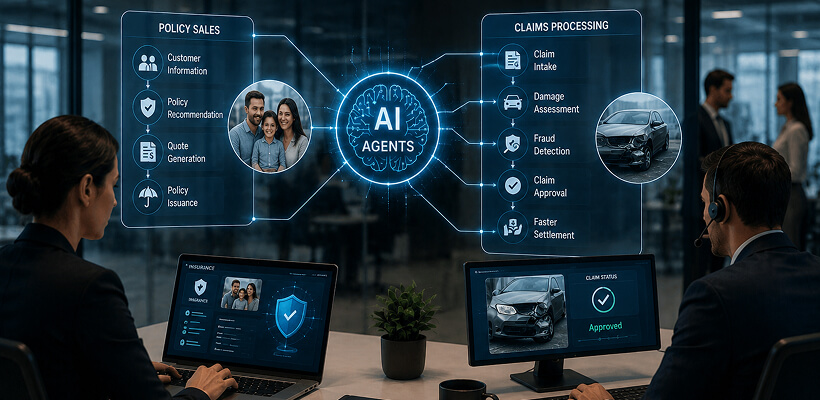
Insurance has long been an industry defined by complexity, human judgment, and lengthy workflows.
Customers expect instant quotes and clear answers. Agents need accurate underwriting insights. Claims teams must balance speed with compliance and documentation.
Yet many insurers still rely on manual steps, disconnected systems, and repetitive data entry, a combination that often leads to delays, errors, and frustrated customers.
This is where AI Agents for insurance are beginning to change the equation.
Unlike simple automation or static chatbots, these intelligent systems can reason, plan, and execute across multiple systems.
From facilitating an insurance policy sale to streamlining claim processing, AI Agents for insurance are helping insurers operate faster, smarter, and with far greater consistency.
From Insights to Intelligent Execution
For years, AI in insurance has focused primarily on predicting risk, identifying potential fraud, or segmenting customers. While those insights are valuable, prediction alone does not complete the task.
AI Agents for insurance bridge that gap by turning insights into action. These agents can interpret goals, organize tasks, sequence decisions, interact with business systems, and adapt to changing conditions.
In other words, they move from answering “What should happen?” to actually making it happen.
This shift toward Agentic AI, where systems operate autonomously with clear intent, distinguishes reactive tools from proactive operational systems.
AI Agents Revamping Insurance Policy Sales
Selling an insurance policy is seldom a straight line. It requires:
- Gathering customer information
- Evaluating risk and coverage needs
- Presenting suitable products
- Validating documentation
- Completing binding and issuance
A basic online form may gather customer data, and a chatbot may answer questions. But a true AI insurance agent can orchestrate the entire journey.
It can identify customer needs through conversation, match risks to appropriate coverage, trigger underwriting checks, and alert advisors when human judgment is required. At the same time, it monitors the process to ensure that nothing stalls before the policy is issued.
Industry research indicates that AI-based underwriting adoption is increasing by 42%, reflecting insurer’s rapid integration of intelligent automation into core policy evaluation workflows.
Instead of asking customers to navigate complex forms on their own, AI Agents for insurance guide them through the experience, reducing friction and improving completion rates.
By integrating with policy engines, CRM platforms, and digital signature tools, these systems enable significantly faster, more seamless issuance of insurance policies.

Autonomous Agents and Claim Processing
If policy sales drive growth, claim processing defines customer trust.
Claims are often among the most complex and resource-intensive operations in insurance. They require collecting documentation, verifying coverage, checking for fraud signals, coordinating across teams, and ensuring compliance.
This is where autonomous agents deliver real value.
AI Agents for Insurance can:
- Ingest and interpret claim documents
- Extract data from text and images
- Cross-reference coverage rules
- Flag anomalies or fraud indications
- Initiate payout workflows
- Escalate complex cases to human adjusters
Rather than moving a claim slowly through disconnected systems, agents coordinate the process end-to-end, handling routine steps automatically and involving people only when necessary.
Industry experience shows that insurance companies implementing AI-driven solutions have reduced claims processing time by up to 75%. The result is not only faster claims resolution but also greater consistency and reduced operational risk.
Why AI Agents Matter for Operational Efficiency
As insurers deepen their investment in AI, operational improvements are becoming increasingly visible.
When AI Agents for insurance coordinate data extraction, verification, and decision workflows, they remove the manual bottlenecks that historically slowed both policy issuance and claims resolution.
These improvements typically come from:
- Reduced manual rework
- Automated cross-system coordination
- Faster decision cycles
- Less human error
- Improved compliance through traceable actions
When policy sales and claims operations run more smoothly, customers notice the difference. Service improves, retention increases, and insurers simultaneously reduce operational costs.
What Makes AI Agents Enterprise-Ready
Deploying AI Agents for insurance requires more than intelligent models. Enterprise environments demand strong governance.
A robust AI Agent architecture includes planning layers that sequence tasks, enforce boundaries, and maintain transparency. It also incorporates human-in-the-loop checkpoints for sensitive decisions and audit trails for regulatory compliance.
Many insurers are also adopting specialized AI Agent frameworks that provide:
- Context and memory management
- Policy enforcement modules
- Integration with core insurance systems
- Monitoring and observability tools
Together, these frameworks enable the scaling of AI Agents for insurance across multiple product lines while maintaining control and compliance.
The Strategic Shift Ahead
Insurance is one of the most regulated and competitive industries in the world. Automating isolated steps is no longer enough.
Insurers increasingly need systems that understand objectives, plan workflows, and execute actions across multiple systems without constant human coordination.
AI Agents for insurance are not about replacing professionals. Instead, they remove repetitive operational work so human experts can focus on advisory roles, complex decision-making, and customer relationships.
When agents handle routine workflows, human expertise becomes even more valuable.
Conclusion
The transformation underway in insurance is not just about faster automation; it is about intelligent orchestration.
By guiding policy purchases, coordinating underwriting steps, and accelerating claim adjudication, AI Agents for insurance bring planning, action, and adaptability into workflows that were once fragmented and manual.
From improving insurance policy issuance to modernizing claim processing, these systems help insurers deliver faster service, stronger compliance, and better operational efficiency. The future of AI in insurance is no longer just predictive.
It is autonomous, coordinated, and capable of executing real outcomes, unlocking a new era of intelligent insurance operations.
FAQs
1. What are AI Agents for insurance?
AI Agents for Insurance are intelligent systems that plan and execute workflows across insurance sales and claims operations.
2. How do AI Agents improve claim processing?
They automate document review, policy validation, fraud detection, and payout workflows.
3. Do AI insurance agents replace human employees?
No. They handle repetitive tasks so human professionals can focus on complex decisions and customer relationships.
4. Can AI Agents comply with insurance regulations?
Yes. With governance layers, audit trails, and oversight mechanisms, they can operate in compliance with regulatory requirements.
5. What is the biggest benefit of AI Agents for insurance?
Faster operations, improved customer experience, and more consistent workflows across policy sales and claims.
How Can [x]cube LABS Help?
At [x]cube LABS, we craft intelligent AI agents that seamlessly integrate with your systems, enhancing efficiency and innovation:
- Intelligent Virtual Assistants: Deploy AI-driven chatbots and voice assistants for 24/7 personalized customer support, streamlining service and reducing call center volume.
- RPA Agents for Process Automation: Automate repetitive tasks like invoicing and compliance checks, minimizing errors and boosting operational efficiency.
- Predictive Analytics & Decision-Making Agents: Utilize machine learning to forecast demand, optimize inventory, and provide real-time strategic insights.
- Supply Chain & Logistics Multi-Agent Systems: Enhance supply chain efficiency by leveraging autonomous agents that manage inventory and dynamically adapt logistics operations.
- Autonomous Cybersecurity Agents: Enhance security by autonomously detecting anomalies, responding to threats, and enforcing policies in real-time.
- Generative AI & Content Creation Agents: Accelerate content production with AI-generated descriptions, visuals, and code, ensuring brand consistency and scalability.
Integrate our Agentic AI solutions to automate tasks, derive actionable insights, and deliver superior customer experiences effortlessly within your existing workflows.
For more information and to schedule a FREE demo, check out all our ready-to-deploy agents here.