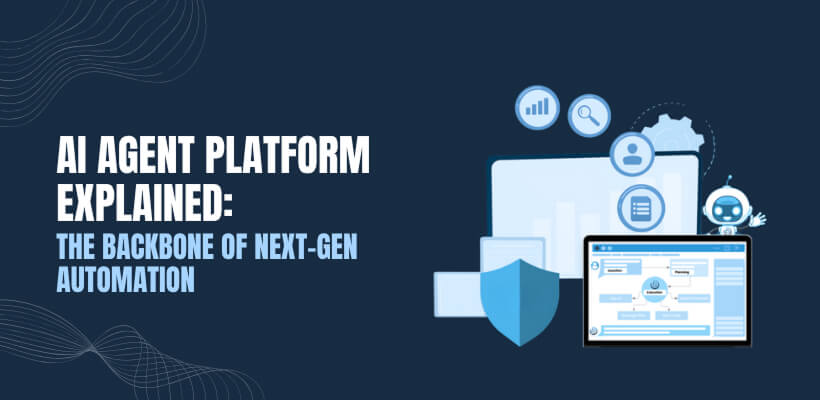
If you’ve ever wished your software could make decisions, act independently, and improve over time, you’re already thinking in terms of AI agents. But to unlock their full potential, you need a solid foundation AI agent platform.
AI agent platforms are the hidden engines powering the next generation of automation. They’re not just plug-ins or chatbots. These platforms orchestrate how intelligent agents perceive, decide, and act across complex systems. In 2025, they’re redefining how businesses operate faster, smarter, and with minimal human intervention.
What Is an AI Agent Platform?
An AI agent platform is a system that allows developers, teams, or organizations to build, deploy, and manage intelligent agents. These platforms provide the tools agents need to:
- Perceive data from environments (internal and external)
- Analyze inputs and learn over time
- Take autonomous actions toward goals
They’re designed to integrate deeply with business operations, connecting apps, workflows, and data pipelines. You can think of them as the “nervous system” that empowers multiple AI agents to work together in real-world environments. The best AI agent platform does all of this seamlessly, whether they’re supporting customer service or backend infrastructure.
Key Components of an AI Agent Platform
To understand how these platforms work, break them down into four core layers:
1. Perception Layer
This layer gathers input from APIs, sensors, databases, or real-time streams. Whether it’s user clicks, sales data, or weather updates is where the agent sees.
2. Cognition Layer
The brain. Here, large language models (LLMs), reasoning engines, and rule-based systems come into play. This is where the agent interprets inputs, plans responses, and makes decisions.
3. Action Layer
Once a decision is made, the platform executes it. This could mean updating a CRM record, sending an email, or triggering another workflow.
4. Learning Layer
Agents analyze outcomes and adjust their strategies accordingly. This feedback loop enables them to adapt and improve over time, much like a junior employee who becomes more knowledgeable with each passing day.
Why AI Agent Platforms Matter in 2025
According to a 2025 report by IDC, over 38% of enterprises have adopted agent-based automation tools to streamline operations. And that number is growing.
Here’s why it matters:
- Speed: Tasks that took hours are now completed in seconds
- Scalability: One platform can deploy hundreds of agents across systems
- Consistency: No fatigue, no variation, just results
- Learning ability: Unlike scripts, agents improve over time
- Decision power: Agents don’t just automate; they optimize
“AI agents are moving from experimental tools to operational workhorses,” says Dr. Elena Fisher, Director of AI Strategy at Accenture. “Platforms give them the structure to scale responsibly and effectively.”
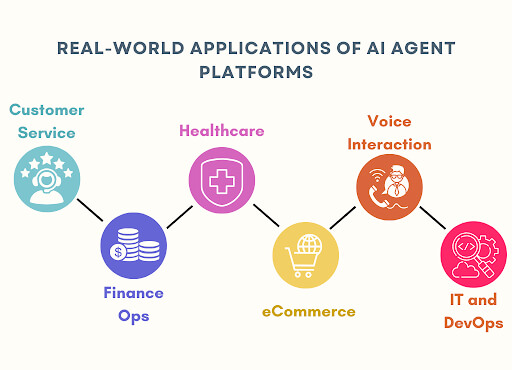
Real-World Applications of AI Agent Platforms
These platforms are already behind some of the most innovative systems you use every day:
- Customer Service: AI agents triage support tickets, escalate issues, or respond autonomously (used by Intercom and Freshdesk).
- Finance Ops: Platforms like UiPath now include agent-based bots that reconcile accounts or flag anomalies in real time.
- Healthcare: Intelligent scheduling, patient follow-ups, and insurance claims handled by specialized AI agents.
- eCommerce: Personalized recommendations, dynamic pricing, and inventory alerts managed via AI agent orchestration platforms.
- Voice Interactions: Some teams implement an AI voice agent platform that answers user queries and routes calls based on intent.
- IT and DevOps: Agents can proactively detect errors, restart services, and notify administrators without requiring human intervention.
Enterprise use cases are evolving from reactive chatbots to proactive, goal-seeking agents embedded in mission-critical workflows—the more complex the task, the greater the return from using a well-designed AI agent platform.
Read more about Agentic AI in the context of supply chain automation.
Popular AI Agent Platforms to Watch
Here are some leading players powering AI agent ecosystems:
1. AutoGPT & BabyAGI
These are open-source agent frameworks that developers use to build goal-driven agents powered by LLMs like GPT-4.
2. LangChain
This is a popular orchestration layer for chaining LLMs with APIs, tools, or memory modules, essential for building thinking agents.
3. CrewAI & MetaGPT
These multi-agent coordination frameworks enable agents to collaborate as a team, much like a group of AI coworkers working together on a project.
4. Open Interpreter
It provides agents with a Python-based reasoning engine that enables secure, real-time code execution on local machines.
Many of these tools are considered the best AI agent platforms in 2025, thanks to their flexibility, power, and open architecture.
Challenges with AI Agent Platforms
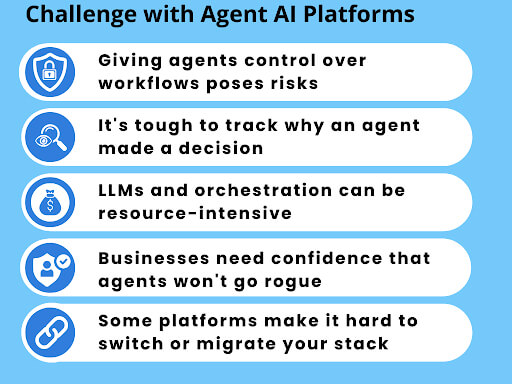
Despite their promise, these platforms aren’t plug-and-play. Here are a few pain points:
- Security: Giving agents control over workflows poses risks
- Observability: It’s tough to track why an agent made a decision
- Cost: LLMs and orchestration can be resource-intensive
- Trust: Businesses need confidence that agents won’t go rogue
- Vendor lock-in: Some platforms make it hard to switch or migrate your stack
The best AI agent platforms today include guardrails such as permissions, monitoring, and fallback logic to keep agents accountable.
What to Look for in an AI Agent Platform
When choosing or building a platform, prioritize:
- Modularity: Can you easily add new agents or tools?
- Governance: Is agent activity visible and controllable?
- Adaptability: Can it learn from your data or feedback?
- Integration: Does it work with your existing tech stack?
- Interoperability: Will it allow cross-platform orchestration and reuse?
Whether you’re deploying an AI voice agent platform or a fully autonomous multi-agent system, these criteria are key.
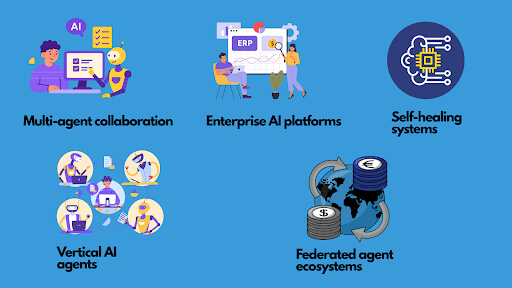
2025 Trends to Watch
- Multi-agent collaboration: Agents that assign tasks to one another
- Enterprise AI platforms: Unified agent hubs across departments
- Self-healing systems: Agents that fix failures without human input
- Vertical AI agents: Vertical AI Agents are built for niche industries (like legal, logistics, or agri-tech)
- Federated agent ecosystems: Cross-company agents interacting securely for mutual tasks
Conclusion
AI agent platforms are not just backend tools; they’re the control centers of a new kind of workforce. If you want more intelligent automation, better decisions, and scalable intelligence, these platforms are your starting point.
The race isn’t about who uses AI, it’s about who uses it wisely. The right AI agent orchestration platform helps your team do more with less, continuously improve, and stay competitive in a world that won’t slow down.
FAQ’s
1. What is an AI Agent Platform?
An AI Agent Platform is a system that enables autonomous agents to perform complex tasks with minimal human input.
2. How does it differ from traditional automation tools?
Unlike rule-based automation, AI agent platforms utilize reasoning, memory, and learning to make dynamic decisions.
3. What industries benefit from AI Agent Platforms?
Sectors like finance, healthcare, retail, and logistics use them to boost efficiency and reduce costs.
4. Can non-technical teams use AI Agent Platforms?
Yes, many platforms offer no-code or low-code tools for business users to deploy intelligent agents easily.
How Can [x]cube LABS Help?
At [x]cube LABS, we craft intelligent AI agents that seamlessly integrate with your systems, enhancing efficiency and innovation:
- Intelligent Virtual Assistants: Deploy AI-driven chatbots and voice assistants for 24/7 personalized customer support, streamlining service and reducing call center volume.
- RPA Agents for Process Automation: Automate repetitive tasks like invoicing and compliance checks, minimizing errors and boosting operational efficiency.
- Predictive Analytics & Decision-Making Agents: Utilize machine learning to forecast demand, optimize inventory, and provide real-time strategic insights.
- Supply Chain & Logistics Multi-Agent Systems: Enhance supply chain efficiency by leveraging autonomous agents that manage inventory and dynamically adapt logistics operations.
- Autonomous Cybersecurity Agents: Enhance security by autonomously detecting anomalies, responding to threats, and enforcing policies in real-time.
- Generative AI & Content Creation Agents: Accelerate content production with AI-generated descriptions, visuals, and code, ensuring brand consistency and scalability.
Integrate our Agentic AI solutions to automate tasks, derive actionable insights, and deliver superior customer experiences effortlessly within your existing workflows.
For more information and to schedule a FREE demo, check out all our ready-to-deploy agents here.