A product team spends eighteen months building something they believe in. The roadmap is tight, the demo lands well, and launch day finally arrives, and for a moment, everything feels finished. Except it isn’t, because launch day is where the real work quietly begins.
Within weeks, support tickets pile up faster than anyone expected, and usage patterns reveal which features customers love and which they silently abandon. Bugs surface under real-world load that no staging environment could replicate, while the team that shipped the product is already stretched thin planning the next release. It’s little surprise that the global AI agents market itself is projected to grow from USD 5.4 billion in 2024 to USD 52.62 billion by 2030, as more companies race to solve exactly this post-launch challenge.
This gap, the space between “shipped” and “sustained,” is exactly where live-Ops as a Service steps in. And increasingly, the engine behind it isn’t a growing headcount of support staff. It’s AI agents, working continuously, learning from every interaction, and keeping products healthy long after the launch confetti settles.
What Is Live-Ops as a Service?
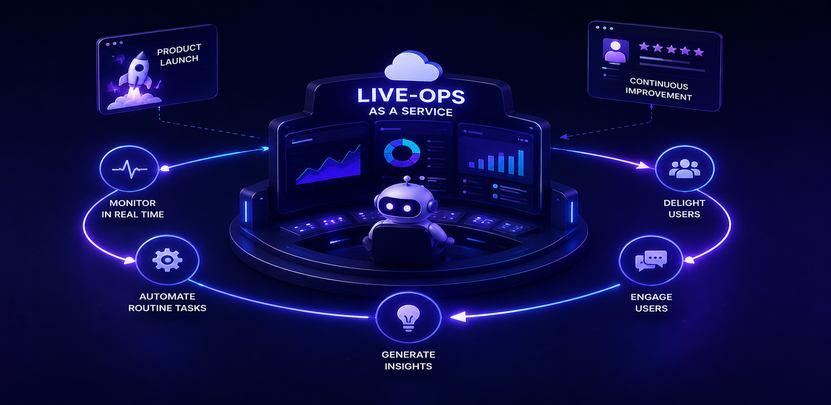
Live-Ops as a Service is a managed operating model built around the ongoing health, performance, and evolution of a live digital product. Rather than treating post-launch work as scattered maintenance tickets handled reactively, it treats product operations as a continuous discipline, monitored, measured, and improved every single day the product is in the hands of real users.
Traditionally, this kind of work has been split across disconnected functions: a support desk answering tickets, an engineering team firefighting bugs, and an analytics team building dashboards nobody checks daily. Live-Ops as a Service consolidates these threads into a single accountable operating layer, powered by a mix of automation, agentic AI, and human oversight, where judgment truly matters.
In short, it answers the question every product team eventually asks: how do we keep this thing running and improving without burning out the team that built it?
The Shift from Launch-Day Thinking to Continuous Operations
For years, software development treated launch as the finish line. Waterfall-era thinking baked this in: build, test, ship, move on. Agile improved release cadence but still largely focused energy on what comes before deployment.
Today’s products don’t work that way. A mobile app, a SaaS platform, or an AI-powered agent product is never really “done.” Customer expectations shift monthly, competitors ship new features weekly, and infrastructure needs constant retuning. Every product is now a living system that needs continuous care.
This is the mindset shift behind Live-Ops as a Service. It reframes post-launch product operations as a strategic function, one that directly affects retention, revenue, and customer trust, rather than a cost center to minimize.
How AI Agents Power Live-Ops as a Service
Here’s where the model gets genuinely interesting. Running true live-ops at scale, across thousands of users, dozens of features, and constant data streams, is beyond what any human team can manage manually. That’s why AI agents have become the backbone of modern Live-Ops-as-a-Service offerings.
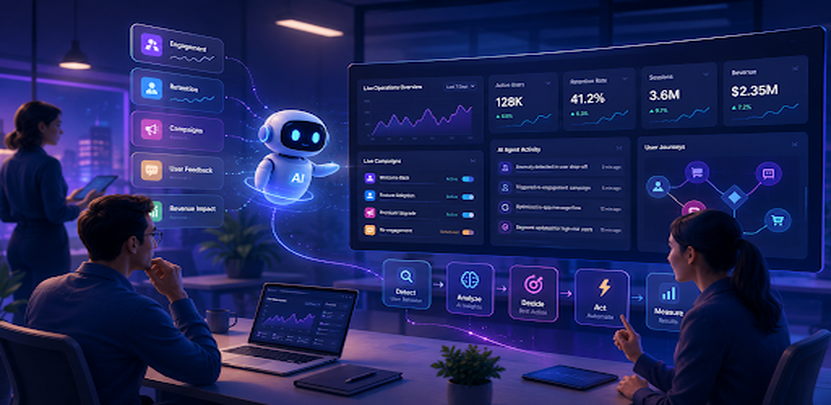
1. Continuous monitoring and anomaly detection: AI agents watch product telemetry around the clock, flagging performance dips, crash spikes, or unusual user behavior long before a human would notice a pattern. Instead of waiting for a customer complaint, the system often catches the issue first.
2. Automated triage and resolution: When an issue is detected, agentic AI can classify severity, route it to the right team, and in many cases resolve routine issues autonomously, restarting a failed service, clearing a cache, or rolling back a faulty configuration, without waiting on a human to wake up and approve it. Gartner has projected that agentic AI will autonomously resolve up to 80% of common customer service issues by 2029, a trend already reshaping how live-ops teams are structured today.
3. User behavior analysis at scale: AI agents continuously analyze how real users interact with a product, surfacing friction points, drop-off patterns, and feature adoption trends. This turns post-launch operations into a feedback engine for product decisions, rather than just a support function.
4. Proactive customer engagement: Some agentic systems go a step further, reaching out to users experiencing friction, offering in-app guidance, or nudging churn-risk accounts before a human support rep ever gets involved.
5. Continuous experimentation: Live-Ops as a Service also enables ongoing A/B testing and feature experimentation, with AI agents managing rollout percentages, measuring impact, and recommending next steps based on live data instead of quarterly review cycles.
Together, these capabilities transform post-launch operations from a reactive scramble into a proactive, always-on discipline. Product teams get to spend their time on strategy and innovation, while AI agents handle the relentless day-to-day grind of keeping a live product stable and improving.

Key Benefits of Live-Ops as a Service
- Faster issue resolution: Problems are caught and often fixed before customers even notice.
- Lower operational overhead: Teams avoid scaling support headcount linearly with user growth.
- Data-driven product decisions: Every user interaction becomes a signal for what to build next.
- Improved retention: Friction gets addressed quickly, reducing churn risk.
- Faster iteration cycles: Continuous experimentation replaces slow, quarterly feedback loops.
- Round-the-clock coverage: AI agents don’t need shifts, time zones, or sleep.
Industry forecasts back this shift up at scale. By 2028, an estimated 68% of customer interactions with vendors are expected to be handled by autonomous tools rather than a person on the other end, underscoring how central agentic AI is becoming to everyday product operations.
It’s worth flagging that exact figures on cost savings or resolution-time improvements vary widely by industry and product complexity, so any specific percentage claims should be verified against current benchmark data before being published or shared externally.
Live-Ops as a Service vs. Traditional Post-Launch Support
Traditional post-launch support tends to be ticket-driven and reactive. A customer reports a problem, a ticket gets logged, and a fix ships whenever bandwidth allows, with data living in silos across support software and engineering dashboards that rarely talk to each other.
Live-Ops as a Service flips this model. AI agents surface problems proactively rather than waiting for reports, data feeds into a unified operational view rather than scattered systems, and the entire operation is measured by product health and growth rather than ticket closure.
The difference isn’t just operational efficiency. It’s a fundamentally different relationship between a company and its live product, built on continuous attention rather than periodic firefighting.
Real-World Use Cases Across Industries
Collectibles and sports platforms: Fan engagement products live and die by real-time responsiveness. When a marketplace app slows during a high-demand drop, AI agents monitoring load and sentiment can catch performance issues instantly and keep the experience seamless.
Fintech and banking apps: Regulatory sensitivity and transaction-critical workflows mean uptime and accuracy are non-negotiable. AI agents monitoring transaction anomalies provide an always-on safety net that manual QA cycles can’t match.
Healthcare platforms: Patient-facing apps need consistent reliability. Continuous monitoring, backed by agentic AI, helps identify friction points that could otherwise affect patient outcomes or engagement.
E-commerce and retail: Seasonal traffic spikes and continuous feature testing make live ops essential for maintaining conversion rates and customer trust year-round.
Across all of these industries, the common thread is the same: launch is just the beginning, and what happens afterward determines whether a product actually succeeds in the market.
What to Look for in a Live-Ops Partner
Not every vendor offering “post-launch support” is actually delivering Live-Ops as a Service. Enterprises evaluating a partner should look for a few specific capabilities:
- Agentic AI maturity: Can their AI agents actually act autonomously on routine issues, or do they only generate alerts for humans to handle manually?
- Unified operational dashboards: Is data from engineering, support, and product analytics consolidated into one live view?
- Proven experimentation frameworks: Do they run continuous testing, or only periodic reviews?
- Industry-specific experience: Have they operated products in similarly regulated or high-traffic environments?
- Transparent reporting: Can they show real, verifiable metrics on issue resolution and product health improvement, rather than vague claims of efficiency gains?
Conclusion
The market has quietly shifted. Building a great product used to be the hard part, and shipping it felt like victory. Today, building the product is only step one. The real competitive advantage lies in what happens after launch: how quickly issues are caught, how quickly teams learn from real usage, and how consistently the experience keeps improving.
Live-Ops as a Service, powered by AI agents that never sleep and never stop learning, gives enterprises a way to meet that challenge without drowning their teams in reactive firefighting. It turns post-launch product operations from a cost center into a genuine growth engine.
The champagne on launch day will always feel good. But the products that actually win are the ones still getting better, quietly and continuously, long after the celebration ends.
FAQs
1. What is Live-Ops as a Service (LOaaS)?
Live-Ops as a Service is a managed approach to post-launch product operations in which AI agents and automation continuously optimize engagement, retention, personalization, and user experience without requiring constant manual intervention.
2. Why are post-launch operations important for digital products?
Launching a product is only the beginning. Continuous monitoring, optimization, and user engagement are essential for retaining customers, improving adoption, and maximizing long-term revenue.
3. How do AI agents support Live-Ops?
AI agents analyze user behavior, identify opportunities, automate campaigns, and make data-driven decisions in real time. This enables teams to react faster and deliver personalized experiences at scale.
4. How is Live-Ops different from traditional product management?
Traditional product management often relies on manual analysis and periodic updates. Live-Ops uses AI-driven automation to continuously optimize product performance and user engagement.
5. Which industries can benefit from Live-Ops as a Service?
Industries such as e-commerce, gaming, fintech, healthcare, SaaS, media, and telecom can use Live-Ops to improve customer engagement and drive business growth.
Why Choose [x]cube LABS?
[x]cube LABS works with enterprise teams to design and deploy AI agents across complex, regulated environments.
We help enterprises become AI-native, not by adding AI on top of existing systems, but by rebuilding the intelligence layer from the ground up. With 950+ products shipped and $5B+ in value created for clients across 15+ industries, here is what we bring to the table:
1. Autonomous AI Agents
We design and deploy agentic AI systems that sense, decide, and act without human bottlenecks, handling complex, multi-step workflows end-to-end with measurable resolution rates and no manual intervention.
2. Enterprise Voice AI
Our voice AI platform, Ello, puts production-ready voice agents in front of your customers in minutes. Zero-latency conversations across 30+ languages, with no call centers and no wait times.
3. AI-Powered Process Automation
We replace manual, error-prone workflows with intelligent automation across invoicing, compliance, customer service, and operations, freeing your teams to focus on work that requires human judgment.
4. Predictive Intelligence and Decision Support
Using machine learning and real-time data pipelines, we build systems that forecast demand, flag risk, optimize inventory, and surface strategic insights before your teams need to ask for them.
5. Connected Products and IoT
We design and build IoT platforms that turn physical devices into intelligent, connected systems with built-in real-time monitoring, remote management, and condition-based automation.
6. Data Engineering and AI Infrastructure
From data lakes and ETL pipelines to AI-ready cloud architecture, we build the foundation that makes everything else possible, scalable, reliable, and designed to grow with your business.
If you are looking to move from AI experimentation to AI-native operations, let’s talk.